India-China Strategic Dialogue on LAC and Trade Concerns
Source:The Hindu ↗
Why It Matters
Demonstrates the fragile and complex nature of India-China normalization, highlighting the intersection of border security, economic dependence (rare earths), and multilateral cooperation in a multipolar world.
Summary
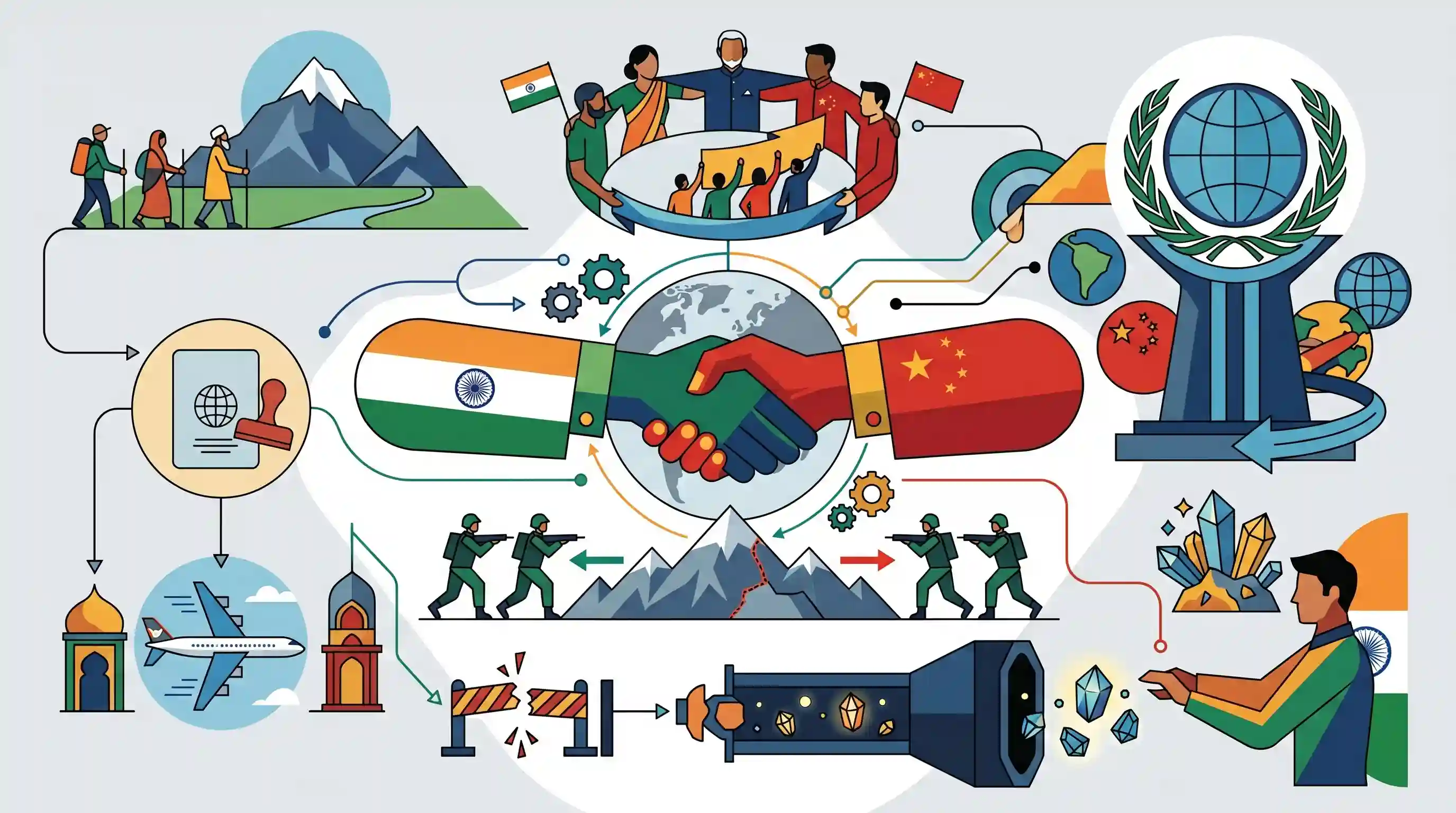
India and China held a Strategic Dialogue focusing on consolidating bilateral ties following the recent disengagement at the Line of Actual Control (LAC) in Eastern Ladakh. The discussions covered India's concerns regarding China's export controls on rare earth minerals, alongside efforts to improve people-to-people contact through resuming the Kailash Mansarovar Yatra, visa facilitation, and updating air services. Multilateral cooperation via BRICS, championing the Global South, and preserving the central role of the UN were also key elements of the dialogue.
Key Points
- The India-China Strategic Dialogue prioritized stabilizing ties following the military disengagement along the LAC in Eastern Ladakh.
- India expressed serious concerns regarding China's export controls on critical materials, particularly rare earth minerals.
- Bilateral issues such as the resumption of the Kailash Mansarovar Yatra, visa facilitation, and updated air services were discussed to build mutual trust.
- Both sides reaffirmed the importance of multilateral cooperation, specifically emphasizing BRICS, multipolarity, and the interests of the Global South.
Important Terms
Line of Actual Control (LAC)

The 3,488 km de facto border separating Indian-controlled territory from Chinese-controlled territory, divided into Western (Ladakh), Middle, and Eastern (Arunachal Pradesh) sectors.
UPSC context
GS Paper 2: India and its neighborhood-relations; critical for understanding border disputes and disengagement processes.
BRICS
A geopolitical bloc of emerging economies (originally Brazil, Russia, India, China, South Africa) that expanded in 2024 to include Egypt, Ethiopia, Iran, and the UAE.
UPSC context
GS Paper 2: Bilateral, regional and global groupings and agreements involving India and/or affecting India's interests.
Rare Earth Minerals
A group of 17 metallic elements essential for high-tech manufacturing, including electric vehicles and defense; currently dominated by Chinese production and export controls.
UPSC context
GS Paper 3: Science & Technology; Economy; and security challenges related to supply chain resilience.
Global South
A geopolitical term for developing and underdeveloped nations primarily in Asia, Africa, and Latin America, emphasizing shared economic and political challenges against the Global North.
UPSC context
GS Paper 2: International Relations; tests India's role as a leader and 'voice' for developing nations.
United Nations (UN)
An international organization founded in 1945 to maintain global peace and security; India and China emphasize its central role in a multipolar world order.
UPSC context
GS Paper 2: Important International institutions, agencies and fora - their structure, mandate.
Kailash Mansarovar Yatra
A high-altitude religious pilgrimage to Mount Kailash and Lake Mansarovar in Tibet, significant for India-China cultural diplomacy and border management.
UPSC context
GS Paper 1: Indian Culture; and GS Paper 2: India-China bilateral ties and people-to-people contact.
Strategic Dialogue
A formal high-level diplomatic mechanism used by India and China to discuss long-term bilateral goals, security, and global cooperation.
UPSC context
GS Paper 2: Bilateral agreements and diplomatic frameworks for conflict resolution and stability.
Prelims Trap
"Depsang Plains are located to the west of the Siachen Glacier."
UPSC frequently tests E/W/N/S mapping arrangements (like the 2020 Siachen question). The Depsang Plains are actually situated to the east of the Siachen Glacier, not west.
Static Concepts Connected
What are the officially recognized routes for the Kailash Mansarovar Yatra from India?
- Lipulekh Pass: Located in Uttarakhand at the India-Nepal-Tibet trijunction. This route involves trekking through rugged, challenging mountainous terrain.
- Nathu La Pass: Located in Sikkim. It offers a relatively easier, fully motorable route for pilgrims compared to the traditional Lipulekh path.
Why are Rare Earth Elements (REEs) strategically significant, and what is India's capability?
- Composition: A group of 17 elements (15 lanthanides + scandium + yttrium) crucial for electronics, defense, and green technologies.
- China's dominance: It controls ~60% of global production and over 85% of processing, allowing it to leverage export controls on minerals like gallium and antimony.
- India's reserves: India holds the world's 5th largest reserves (found in monazite sands) but relies heavily on imports for processed materials.
Cross-Topic Patterns
Mineral Monopoly vs. Green Energy Transition
China's export controls on gallium and germanium directly threaten India's EV battery and solar manufacturing targets, complicating its 'Panchamrit' net-zero commitments.
DSDBO Road and LAC Strategy
The Depsang disengagement secures the critical Darbuk-Shyok-Daulat Beg Oldie (DSDBO) road, linking Leh to the Karakoram Pass, pivotal for India's northern border logistics.

Mapping of LAC friction points (Depsang, Demchok) combined with China's critical mineral monopoly will likely feature in Prelims 2026.
Linked PYQs · 3
Linked PYQs · 3
- 2014MainsGS2
With respect to the South China sea, maritime territorial disputes and rising tension affirm the need for safeguarding maritime security to ensure freedom of navigation and over flight throughout the region. In this context, discuss the bilateral issues between India and China.
- 2012PrelimsGS1
Recently, there has been a concern over the short supply of a group of elements called 'rare earth metals'. Why? 1. China, which is the largest producer of these elements, has imposed some restrictions on their export. 2. Other than China, Australia, Canada and Chile, these elements are not found in any country. 3. Rare earth metals are essential for the manufacture of various kinds of electronic items and there is a growing demand for these elements. Which of the statements given above is/are correct?
- 2012MainsGS2
Compare the significance of IBSA and BRICS in the context of India's multilateral diplomacy.
