India China Strategic Dialogue on Trade Concerns and LAC Stability
Source:The Hindu ↗
Why It Matters
This is critical for understanding the evolving normalization of India-China relations post-2024 LAC disengagement. It also highlights economic security challenges (critical mineral dependency) and the paradox of bilateral tensions juxtaposed with active cooperation in multilateral blocs like BRICS.
Summary
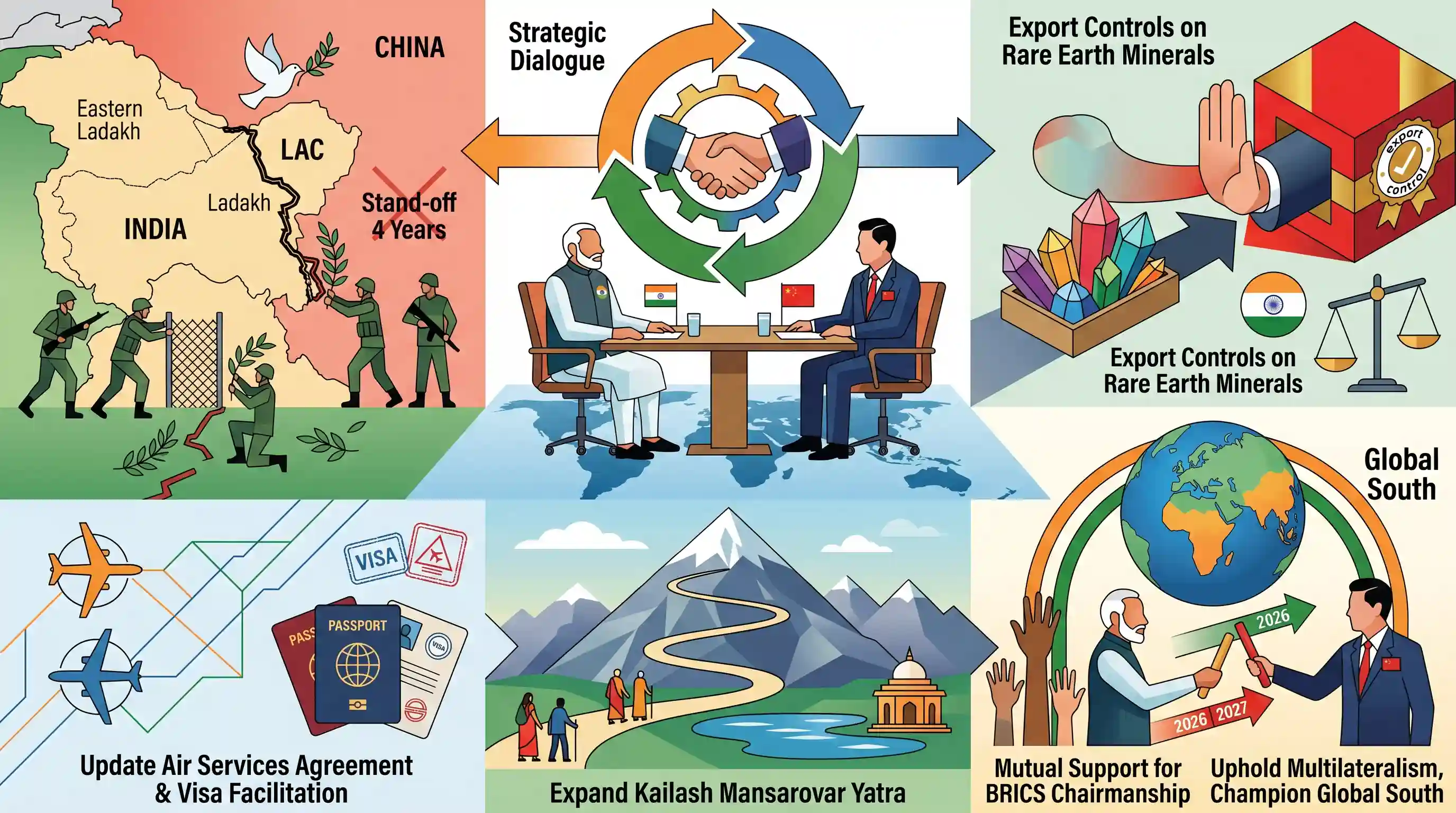
Foreign Secretary Vikram Misri and Chinese Executive Vice Foreign Minister Ma Zhaoxu recently held talks under the India-China Strategic Dialogue, focusing on maintaining peace along the LAC and normalizing ties after the four-year standoff in eastern Ladakh. India notably raised concerns over China's export controls on rare earth minerals, which affect bilateral trade. The discussions also covered practical measures like updating the air services agreement, easing visa facilitation, and expanding the Kailash Mansarovar Yatra. On the global front, both countries agreed to support each other's BRICS Chairmanship for 2026 and 2027, uphold multilateralism, and champion the interests of the Global South.
Key Points
- India and China held a Strategic Dialogue focusing on stabilizing and rebuilding bilateral ties following the resolution of the four-year military standoff in eastern Ladakh.
- Key concerns raised by India included China's export control measures on critical rare earth minerals and general bilateral trade issues.
- The dialogue emphasized the need for peace at the borders and highlighted cooperation at multilateral forums, with mutual support pledged for their respective BRICS chairmanships in 2026 and 2027.
- Other significant outcomes included discussions on early conclusion of an updated air services agreement, visa facilitation, and the resumption and expansion of the Kailash Mansarovar Yatra.
Important Terms
Line of Actual Control (LAC)

The 3,488 km de facto border between India and China, divided into Western (Ladakh), Middle (Himachal/Uttarakhand), and Eastern (Arunachal/Sikkim) sectors. It remains undemarcated, leading to differing perceptions and periodic standoffs.
UPSC context
GS Paper II & III: Key for bilateral relations and border management; tests understanding of territorial disputes and disengagement processes.
India-China Strategic Dialogue
A high-level diplomatic mechanism for senior officials to discuss bilateral issues, border stability, and global cooperation. It serves as a key channel for normalizing ties and managing strategic competition.
UPSC context
GS Paper II: International Relations; tests knowledge of diplomatic frameworks and bilateral conflict resolution mechanisms.
BRICS
An intergovernmental organization of major emerging economies (Brazil, Russia, India, China, South Africa, and recent invitees) focused on reforming global governance. India and China will hold the chairmanship in 2026 and 2027 respectively.
UPSC context
GS Paper II: Multilateral groupings; tests understanding of South-South cooperation and the shifting global economic order.
Global South
A term referring to developing or less-developed nations in Asia, Africa, and Latin America. These countries share histories of colonialism and seek more equitable representation in global financial and political institutions.
UPSC context
GS Paper II: International Relations; tests India's leadership role and its strategy to bridge the North-South divide.
Rare Earth Minerals
A group of 17 metallic elements essential for high-tech industries (EVs, defense, electronics). China dominates the global supply chain, and its export controls significantly impact India's strategic and manufacturing sectors.
UPSC context
GS Paper III: Economy/Science & Tech; tests knowledge of critical mineral security and supply chain resilience (Atmanirbhar Bharat).
Air Services Agreement
A bilateral treaty that establishes the legal framework for international commercial aviation between two countries. Updating this is crucial for restoring direct flight connectivity and people-to-people exchanges post-standoff.
UPSC context
GS Paper II & III: Infrastructure and International Relations; tests understanding of bilateral connectivity and its impact on trade and tourism.
Prelims Trap
The Kailash Mansarovar Yatra officially operates exclusively through the Nathu La pass in Sikkim.
The official Yatra is conducted via two routes: Nathu La in Sikkim AND Lipulekh Pass in Uttarakhand (near the tri-junction of India, Nepal, and China).
Static Concepts Connected
What are Rare Earth Elements (REEs) and their strategic significance?
- Composition: A group of 17 elements (15 lanthanides plus scandium and yttrium) naturally found together in geological deposits.
- Strategic Use: Highly crucial for clean energy transition technologies (EV batteries, wind turbines), advanced electronics, and modern defense systems.
- Global Supply: While reserves are globally distributed (including in India), China controls over 85% of global processing and refining capacity.
What are the geographical locations of the official Kailash Mansarovar Yatra routes?
- Lipulekh Pass: Located in Uttarakhand's Kumaon region, it forms a strategic tri-junction between India, Nepal, and China's Tibet Autonomous Region.
- Nathu La Pass: Located in Sikkim, it connects India directly to the Tibet Autonomous Region and forms a branch of the ancient Silk Route.
Cross-Topic Patterns
Critical Minerals & MSP
India's concerns over China's rare earth export controls highlight the strategic importance of its entry into the US-led Minerals Security Partnership (MSP) to de-risk supply chains.
BRICS Expansion & Global South Dynamics
Mutual support for 2026-2027 BRICS presidencies illustrates how India and China compartmentalize bilateral border friction to jointly shape multipolar institutions and court the Global South.

Expect a multi-statement 2026 question linking Chinese rare earth export controls with India's critical mineral auctions and the MSP.
Linked PYQs · 3
Linked PYQs · 3
- 2014MainsGS2
With respect to the South China sea, maritime territorial disputes and rising tension affirm the need for safeguarding maritime security to ensure freedom of navigation and over flight throughout the region. In this context, discuss the bilateral issues between India and China.
- 2012PrelimsGS1
Recently, there has been a concern over the short supply of a group of elements called 'rare earth metals'. Why? 1. China, which is the largest producer of these elements, has imposed some restrictions on their export. 2. Other than China, Australia, Canada and Chile, these elements are not found in any country. 3. Rare earth metals are essential for the manufacture of various kinds of electronic items and there is a growing demand for these elements. Which of the statements given above is/are correct?
- 2012MainsGS2
Compare the significance of IBSA and BRICS in the context of India's multilateral diplomacy.
