Doxing menace and legal gaps in digital personal data protection rules
Source:The Hindu ↗
Why It Matters
Highlights the emerging non-traditional security threats posed by cyberbullying, doxing, and social media disinformation campaigns, directly linking to UPSC GS3 topics on cyber security and the role of social networks in internal security challenges.
Summary
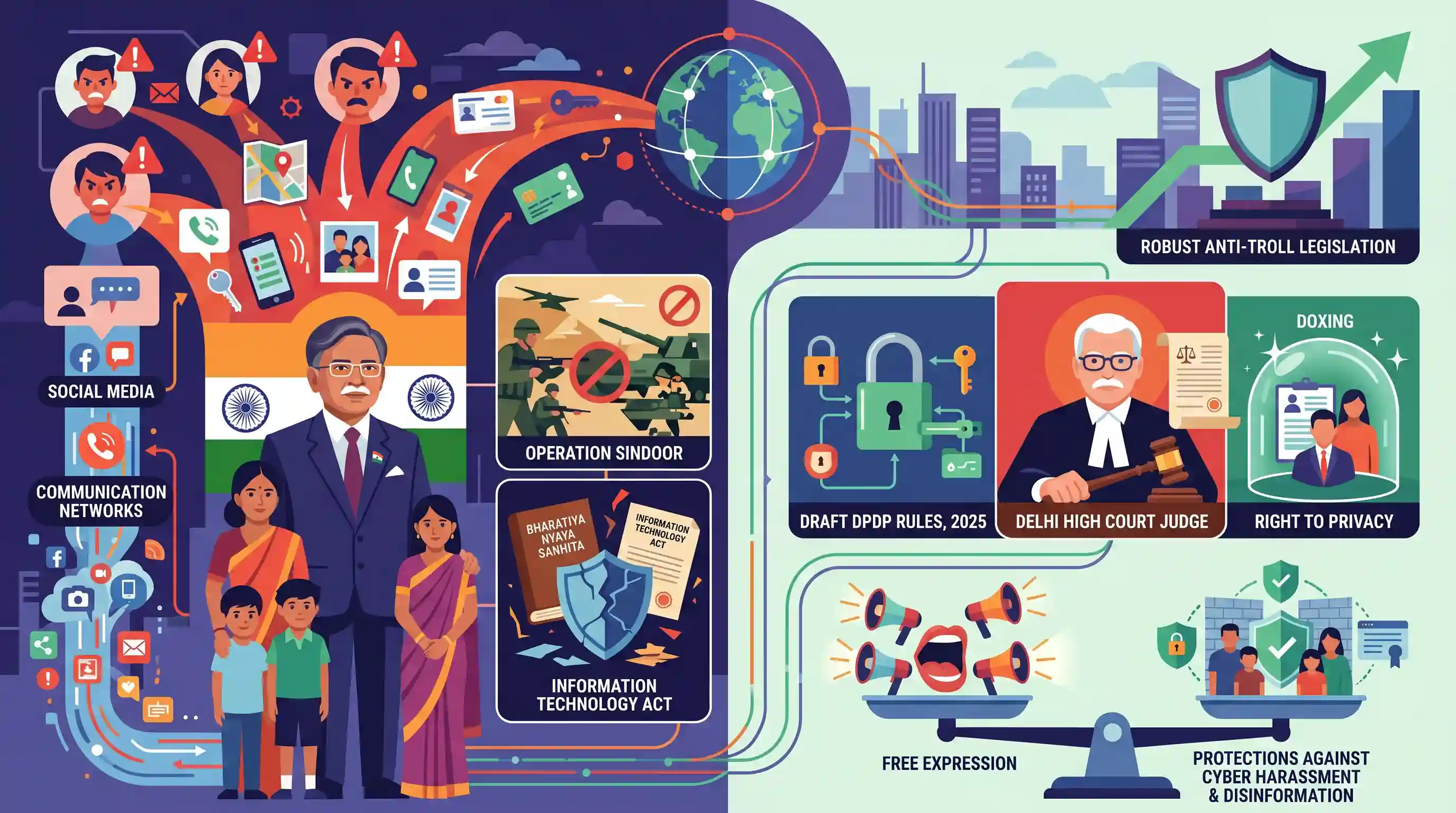
The editorial condemns the toxic online trolling and doxing directed at India's Foreign Secretary Vikram Misri and his family following the halt of Operation Sindoor. Highlighting the limitations of current legal frameworks like the Bharatiya Nyaya Sanhita and the Information Technology Act, it calls for robust anti-troll legislation and the strict enforcement of the draft DPDP Rules, 2025. It also references the Delhi High Court's ruling that doxing violates the right to privacy, emphasizing the need to balance free expression with protections against organized cyber harassment and disinformation campaigns.
Key Points
- Following the announcement to halt military actions under Operation Sindoor, India's Foreign Secretary Vikram Misri faced severe online trolling and the doxing of his daughter, highlighting the growing menace of cyberbullying.
- Existing legal provisions under the Bharatiya Nyaya Sanhita and the Information Technology Act are inadequate to address the complexities of modern online harassment, hate speech, and organized doxing.
- The Delhi High Court, in the 2024 Shaviya Sharma case, explicitly ruled that unchecked doxing constitutes a violation of the fundamental right to privacy.
- Swift implementation of the draft Digital Personal Data Protection (DPDP) Rules, 2025, and a dedicated anti-troll law are essential to counter disinformation and safeguard individuals' privacy while preserving democratic free speech.
Important Terms
Digital Personal Data Protection (DPDP) Rules, 2025

The administrative framework notified in late 2025 to operationalize the 2023 Act, prescribing procedures for consent, data breach notifications, and the functioning of the Data Protection Board.
UPSC context
GS-III: Cyber Security & GS-II: Right to Privacy. Tests understanding of data governance and individual rights.
Bharatiya Nyaya Sanhita (BNS)
India's primary penal code (effective July 2024), containing specific provisions like Section 78 (stalking) and Section 356 (defamation) applicable to online harassment and digital threats.
UPSC context
GS-II: Important aspects of governance, transparency, and accountability. Tests legal literacy regarding the new criminal justice system.
Information Technology Act, 2000
The primary law for cybercrime and e-commerce. Section 69A empowers the government to block content, while Section 79 provides 'safe harbor' protection for social media intermediaries.
UPSC context
GS-III: Security challenges and their management in communication networks. Tests knowledge of regulatory frameworks for digital platforms.
Doxing
The malicious act of revealing an individual's private identifiable information (address, phone number) online without consent, often leading to real-world harassment or threats.
UPSC context
GS-III: Role of social networking sites in internal security. Tests awareness of emerging digital threats and privacy violations.
Right to Privacy
A fundamental right under Article 21, recently interpreted by courts to include the 'Right to be Forgotten'—allowing individuals to request removal of personal data from the internet.
UPSC context
GS-II: Indian Constitution-Fundamental Rights. Tests ability to link judicial interpretations to contemporary digital issues.
Ministry of Information and Broadcasting (I&B)
The nodal agency for regulating media content. Recent amendments to IT Rules propose granting it direct powers to order removal of user-generated news content on social media.
UPSC context
GS-II: Statutory, regulatory and various quasi-judicial bodies. Tests knowledge of the executive's role in media regulation.
Prelims Trap
Doxing is explicitly defined and penalized as a distinct cybercrime under the Information Technology (IT) Act, 2000.
India lacks a specific statutory definition for doxing. Law enforcement relies on allied provisions like stalking or defamation under the BNS, not a dedicated anti-doxing IT Act clause.
Static Concepts Connected
How is digital privacy legally protected under the Indian Constitution?
- Fundamental Right: Declared an intrinsic part of Article 21 (Right to Life) by the Supreme Court in the landmark 2017 K.S. Puttaswamy judgment.
- Judicial expansion: High Courts have progressively expanded privacy to include the 'Right to be Forgotten' and protection against doxing (as seen in the Delhi HC Shaviya Sharma case).
- Statutory backing: The DPDP Act 2023 operationalizes this right, establishing a framework to penalize unauthorized exposure or breaches of personal data.
What are the limitations of India's current legal framework against cyberbullying?
- Definitional gaps: Modern offenses like cyberbullying, doxing, and trolling lack explicit definitions and distinct penalties in both the IT Act and the Bharatiya Nyaya Sanhita (BNS).
- Reliance on allied laws: Law enforcement is forced to use indirect provisions like BNS Section 78 (stalking) or Section 356 (defamation), which rarely capture the full severity of coordinated digital harassment.
- Anonymity and jurisdiction: Perpetrators frequently use foreign servers, VPNs, or burner accounts, complicating the attribution and prosecution process for domestic law enforcement agencies.
Cross-Topic Patterns
Cyber warfare against foreign policy
Targeting diplomats bridges GS-3 cybersecurity and GS-2 international relations, illustrating how non-state actors weaponize social media for psychological warfare to pressure foreign policy decisions.
BNS transition vs. Emerging Cybercrimes
The shift to the Bharatiya Nyaya Sanhita modernizes traditional offences like stalking but exposes a legislative lag in addressing modern, coordinated digital threats like doxing natively.

Mains 2026 GS-3: Expect a question linking cyber psychological warfare by non-state actors with the adequacy of the DPDP Act & BNS frameworks.
Linked PYQs · 5
Linked PYQs · 5
- 2024MainsGS3
Social media and encrypting messaging services pose a serious security challenge. What measures have been adopted at various levels to address the security implications of social media? Also suggest any other remedies to address the problem.
- 2016MainsGS3
Use of Internet and social media by non-state actors for subversive activities is a major security concern. How have these been misused in the recent past? Suggest effective guidelines to curb the above threat.
- 2020MainsGS3
Discuss different types of cyber crimes and measures required to be taken to fight the menace.
- 2024MainsGS2
Right to privacy is intrinsic to life and personal liberty and is inherently protected under Article 21 of the constitution. Explain. In this reference discuss the law relating to D.N.A. testing of child in the womb to establish its paternity.
- 2017MainsGS2
Examine the scope of Fundamental Rights in the light of the latest judgement of the Supreme Court on Right to Privacy.
