Rajasthan Transmission Tower Collapses And Renewable Energy Loss
Source:down-to-earth ↗
Why It Matters
Understanding the vulnerabilities of high-voltage transmission lines to extreme weather is crucial for India's 500 GW non-fossil capacity goals. In the context of Rajasthan, managing the grid without hydro balancing and during sudden weather-induced demand drops in the agricultural sector represents a prime policy and engineering challenge for sustainable energy transition.
Summary
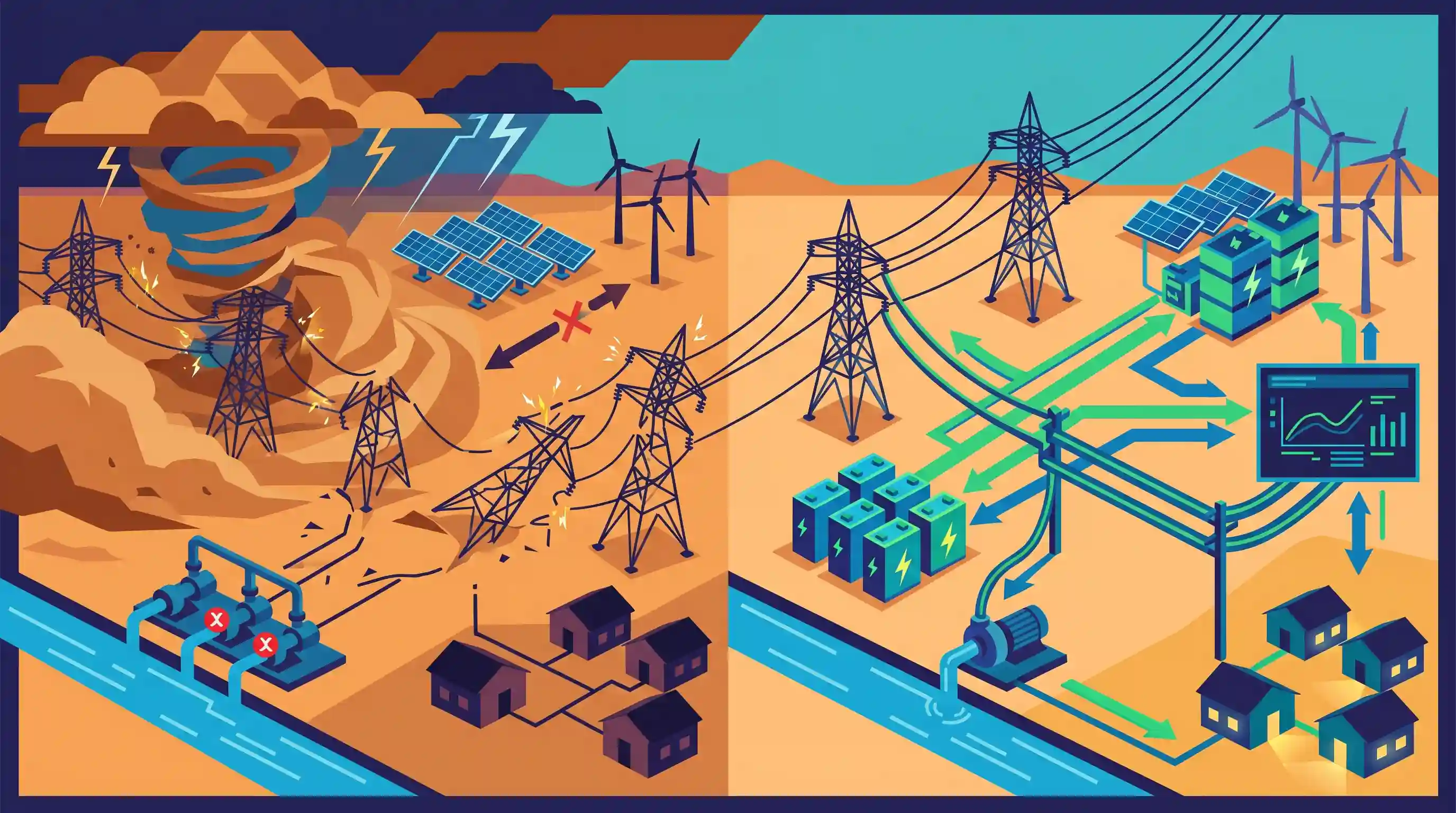
In late May and early June, severe dust storms and thunderstorms swept across western Rajasthan, collapsing 15–20 high-voltage transmission towers near Chandan and Pokhran. The disaster disrupted critical renewable energy evacuation of about 500–600 MW and cut power to the Indira Gandhi Canal-linked Mohangarh drinking water system. This event highlights India's growing grid resilience gaps, emphasizing the urgent need for transmission reinforcement, Battery Energy Storage Systems (BESS), and system flexibility in renewable-heavy states that lack hydro-balancing power.
Key Points
- A series of severe dust storms and thunderstorms in western Rajasthan in late May and early June caused the collapse of 15 to 20 transmission towers near Chandan and Pokhran in Jaisalmer district.
- The damage disrupted two 400 kV and multiple 220 kV transmission lines, leading to an estimated 500–600 MW hit to renewable energy evacuation.
- The power outage temporarily halted electricity to the critical Mohangarh drinking water scheme, which is fed by the Indira Gandhi Canal (IGNP).
- The incident exposes structural challenges in Rajasthan's power grid: lack of hydro-balancing capacity, technical limit on thermal back-downs during low demand periods, and a lack of large-scale Battery Energy Storage Systems (BESS).
- An inherent mismatch exists since western Rajasthan's energy consumption is dominated by agriculture. When storms or rains occur, agricultural power demand collapses, forcing grid operators to curtail solar and wind power to ensure stability.
- Key regulatory officials from the Central Electricity Authority (CEA) and Central Electricity Regulatory Commission (CERC) emphasized that the next phase of India's green transition must prioritize grid readiness, storage, and system flexibility over mere capacity addition.
Important Terms
Indira Gandhi Canal Project (IGNP)

One of India's largest canal systems, diverting water from the Sutlej-Beas confluence at Harike Barrage in Punjab to irrigate and provide drinking water to the arid Thar Desert region of northwestern Rajasthan.
UPSC context
GS Paper 1 (Geography) & GS Paper 3 (Water Resources); tests knowledge of inter-basin water transfer, desert development, and ecological impacts.
PM-KUSUM Scheme
A flagship central scheme launched in 2019 to deploy decentralized solar plants, distribute standalone solar pumps, solarize grid-connected pumps, and enhance farmers' income through surplus power sales.
UPSC context
GS Paper 3 (Agriculture & Renewable Energy); tests understanding of rural energy security, government interventions, and agricultural decarbonization.
Central Electricity Authority (CEA)
An attached office and statutory body under the Ministry of Power that advises the government on national electricity policies and sets technical and safety standards for grid construction and operation.
UPSC context
GS Paper 3 (Infrastructure & Energy); tests understanding of statutory bodies, technical standard-setting, and overall planning of India's power sector.
Central Electricity Regulatory Commission (CERC)
A statutory, quasi-judicial body under the Electricity Act, 2003, that regulates interstate electricity tariffs, issues licenses for interstate transmission and trading, and adjudicates grid-related power disputes.
UPSC context
GS Paper 3 (Regulatory Bodies); tests understanding of independent power sector regulation, tariff determination, and inter-state electricity market reforms.
Rajasthan Renewable Energy Corporation Limited (RRECL)
A state public sector undertaking serving as the nodal agency for promoting non-conventional energy and enforcing energy conservation measures under the Energy Conservation Act, 2001 in Rajasthan.
UPSC context
GS Paper 3 (Renewable Energy); tests state-level institutional frameworks, decentralized solar initiatives, and regional green energy transitions.
Rajasthan Solar Energy Policy 2019
A state policy that targeted installing 30,000 MW of solar power by 2024-25, emphasizing utility-scale solar parks, rooftop systems, and storage integration to scale Rajasthan's solar transition.
UPSC context
GS Paper 3 (Energy & Climate Change); tests local policy mechanisms, clean energy targets, and state-driven renewable transition models.
Prelims Trap
The 445 km long Indira Gandhi Main Canal terminates at Gadra Road in the Barmer district.
The 445-km long Indira Gandhi Main Canal (Stage II) actually terminates at Mohangarh in Jaisalmer. The extension to Gadra Road in Barmer is a tail-end feeder/link channel, not the Main Canal.
Static Concepts Connected
How do pre-monsoon convective dust storms (Andhis) form in Western Rajasthan?
- Convective Instability: Intense summer solar insolation heats the dry sandy desert surface, creating highly unstable, localized low-pressure pockets and strong thermal updrafts.
- Downdraft Trigger: As dry convective currents rise and meet upper-level moisture, weak cumulonimbus clouds form, triggering violent downdrafts and high-velocity winds.
- Dust Entrainment: Strong turbulent winds sweep loose, dry desert topsoil, lifting it into massive, towering walls of dust that drastically reduce visibility and damage infrastructure.
What is grid balancing and why is hydro-balancing preferred over thermal balancing?
- Frequency Management: Grid balancing requires matching power supply with load demand in real-time to maintain system frequency within a tight band (49.9–50.05 Hz).
- Ramp-up Flexibility: Hydroelectric and Pumped Storage Projects (PSPs) can ramp generation up or down within minutes, ideal for balancing sudden solar or wind drops.
- Thermal Constraints: Coal-fired thermal plants have high technical minimums (cannot easily run below 50-55% capacity) and require hours to start up, limiting their grid-balancing utility.
Cross-Topic Patterns
Green Corridors + Climate Disasters
India's high-yielding renewable zones (deserts and coastlines) are geographically coincident with high-risk weather zones, demanding disaster-resilient standards for green energy corridors.
Water-Energy Nexus in Drylands
Grid failures in arid zones immediately halt canal-lift systems, proving that dryland water and food security are entirely dependent on continuous energy grid resilience.

Grid-balancing tech (BESS/PSPs) matched against extreme weather disruptions in green corridors will likely be a core 2026 GS-3 infrastructure theme.
Linked PYQs · 4
Linked PYQs · 4
- 2023RPSC_PRELIMSGS1
Which agency has been given the responsibility of implementing the PM-KUSUM scheme (Component A) in Rajasthan, which involves the establishment of solar power plants with a capacity of 0.5 MW to 2 MW?
- 2021RPSC_PRELIMSGS1
In which year was the Rajasthan Solar Energy Policy announced?
- 2018RPSC_PRELIMSGS1
The dust storms occurring in Rajasthan during May-June months are responsible for: (a) Origin of convective currents at some places (b) Aravalli hills are parallel to the southwest winds. (c) Origin of very intense easterly winds
- 2016RPSC_PRELIMSGS1
The district pair that benefits from the Chaudhary Kumbha Ram canal is
