Feminisation of Agriculture and Women Farmer Land Rights
Source:The Hindu ↗
Why It Matters
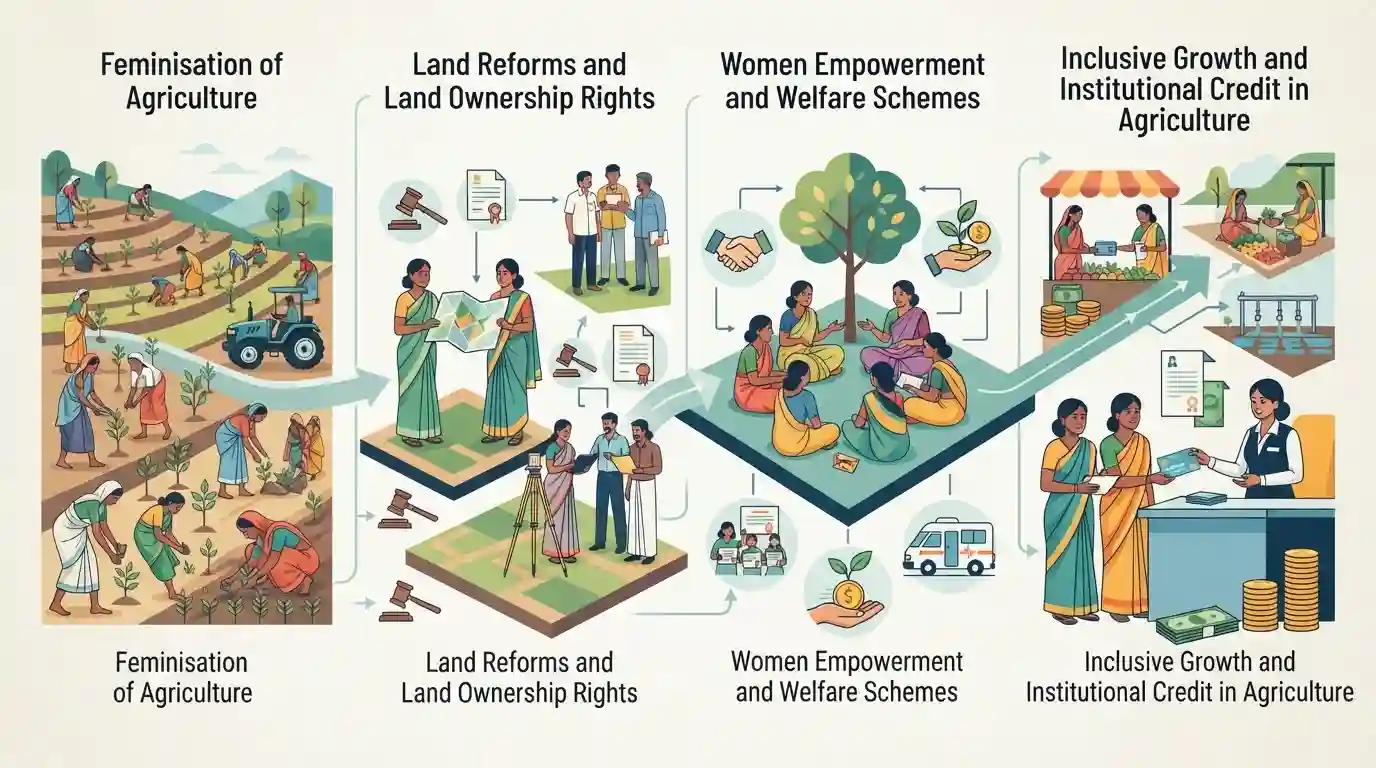
It addresses 'feminisation of agriculture', a core theme under Indian agriculture and inclusive growth, highlighting how structural gender inequalities in land ownership and institutional credit impede agricultural productivity and rural development.
Summary
The article examines the critical issue of recognising women farmers in India, addressing the structural challenges of land ownership, lack of formal recognition, and barriers to institutional credit and agricultural support services amidst the ongoing feminisation of agriculture.
Key Points
- Feminisation of agriculture highlights the growing role of women as cultivators and labourers, yet they face severe structural exclusion, particularly regarding land ownership and formal recognition as farmers.
- Lack of land titles restricts women's access to institutional credit, agricultural subsidies, training programmes, and crop insurance schemes.
- Recognising women farmers is crucial not only for gender justice and economic empowerment but also for enhancing overall agricultural productivity and food security.
- Policy interventions must focus on joint land titling, incentivizing ownership by women, and expanding credit access through collectivization like Self-Help Groups (SHGs) and Farmer Producer Organisations (FPOs).
Prelims Trap
Absence of a land title permanently bars a woman from accessing any agricultural welfare scheme or institutional credit in India.
Aspirants often assume owning land is the sole legal gateway to being recognized as a farmer in India, missing innovative sub-national certificates.
Static Concepts Connected
What are the major structural hurdles faced by women in Indian agriculture regarding land and credit?
- Inheritance Norms: Patriarchal inheritance customs legally and socially restrict women's ancestral land rights across most communities.
- Collateral Deficit: Lack of individual land titles prevents women from offering collateral for formal institutional bank loans.
- Welfare Exclusion: Without land registration, women are frequently excluded from direct agricultural subsidies, input kits, and crop insurance payouts.
Cross-Topic Patterns
Land Reforms + Institutional Agricultural Credit
Land reform laws governed by state lists intersect with central agricultural credit mandates, creating complex Centre-State policy dynamics in empowering female cultivators.
SHG Collectivisation + Rural Credit Exclusion
MKSP and National Rural Livelihoods Mission leverage SHGs to substitute for missing land collateral, linking rural development with agrarian reform.

Feminisation of agriculture + land title barriers + alternative certification (like Maharashtra's model) is prime for Prelims/Mains.
Linked PYQs · 1
Linked PYQs · 1
- 2021MainsGS3
How did land reforms in some parts of the country help to improve the socio-economic conditions of marginal and small farmers?
