Ladki Bahin Scheme Faces Implementation and Verification Challenges
Source:Indian Express ↗
Why It Matters
The article provides an excellent real-world case study for GS-2 answers regarding e-governance. It perfectly illustrates how a lack of user-centric design in digital interfaces (a confusing e-KYC form) can result in massive exclusion errors in critical welfare schemes. It also touches upon inclusion errors (men exploiting a scheme for women) and the fiscal debates surrounding pre-election cash transfers.
Summary
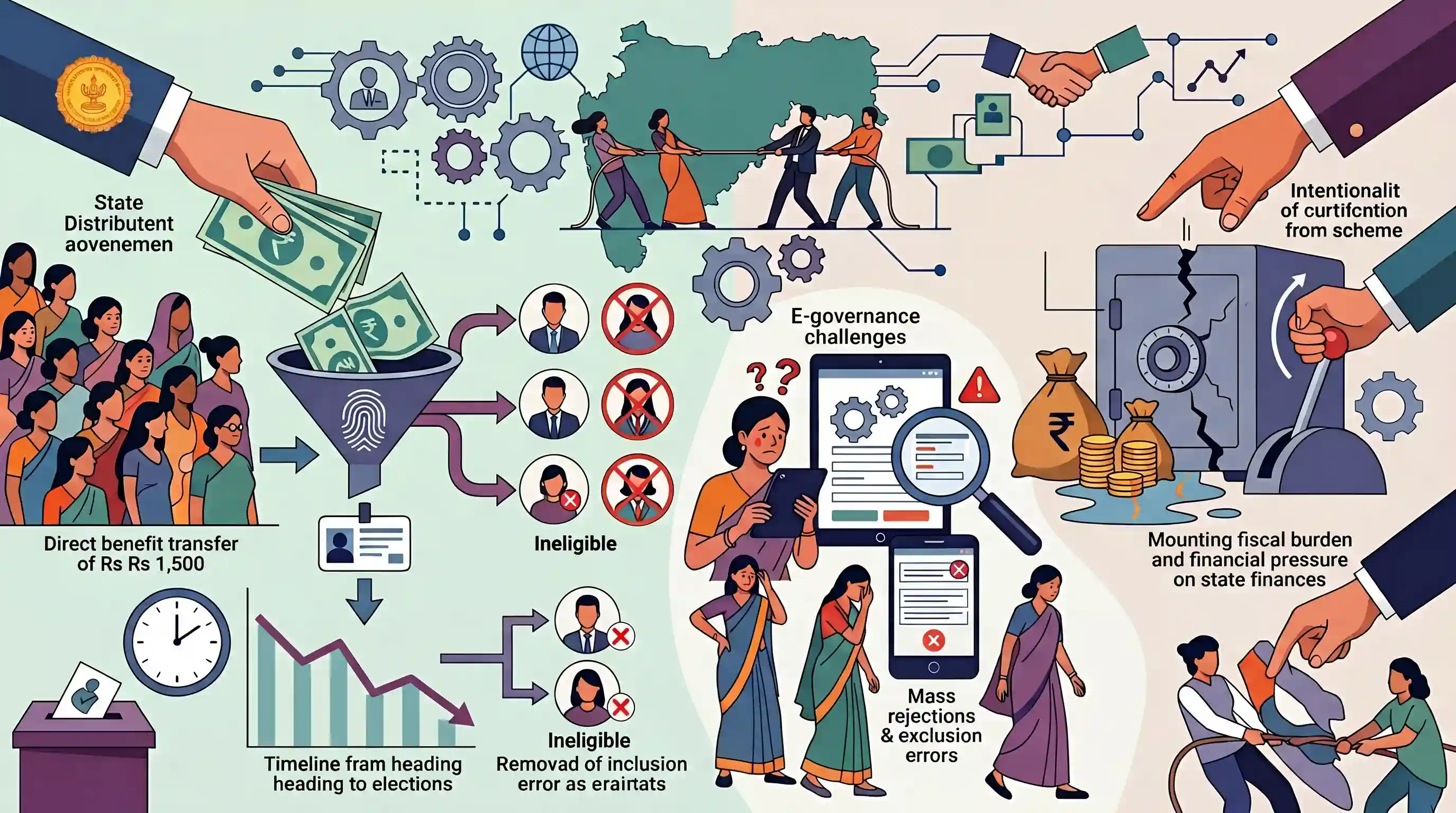
The Mahayuti government's flagship 'Mukhyamantri Majhi Ladki Bahin Yojana' in Maharashtra, which provides a Rs 1,500 monthly stipend to eligible women, is facing severe political and administrative headwinds ahead of state elections. Following a mandatory e-KYC integration process, the number of beneficiaries drastically plummeted from 2.47 crore to 1.66 crore. The state attributes this reduction to the successful removal of ineligible applicants, citing inclusion errors such as 16,000 men wrongfully receiving benefits. Conversely, the opposition Maha Vikas Aghadi (MVA) accuses the government of deliberately curtailing the scheme to mitigate a mounting fiscal burden. Furthermore, administrative flaws, including ambiguously worded e-KYC forms that led to mass rejections of genuine applicants (exclusion errors), underscore critical vulnerabilities in the digital delivery of welfare schemes and highlight the urgent necessity for user-centric e-governance interfaces.
Key Points
- The Mahayuti government's Ladki Bahin scheme, offering Rs 1,500 monthly to women, saw its beneficiary count drop from 2.47 crore to 1.66 crore following a mandatory e-KYC drive.
- The state government defends the drop as a necessary clean-up of inclusion errors, noting that ineligible individuals—including 16,000 men—had been fraudulently receiving benefits.
- Opposition parties (MVA) allege the government is deliberately scaling back the scheme due to an inability to sustain the massive fiscal burden on the state exchequer.
- A poorly phrased question in the e-KYC digital form confused many genuine applicants, leading them to accidentally disqualify themselves, highlighting issues with non-user-centric e-governance design.
- The controversy underscores the ongoing debate over the sustainability of direct cash transfers introduced ahead of elections and the challenges of accurate digital targeting (DBT).
Important Terms
Mukhyamantri Majhi Ladki Bahin Yojana

A Maharashtra state welfare scheme launched in 2024, providing a ₹1,500 monthly stipend to women aged 21–65 with annual family incomes below ₹2.5 lakh.
UPSC context
GS Paper II: Welfare schemes for vulnerable sections; tests understanding of state-level social security and financial empowerment initiatives.
Direct Benefit Transfer (DBT)
A governance mechanism that transfers subsidies and benefits directly into the bank accounts of beneficiaries to reduce leakages and eliminate intermediaries.
UPSC context
GS Paper II & III: Governance and Economy; critical for topics on subsidy reforms and inclusive growth.
Inclusion and Exclusion Errors
Efficiency flaws in welfare targeting: inclusion errors occur when ineligible persons receive benefits, while exclusion errors occur when deserving individuals are denied them.
UPSC context
GS Paper II: Social Justice and Governance; tests ability to analyze implementation challenges in public service delivery.
Mahayuti
The ruling political alliance in Maharashtra, primarily comprising the Bharatiya Janata Party (BJP), Shiv Sena (Eknath Shinde faction), and the Nationalist Congress Party (Ajit Pawar faction).
UPSC context
GS Paper II: Polity and Federalism; relevant for understanding state-level coalition politics and governance.
Maha Vikas Aghadi (MVA)
The opposition political alliance in Maharashtra, consisting of the Shiv Sena (UBT), Nationalist Congress Party (Sharadchandra Pawar), and the Indian National Congress.
UPSC context
GS Paper II: Polity; relates to political dynamics, opposition roles, and the functioning of the state legislature.
e-KYC (electronic Know Your Customer)
A paperless identification process where a customer's identity and address are verified electronically through biometric or OTP-based authentication via Aadhaar.
UPSC context
GS Paper II: E-governance; tests knowledge of digital tools in streamlining administrative processes and enhancing transparency.
Prelims Trap
"Aadhaar-based e-KYC and DBT completely eliminate targeting errors in welfare schemes."
While e-KYC reduces inclusion errors (ghost beneficiaries), it frequently exacerbates exclusion errors where genuine beneficiaries are denied due to tech/biometric failures.
Static Concepts Connected
What are Inclusion and Exclusion Errors in welfare targeting?
- Inclusion Error: Providing welfare benefits to ineligible individuals, leading to fiscal leakages (e.g., men receiving women-only stipends or ghost beneficiaries).
- Exclusion Error: Denying benefits to genuine, eligible individuals. This is often an unintended consequence of strict biometric or digital verification hurdles.
How do unconditional state cash transfers impact macro-fiscal health?
- Revenue Deficit: These schemes balloon revenue expenditure without creating productive assets, directly worsening the state's revenue deficit.
- Crowding Out CapEx: High committed expenditure on subsidies forces states to slash capital expenditure, stifling long-term infrastructure growth.
- FRBM Constraints: Mounting scheme costs push states closer to breaching their Fiscal Responsibility and Budget Management (FRBM) borrowing limits.
Cross-Topic Patterns
E-governance UI vs Welfare Rights
Exclusion due to poorly phrased e-KYC forms mirrors the Aadhaar-PDS linkage debate, showing how digital UI flaws can inadvertently impede basic welfare rights.
EC Guidelines on Freebies
The fiscal strain of such cash transfers connects to the Supreme Court and Election Commission's ongoing scrutiny over irrational poll freebies versus targeted merit goods.

Expect a GS2/GS3 Mains question asking to evaluate the trade-off between plugging fiscal leakage and causing digital exclusion in DBT.
Linked PYQs · 4
Linked PYQs · 4
- 2025MainsGS2
e-governance projects have a built-in bias towards technology and back-end integration than user-centric designs. Examine.
- 2023MainsGS2
“Development and welfare schemes for the vulnerable, by its nature, are discriminatory in approach.” Do you agree? Give reasons for your answer.
- 2019MainsGS2
Performance of welfare schemes that are implemented for vulnerable sections is not so effective due to absence of their awareness and active involvement at all stages of policy process. Discuss.
- 2024MainsGS1
Distinguish between gender equality, gender equity and women's empowerment. Why is it important to take gender concerns into account in programme design and implementation?
