West Bengal health minister orders strict crackdown on hospital touts
Source:the-statesman ↗
কেন এটি গুরুত্বপূর্ণ
Highlights systemic administrative challenges—such as the tout system and general inefficiency—in state public healthcare, and outlines governance measures and disciplinary steps being taken to reform hospital administration in West Bengal.
সারসংক্ষেপ
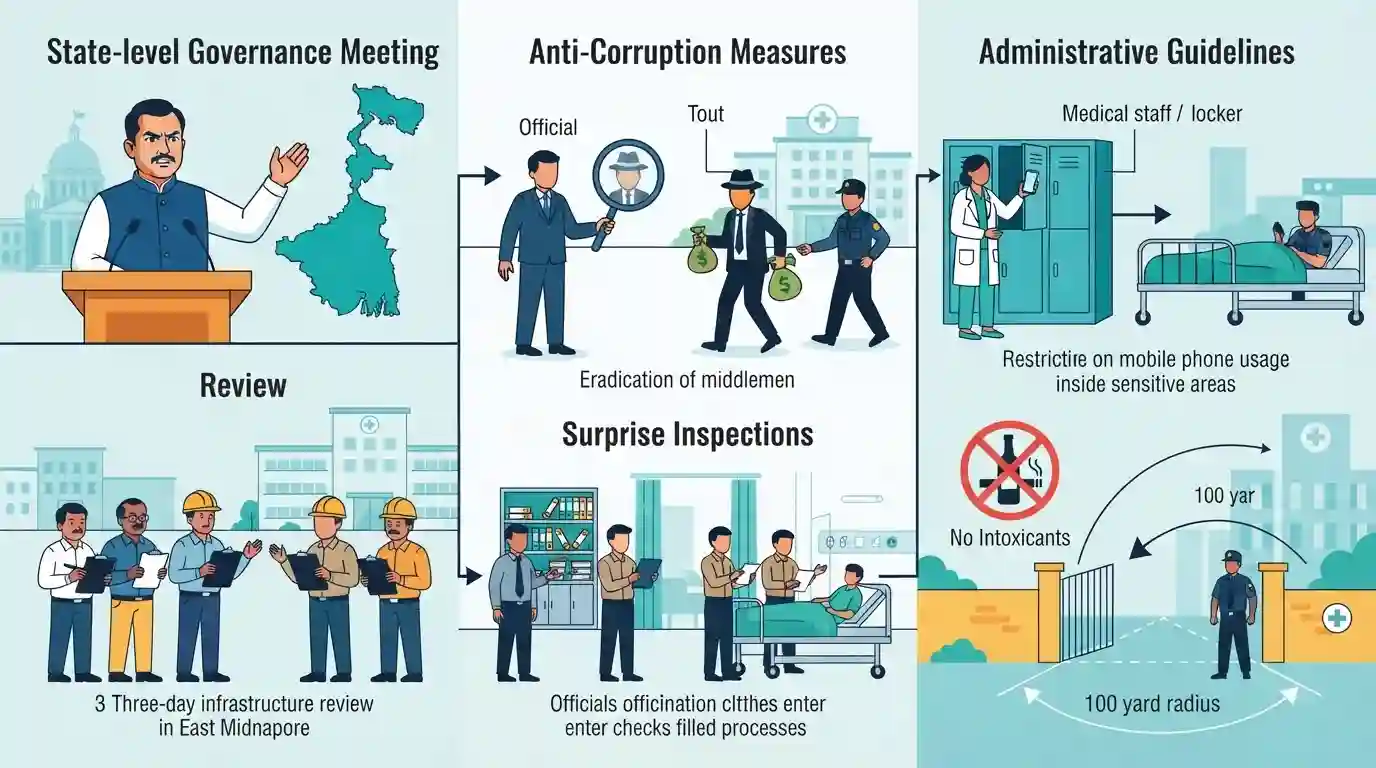
West Bengal Health Minister Sharadwat Mukherjee has announced strict measures to eradicate corruption and the tout system from government hospitals in the state, following a three-day review of health infrastructure in the East Midnapore (Purba Medinipur) district. Acting on the directives of Chief Minister Suvendu Adhikari, the health department will initiate surprise inspections across various government medical facilities. New administrative guidelines restrict mobile phone usage by medical staff inside wards and prohibit intoxicating substances within a 100-yard radius of hospitals to improve patient care and administrative efficiency.
মূল বিষয়
- West Bengal Health Minister Sharadwat Mukherjee conducted a three-day review of hospitals in East Midnapore, discovering widespread inefficiency and corruption.
- Strict warnings were issued to eradicate the tout system in government hospitals, under the directive of Chief Minister Suvendu Adhikari.
- New guidelines restrict the use of mobile phones by doctors and nurses inside indoor wards to ensure focused patient care.
- The sale and consumption of intoxicating substances have been strictly banned within a 100-yard radius of government hospitals.
- Surprise visits and strict performance monitoring of Medical Superintendents (MSVPs) and Principals are planned across the state.
গুরুত্বপূর্ণ শব্দ
Department of Health and Family Welfare, West Bengal

The principal state department responsible for managing, developing, and regulating the public healthcare system, medical education, and the implementation of state and central health schemes in West Bengal.
UPSC context
GS Paper II: Governance and Social Sector issues relating to Public Health and state-level administrative machinery.
Tout System
An informal, corrupt network of unauthorized middlemen or intermediaries operating within public healthcare facilities who exploit vulnerable patients by charging illegal fees for access to beds, medicines, or services.
UPSC context
GS Paper II: Governance challenges, accountability, and anti-corruption measures in public service delivery.
Public Health Governance
The systemic administration, policy formulation, and regulatory oversight by state bodies to ensure equitable access to quality healthcare, efficient resource allocation, and clinical accountability.
UPSC context
GS Paper II: Issues relating to development and management of Social Sector/Services relating to Health.
Ayushman Bharat Pradhan Mantri Jan Arogya Yojana (AB-PMJAY)
A flagship national health assurance scheme providing cashless coverage of up to ₹5 lakh per family per year for secondary and tertiary care hospitalization to poor and vulnerable families.
UPSC context
GS Paper II: Welfare schemes for vulnerable sections and government policies on health.
প্রিলিমস ফাঁদ
Public health, sanitation, and hospitals fall under the Concurrent List of the Seventh Schedule, enabling central legislative supremacy.
Public health and sanitation is strictly a State List subject (Entry 6). The Union implements schemes via financial grants, but legislative power belongs exclusively to states.
সংযুক্ত স্থির ধারণা
How does the Indian Constitution distribute legislative competence regarding public health?
- State List: Entry 6 of List II places public health, sanitation, and hospitals exclusively under state jurisdiction.
- Concurrent List: Entry 29 covers prevention of infectious diseases, allowing joint Center-State legislative action.
- Directive Principles: Article 47 mandates the State to improve public health as one of its primary duties.
What is the three-tier administrative structure of rural public healthcare in India?
- Primary level: Comprises Sub-Centres for basic contact and Primary Health Centres (PHCs) acting as referral units for rural populations.
- Secondary level: Consists of Community Health Centres (CHCs) and sub-divisional hospitals providing specialized care.
- Tertiary level: Includes district hospitals and state-run medical colleges offering highly specialized, advanced medical services.
আন্তঃবিষয় প্যাটার্ন
E-Governance as an anti-corruption tool
Using real-time bed monitoring and smart OPDs bypasses middleman networks, directly addressing the corruption and tout systems that plague offline public delivery channels.
Social accountability in public administration
Enforcing strict administrative guidelines on healthcare staff and regulating hospital perimeters links public service delivery to Citizen's Charters, reinforcing trust in state-funded safety nets.

Mains 2026 may evaluate how informational asymmetry in public healthcare breeds intermediary corruption, requiring structural digital reforms.
সংযুক্ত PYQ · 2
সংযুক্ত PYQ · 2
- 2021WBCS_PRELIMSGS1
How many new Government Medical Colleges have become functional in West Bengal during the last ten years?
- 2017WBCS_PRELIMSGS1
Which district of West Bengal has achieved the highest level of Human Development Index in the state?
