Public Health Burden of Snakebites in India
Source:The Hindu ↗
Why It Matters
Snakebite envenoming is a critical public health issue in rural India, reflecting gaps in primary healthcare and diagnostic capabilities. It serves as a prime example of health inequities affecting agricultural workers and highlights the need for state intervention and medical research at the grassroots level.
Summary
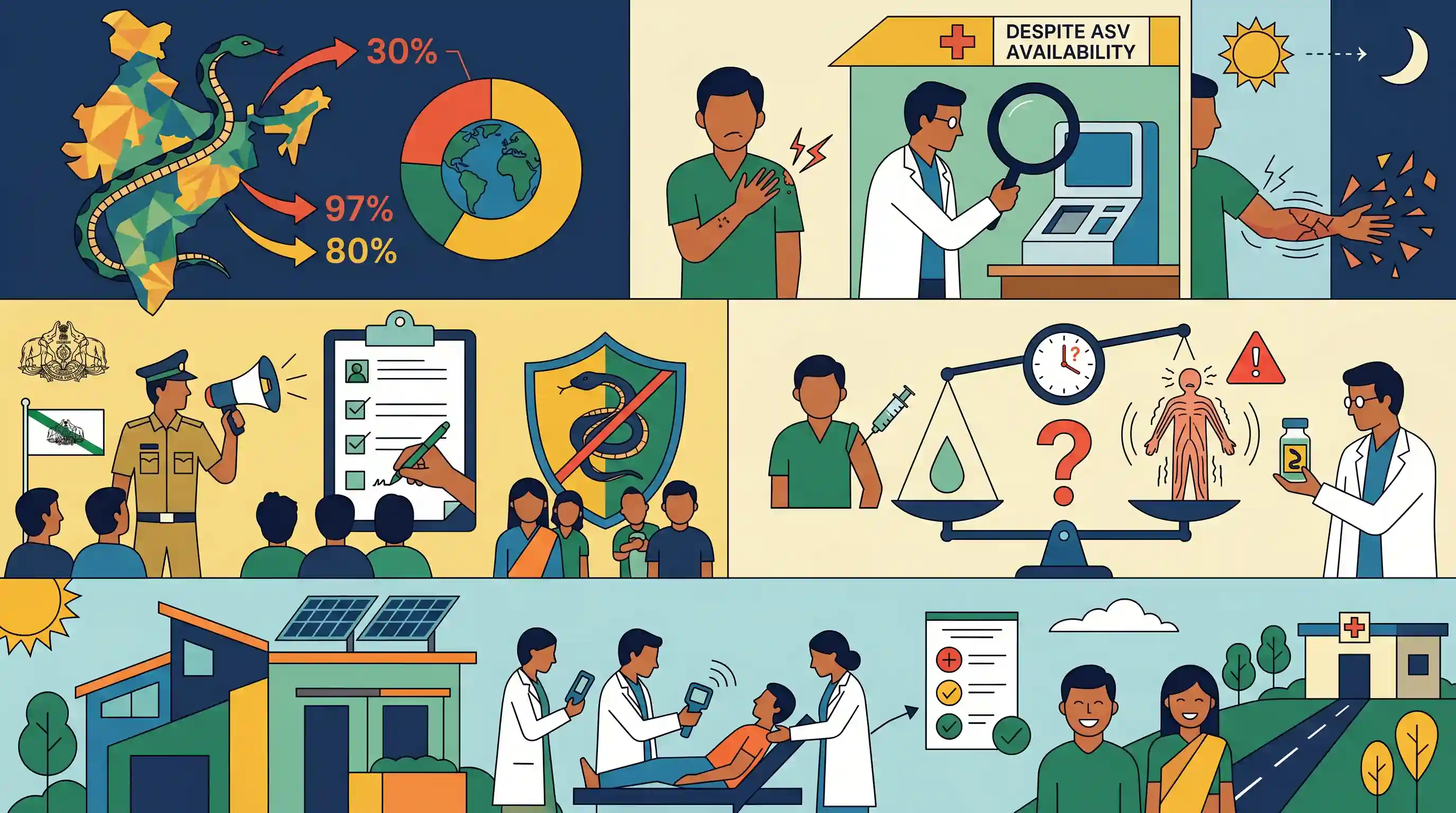
India faces a severe public health challenge from snakebites, contributing to nearly half of all global cases. While Kerala has launched the SARPA programme and declared snakebites a notifiable disease, fatalities persist despite the availability of anti-snake venom (ASV). A key bottleneck is the lack of rapid diagnostic kits, forcing doctors to rely on a 'syndromic approach' where treatment is delayed until symptoms manifest, often leading to irreversible tissue damage. Furthermore, since most bites are non-venomous or dry, premature ASV use risks fatal anaphylactic reactions. Addressing this issue requires urgent advancements in rural healthcare diagnostics and primary healthcare infrastructure.
Key Points
- India accounts for nearly half of global snakebite cases, disproportionately affecting agricultural workers and children.
- Despite widespread availability of anti-snake venom (ASV), snakebite fatalities continue, notably in Kerala, due to a lack of rapid venom detection diagnostic kits.
- The medical reliance on a 'syndromic approach'—waiting for symptoms to administer ASV—is flawed because irreversible tissue damage often occurs by the time symptoms appear.
- Approximately 70% of snakebites involve non-venomous species or are 'dry bites,' meaning unnecessary ASV administration carries risks of fatal anaphylactic reactions.
- Kerala has declared snakebite a notifiable disease and launched awareness and rescue initiatives (e.g., SARPA programme), but grassroots primary healthcare infrastructure remains inadequate.
Important Terms
SARPA initiative

Acronym for Snake Awareness, Rescue and Protection; a digital platform and mobile app by Kerala for real-time snake rescue, awareness, and hospital mapping.
UPSC context
GS Paper 2/3: Digital health, human-wildlife conflict, and state-level healthcare innovations.
Notifiable Disease
A disease legally required to be reported to government authorities. Kerala and Karnataka have notified snakebites to improve surveillance and anti-venom supply chain management.
UPSC context
GS Paper 2: Public health governance, disease surveillance, and the Integrated Disease Surveillance Programme (IDSP).
Neglected Tropical Diseases (NTDs)
A group of infections common in tropical regions; WHO classified snakebite envenoming as a high-priority NTD in 2017 to focus global resources on treatment.
UPSC context
GS Paper 2: International health issues and India's significant burden of tropical ailments.
Syndromic approach
A clinical method where treatment (like anti-venom) is delayed until physical symptoms manifest, necessitated by the absence of rapid diagnostic kits for snake venom.
UPSC context
GS Paper 3: Healthcare infrastructure gaps and the role of diagnostic technology in rural health.
ICMR (Indian Council of Medical Research)
India's apex biomedical research body, currently conducting a 13-state study to quantify the true national incidence, mortality, and socio-economic burden of snakebites.
UPSC context
GS Paper 2/3: Institutional framework for health research and evidence-based policymaking.
SARPA Padam
A specific snake awareness and educational campaign for school students in Kerala, translated as 'Snake Lessons,' integrated into the broader SARPA project.
UPSC context
GS Paper 2: Public health awareness and community-based safety programs in schools.
Prelims Trap
Immediate administration of Anti-Snake Venom (ASV) is recommended as a universal first-line treatment for all snakebites.
Around 70% of snakebites are dry or non-venomous. Premature ASV administration risks fatal anaphylaxis, forcing a wait-and-watch 'syndromic approach' without rapid tests.
Static Concepts Connected
What defines a Neglected Tropical Disease (NTD) according to the WHO?
- Vulnerable populations: Disproportionately impacts impoverished, marginalized communities in tropical and sub-tropical regions, often linked to poor sanitation.
- Diverse pathogens: Caused by a diverse group of viruses, bacteria, parasites, fungi, and toxins (including snakebite envenoming).
- Funding gap: Historically lack adequate global funding for R&D and treatment compared to high-profile diseases like HIV/AIDS, tuberculosis, or malaria.
What is the governance significance of declaring a condition a "Notifiable Disease"?
- Mandatory reporting: Creates a legal mandate for all registered clinics and hospitals to report every diagnosed case to government health authorities.
- Disease surveillance: Enables the state to track exact disease burden, map geographic hotspots, and ensure adequate supply chain logistics for treatments (like ASV).
- State jurisdiction: Since "Public Health" is a State subject under Schedule VII, individual states have the authority to notify diseases based on local prevalence.
Cross-Topic Patterns
One Health & human-wildlife conflict
Snakebite mitigation overlaps with the 'One Health' approach, connecting environmental degradation, changing agricultural footprints, and human-wildlife conflict in rural ecosystems.
E-governance in Public Health
Kerala's SARPA app mirrors digital interventions like the Ni-kshay portal (TB) or U-WIN, illustrating the rising use of e-governance for grassroots disease surveillance and hotspot mapping.

Expect a Prelims science question linking Neglected Tropical Diseases (NTDs) with snakebite envenoming and the risks of polyvalent ASV.
Linked PYQs · 2
Linked PYQs · 2
- 2024MainsGS2
In a crucial domain like the public healthcare system the Indian State should play a vital role to contain the adverse impact of marketisation of the system. Suggest some measures through which the State can enhance the reach of public healthcare at the grassroots level.
- 2021MainsGS2
“Besides being a moral imperative of a Welfare State, primary health structure is a necessary precondition for sustainable development.” Analyze.
