Snakebite Envenoming Burden and Public Health Infrastructure Gaps
Source:The Hindu ↗
Why It Matters
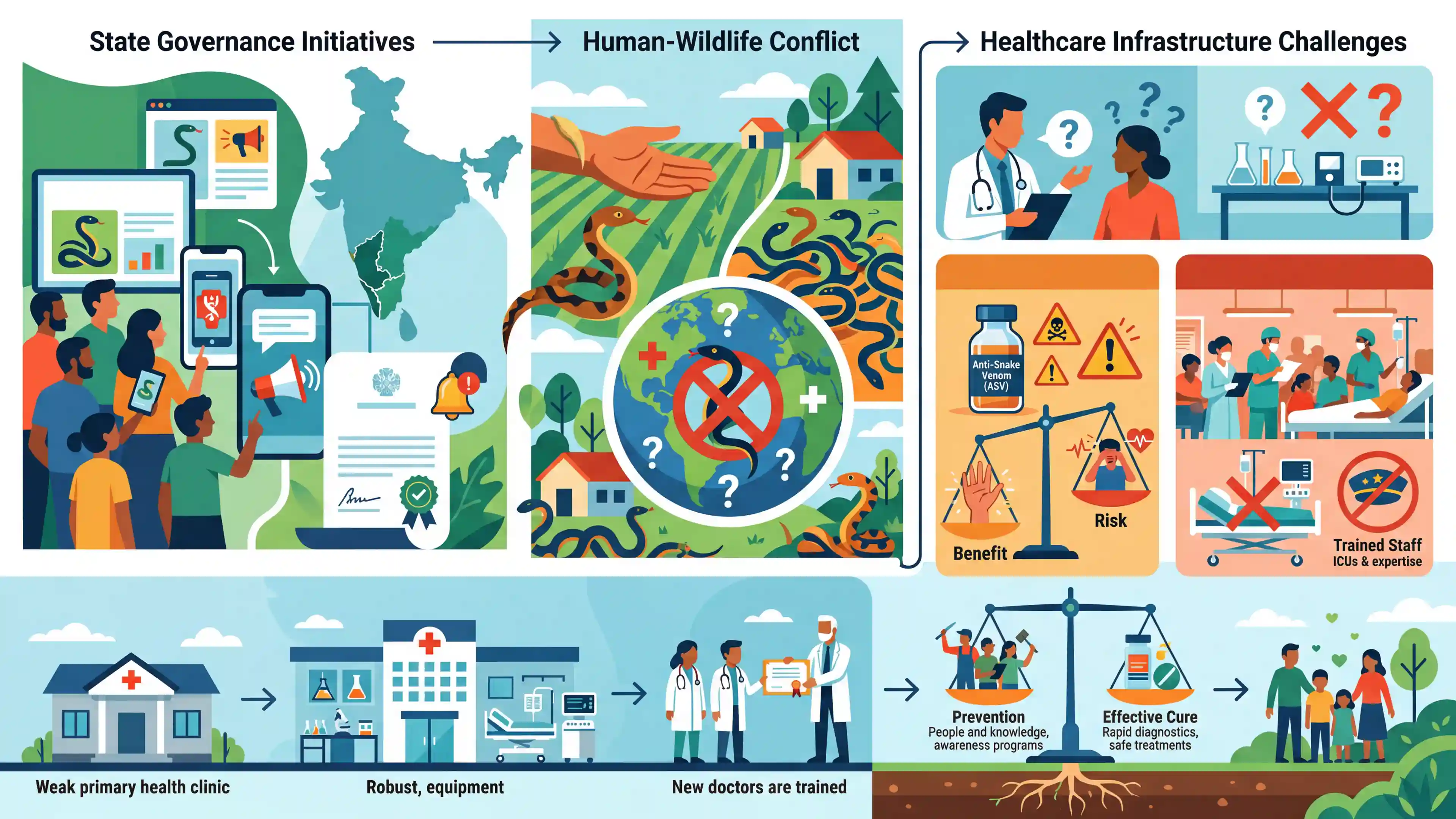
Highlights a major rural public health crisis and Neglected Tropical Disease (NTD) in India, illustrating the gaps in primary health infrastructure, diagnostics, and human resources required to handle medical emergencies effectively.
Summary
The article analyzes India's immense burden of snakebites, recognized by the WHO as a Neglected Tropical Disease, with a focus on Kerala's proactive measures. Despite declaring snakebites a notifiable disease and launching awareness programs like SARPA, India faces severe medical infrastructure challenges. The key issue lies in the symptomatic diagnosis of bites, as rapid venom detection tests are unavailable. Indiscriminate use of Anti-Snake Venom (ASV) is risky due to potential fatal anaphylaxis, compounded by a lack of ICU beds and trained medical staff to manage such emergencies. The piece calls for strengthening the primary health structure and diagnostic capabilities to balance preventive measures with effective cures.
Key Points
- India bears the highest global burden of snakebites, accounting for nearly 50% of the worldwide incidence.
- The WHO classifies snakebite envenoming as a Neglected Tropical Disease (NTD).
- Ectothermic snake behavior, hotter summers, and human-wildlife habitat overlap are driving up encounters.
- Medical challenges are significant: 70% of bites are non-venomous and many are "dry bites," yet India lacks rapid venom detection tools.
- Administering Anti-Snake Venom (ASV) without confirmation is dangerous as it can trigger fatal anaphylactic shock.
- Kerala has designated snakebites a notifiable disease and launched the 'SARPA' rescue app, but its healthcare "cure" infrastructure still needs strengthening.
Important Terms
Neglected Tropical Diseases (NTDs)

A diverse group of tropical infections common in low-income populations. The WHO added snakebite envenoming to this category in 2017 to prioritize global funding and research.
UPSC context
GS Paper 2 (Social Justice/Health); tests understanding of global health priorities and India's high burden of preventable diseases.
Notifiable Disease
A disease that is legally required to be reported to government health authorities. Kerala recently notified snakebites as such to improve data collection and emergency response.
UPSC context
GS Paper 2 (Governance/Health Policy); tests knowledge of public health surveillance mechanisms and state-level policy interventions.
SARPA (Snake Awareness, Rescue and Protection App)
A Kerala Forest Department mobile platform that professionalizes snake rescue, connects citizens with certified handlers, and maps incidents to reduce human-wildlife conflict.
UPSC context
GS Paper 3 (Science & Tech/Disaster Mgmt); tests understanding of digital governance and technology in mitigating human-wildlife conflict.
Anti-Snake Venom (ASV)
The only specific treatment for venomous snakebites, created by harvesting antibodies from immunized animals. Misuse can lead to fatal allergic reactions like anaphylaxis.
UPSC context
GS Paper 3 (Science & Technology); tests knowledge of medical biotechnology and the challenges of emergency healthcare delivery.
Syndromic Approach
A medical diagnosis method based on physical symptoms rather than lab tests. For snakebites, this often leads to delayed or indiscriminate use of antivenom.
UPSC context
GS Paper 2 (Public Health/Medical Infrastructure); tests awareness of gaps in India's diagnostic capabilities and primary healthcare.
SARPA Padam / Suraksha
Kerala's specialized awareness initiatives (Padam for school lessons, Suraksha for safety audits) aimed at educating students and rural workers on snakebite prevention and ecology.
UPSC context
GS Paper 2 (Governance/Health); tests knowledge of decentralized, state-specific social sector initiatives and grassroots awareness models.
Prelims Trap
"Snakebite envenoming is a zoonotic viral infection classified as a Neglected Tropical Disease by the WHO."
Aspirants often conflate NTDs with infectious/viral pathogens. Snakebite envenoming is officially an NTD, but it is a toxin-mediated injury, not an infection.
Static Concepts Connected
What characterizes Neglected Tropical Diseases (NTDs)?
- Core focus: Diseases primarily affecting impoverished communities in tropical areas, often overshadowed by high-profile diseases like HIV/AIDS or Malaria.
- Diverse causes: Caused by a variety of pathogens (viruses, bacteria, parasites, fungi) and toxins, explicitly including snake envenoming.
- WHO recognition: The WHO currently lists 20 conditions as NTDs, prioritizing them for global elimination and control targets by 2030.
What are the implications of a "Notifiable Disease" in India?
- Mandatory reporting: Legally obligates medical practitioners and hospitals to report every diagnosed case to government authorities to track disease prevalence.
- State jurisdiction: Public health is a State subject (Schedule VII). States individually notify diseases under state acts or the Epidemic Diseases Act.
Cross-Topic Patterns
Climate impact on ectothermic wildlife
Rising temperatures and humidity alter the habitat ranges of ectothermic (cold-blooded) animals like snakes, directly increasing human-wildlife habitat overlap and conflict.
E-governance in bio-emergency response
Kerala’s SARPA app demonstrates localized digital public infrastructure (DPI) applied to environmental health threats, bridging wildlife rescue and immediate medical triage.

UPSC 2026 may frame a multi-statement question linking climate change effects on ectotherms with WHO's NTD classifications.
Linked PYQs · 3
Linked PYQs · 3
- 2021MainsGS2
“Besides being a moral imperative of a Welfare State, primary health structure is a necessary precondition for sustainable development.” Analyze.
- 2024MainsGS2
In a crucial domain like the public healthcare system the Indian State should play a vital role to contain the adverse impact of marketisation of the system. Suggest some measures through which the State can enhance the reach of public healthcare at the grassroots level.
- 2008PrelimsGS1
For which one of the following snakes is the diet mainly composed of other snakes?
