हैप्टिक उद्दीपन और मानव स्वायत्त तंत्रिका तंत्र की प्रतिक्रिया
स्रोत:द हिंदू ↗
क्यों मायने रखता है
संवेदी इनपुट के प्रति मानवीय शारीरिक प्रतिक्रियाओं को समझना स्वास्थ्य सेवा (मानसिक स्वास्थ्य उपचार, साइकोफिजियोलॉजी) और उभरती प्रौद्योगिकियों (हैप्टिक्स, अफेक्टिव कंप्यूटिंग, AI) के विकास, दोनों के लिए अत्यंत महत्वपूर्ण है। यह जैविक विज्ञान, मानसिक स्वास्थ्य और प्रौद्योगिकी के बीच अंतःविषय ओवरलैप (interdisciplinary overlap) को प्रदर्शित करता है।
सारांश
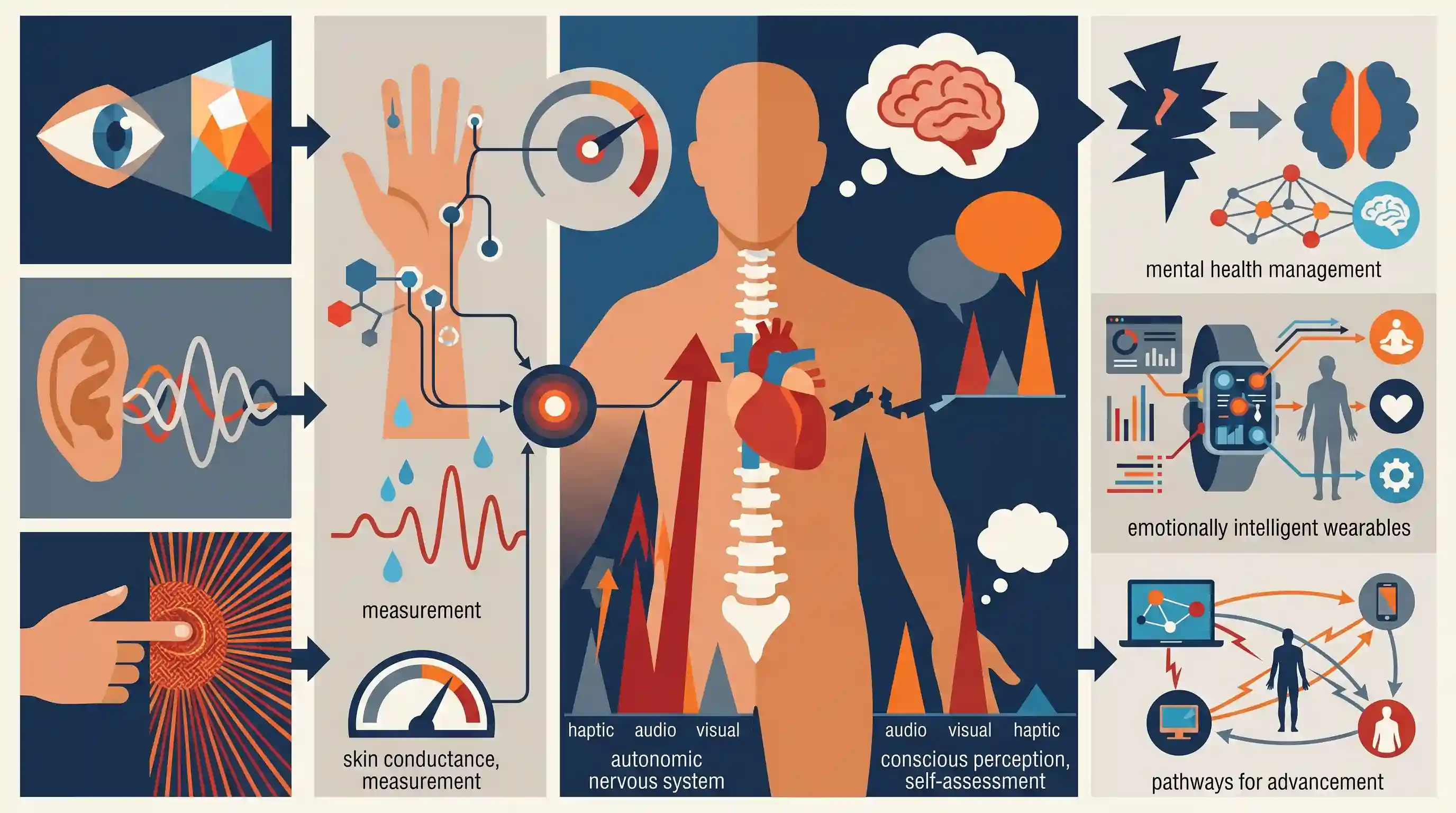
A recent study published in PLOS Mental Health by researchers from the New York University Tandon School of Engineering has revealed that touch-related (haptic) sensations trigger the most robust responses in the human autonomic nervous system compared to images and sounds. By monitoring skin conductance to measure cognitive arousal, the study highlighted a distinct difference between how the human mind consciously perceives a stimulus and how the body physically responds to it. These findings open new pathways for understanding and managing mental health conditions linked to sensory processing and could accelerate the development of emotionally intelligent technologies and advanced wearable tech that interact dynamically with human physiological states.
मुख्य बिंदु
- Research indicates that haptic (touch-related) stimuli induce significantly higher physiological and cognitive arousal than auditory or visual inputs.
- अध्ययन में मुख्य रूप से स्किन कंडक्टेंस (गैल्वेनिक स्किन रिस्पांस) के माध्यम से ऑटोनोमिक नर्वस सिस्टम की प्रतिक्रियाओं को मापा गया, जिससे कॉग्निटिव अराउज़ल को ट्रैक किया गया।
- Researchers observed a disconnect between conscious perception of sensory intensity and the actual physiological response.
- The findings are significant for mental health research, potentially improving treatments for disorders with sensory processing components.
- These insights may also advance the field of 'affective computing' and emotionally intelligent technologies, such as bio-responsive wearables.
महत्वपूर्ण शब्द
Haptic Sensations

The science and technology of simulating touch sensations, such as vibrations, pressure, or motion, to enable human-computer interaction or perceive digital content as physical objects.
UPSC context
Relevant for GS Paper 3 under Science & Technology (Emerging Technologies like VR/AR and Human-Computer Interaction).
Autonomic Nervous System (ANS)
परिधीय तंत्रिका तंत्र का एक हिस्सा जो अपने अनुकंपी (sympathetic) और परानुकंपी (parasympathetic) विभाजनों के माध्यम से हृदय गति, पाचन और श्वसन दर जैसे अनैच्छिक शारीरिक कार्यों को अचेतन रूप से नियंत्रित करता है।
UPSC context
Key concept in Biology and Human Physiology, frequently appearing in Prelims and Medical Science optional.
Skin Conductance
A measure of the skin's electrical conductivity that varies with sweat gland activity, serving as a physiological indicator of emotional or cognitive arousal and stress levels.
UPSC context
स्वास्थ्य अनुसंधान में शारीरिक संकेतकों (physiological markers) और विज्ञान एवं प्रौद्योगिकी (Science & Technology) में उभरते नैदानिक वियरेबल्स (diagnostic wearables) को समझने के लिए महत्वपूर्ण।
संवेदी प्रसंस्करण
The neurological process of receiving, organizing, and interpreting information from the senses (touch, sound, etc.) to produce an appropriate motor or behavioral response.
UPSC context
मानसिक स्वास्थ्य और न्यूरोडेवलपमेंटल विकारों के संबंध में GS पेपर 2 (स्वास्थ्य) और GS पेपर 3 (विज्ञान) के लिए प्रासंगिक।
Wearable Technology
Advanced electronic devices worn on the body, such as smartwatches or patches, that monitor physiological data like heart rate and skin conductance for health management.
UPSC context
A critical topic in GS Paper 3 under 'Developments and their Applications' in IT and Electronics.
भावनात्मक रूप से समझदार तकनीक
Systems designed to recognize, interpret, and respond to human emotions by analyzing physiological signals, aiming to improve mental health support and user experience.
UPSC context
Interdisciplinary topic under AI and Ethics in GS Paper 3 and GS Paper 4.
प्रारंभिक ट्रैप
Galvanic Skin Response (GSR) measures electrical activity in the brain to gauge cognitive arousal.
GSR measures the electrical conductance of the skin (driven by sweat gland activity), not the brain. Brain electrical activity is measured by an EEG.
संबंधित अवधारणाएँ
स्वायत्त तंत्रिका तंत्र (ANS) के मुख्य विभाजन कौन से हैं?
- Sympathetic Nervous System: Triggers 'fight or flight' responses, increasing heart rate and stimulating sweat glands during stress or high arousal.
- Parasympathetic Nervous System: Promotes 'rest and digest' states, conserving energy, slowing the heart rate, and regulating basal body functions.
What distinguishes Haptic Technology from Affective Computing?
- Haptic Technology: Simulates the sensation of touch by applying forces, vibrations, or motions to the user (e.g., smartphone vibrations, advanced prosthetics).
- अफेक्टिव कंप्यूटिंग: AI का उपयोग करने वाला एक अंतःविषय क्षेत्र जो ऐसी प्रणालियों का निर्माण करता है जो मानवीय भावनाओं और शारीरिक स्थितियों को पहचानने, उनकी व्याख्या करने और उनके प्रति गतिशील रूप से प्रतिक्रिया देने में सक्षम हैं।
अंतर-विषय पैटर्न
वियरेबल बायो-सेंसर और डेटा गोपनीयता
As affective computing tracks emotional states via skin conductance, it raises significant biometric data privacy concerns under India's Digital Personal Data Protection (DPDP) Act.
AR/VR and the Metaverse
Haptic technology provides kinaesthetic communication, enabling physical interaction with digital objects—a fundamental requirement for fully immersive AR/VR and Metaverse environments.

Emerging tech questions in 2026 will likely test 'Affective Computing' and 'Haptics' as application pairs in wearables.
संबद्ध PYQ · 3
संबद्ध PYQ · 3
- 2024PrelimsGS1
Which one of the following is synthesised in human body that dilates blood vessels and increases blood flow?
- 2022PrelimsGS1
Which one of the following statements best describes the role of B cells and T cells in the human body?
- 2020PrelimsGS1
With the present state of development, Artificial Intelligence can effectively do which of the following? 1. Bring down electricity consumption in industrial units 2. Create meaningful short stories and songs 3. Disease diagnosis 4. Text-to-Speech Conversion 5. Wireless transmission of electrical energy Select the correct answer using the code given below:
