Haptic Stimuli and Human Autonomic Nervous System Response
Source:The Hindu ↗
Why It Matters
Understanding human physiological responses to sensory inputs is crucial for both healthcare (mental health treatments, psychophysiology) and the development of emerging technologies (haptics, affective computing, AI). It demonstrates the interdisciplinary overlap between biological sciences, mental health, and technology.
Summary
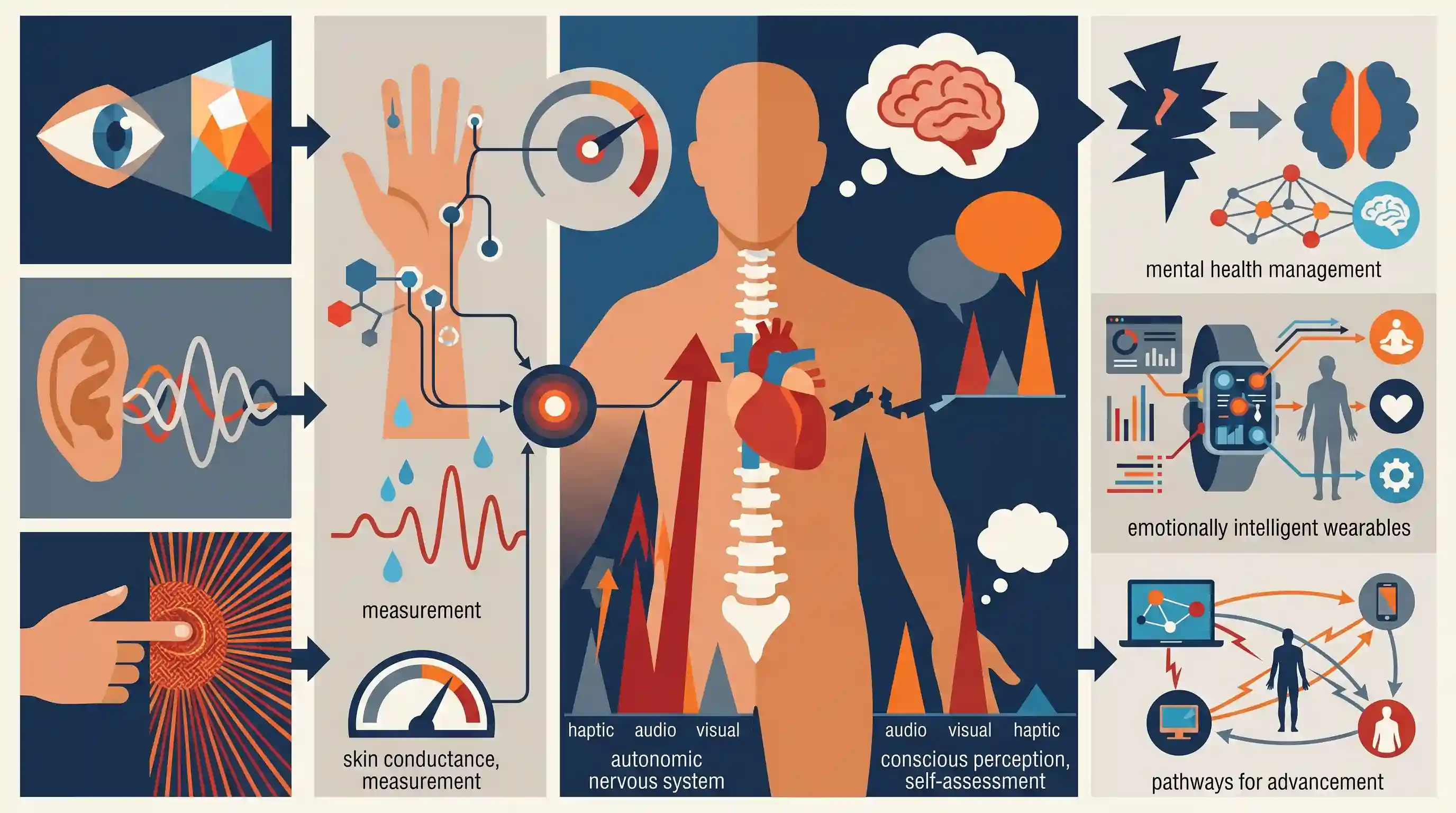
A recent study published in PLOS Mental Health by researchers from the New York University Tandon School of Engineering has revealed that touch-related (haptic) sensations trigger the most robust responses in the human autonomic nervous system compared to images and sounds. By monitoring skin conductance to measure cognitive arousal, the study highlighted a distinct difference between how the human mind consciously perceives a stimulus and how the body physically responds to it. These findings open new pathways for understanding and managing mental health conditions linked to sensory processing and could accelerate the development of emotionally intelligent technologies and advanced wearable tech that interact dynamically with human physiological states.
Key Points
- Research indicates that haptic (touch-related) stimuli induce significantly higher physiological and cognitive arousal than auditory or visual inputs.
- The study measured autonomic nervous system responses primarily through skin conductance (galvanic skin response), tracking cognitive arousal.
- Researchers observed a disconnect between conscious perception of sensory intensity and the actual physiological response.
- The findings are significant for mental health research, potentially improving treatments for disorders with sensory processing components.
- These insights may also advance the field of 'affective computing' and emotionally intelligent technologies, such as bio-responsive wearables.
Important Terms
Haptic Sensations

The science and technology of simulating touch sensations, such as vibrations, pressure, or motion, to enable human-computer interaction or perceive digital content as physical objects.
UPSC context
Relevant for GS Paper 3 under Science & Technology (Emerging Technologies like VR/AR and Human-Computer Interaction).
Autonomic Nervous System (ANS)
A part of the peripheral nervous system that unconsciously regulates involuntary bodily functions like heart rate, digestion, and respiratory rate through its sympathetic and parasympathetic divisions.
UPSC context
Key concept in Biology and Human Physiology, frequently appearing in Prelims and Medical Science optional.
Skin Conductance
A measure of the skin's electrical conductivity that varies with sweat gland activity, serving as a physiological indicator of emotional or cognitive arousal and stress levels.
UPSC context
Important for understanding physiological markers in health research and emerging diagnostic wearables in Science & Technology.
Sensory Processing
The neurological process of receiving, organizing, and interpreting information from the senses (touch, sound, etc.) to produce an appropriate motor or behavioral response.
UPSC context
Relevant for GS Paper 2 (Health) and GS Paper 3 (Science) regarding mental health and neurodevelopmental disorders.
Wearable Technology
Advanced electronic devices worn on the body, such as smartwatches or patches, that monitor physiological data like heart rate and skin conductance for health management.
UPSC context
A critical topic in GS Paper 3 under 'Developments and their Applications' in IT and Electronics.
Emotionally Intelligent Technology
Systems designed to recognize, interpret, and respond to human emotions by analyzing physiological signals, aiming to improve mental health support and user experience.
UPSC context
Interdisciplinary topic under AI and Ethics in GS Paper 3 and GS Paper 4.
Prelims Trap
Galvanic Skin Response (GSR) measures electrical activity in the brain to gauge cognitive arousal.
GSR measures the electrical conductance of the skin (driven by sweat gland activity), not the brain. Brain electrical activity is measured by an EEG.
Static Concepts Connected
What are the core divisions of the Autonomic Nervous System (ANS)?
- Sympathetic Nervous System: Triggers 'fight or flight' responses, increasing heart rate and stimulating sweat glands during stress or high arousal.
- Parasympathetic Nervous System: Promotes 'rest and digest' states, conserving energy, slowing the heart rate, and regulating basal body functions.
What distinguishes Haptic Technology from Affective Computing?
- Haptic Technology: Simulates the sensation of touch by applying forces, vibrations, or motions to the user (e.g., smartphone vibrations, advanced prosthetics).
- Affective Computing: An interdisciplinary field using AI to create systems that can detect, interpret, and dynamically respond to human emotions and physiological states.
Cross-Topic Patterns
Wearable Biosensors & Data Privacy
As affective computing tracks emotional states via skin conductance, it raises significant biometric data privacy concerns under India's Digital Personal Data Protection (DPDP) Act.
AR/VR and the Metaverse
Haptic technology provides kinaesthetic communication, enabling physical interaction with digital objects—a fundamental requirement for fully immersive AR/VR and Metaverse environments.

Emerging tech questions in 2026 will likely test 'Affective Computing' and 'Haptics' as application pairs in wearables.
Linked PYQs · 3
Linked PYQs · 3
- 2024PrelimsGS1
Which one of the following is synthesised in human body that dilates blood vessels and increases blood flow?
- 2022PrelimsGS1
Which one of the following statements best describes the role of B cells and T cells in the human body?
- 2020PrelimsGS1
With the present state of development, Artificial Intelligence can effectively do which of the following? 1. Bring down electricity consumption in industrial units 2. Create meaningful short stories and songs 3. Disease diagnosis 4. Text-to-Speech Conversion 5. Wireless transmission of electrical energy Select the correct answer using the code given below:
