Price Crash of Totapuri Mangoes Triggers Distress in Andhra Pradesh
Source:The Hindu ↗
Why It Matters
This article provides an excellent contemporary example of government intervention (MIS and PDP) in horticultural marketing, showcasing how the state protects farmers from distress sales of perishable crops when faced with oligopsonistic processing cartels. It highlights federal financial sharing, APMC-based procurement, and the administrative challenges of implementing price safety nets in real-time.
Summary
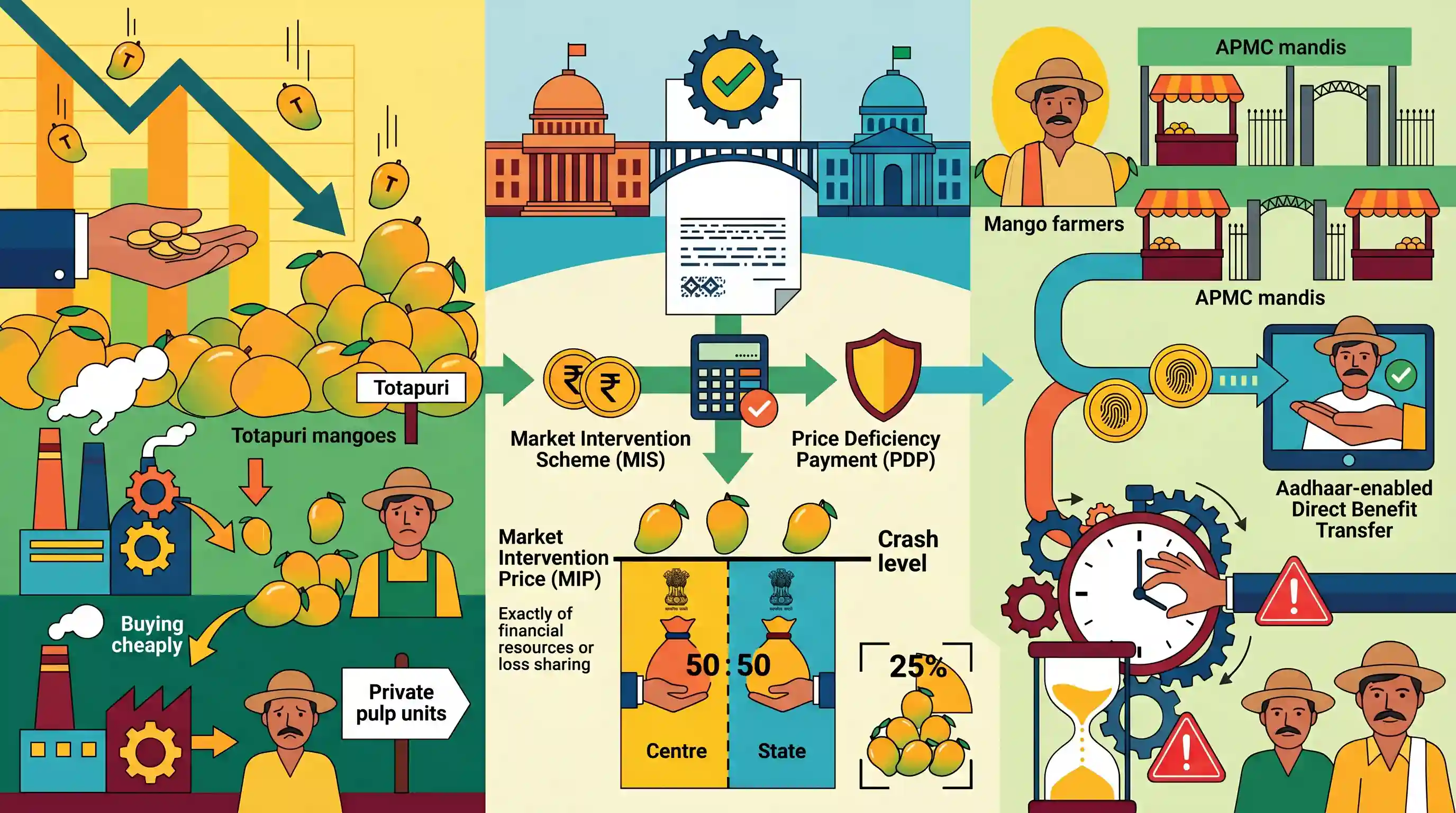
The Union Ministry of Agriculture and Farmers Welfare has approved Andhra Pradesh's proposal to implement the Price Deficiency Payment (PDP) under the Market Intervention Scheme (MIS) for Totapuri mangoes in the 2026-27 marketing season. This comes in response to a steep price crash where private pulp processing units in Chittoor are buying mangoes for less than ₹6 per kg. Under the scheme, the Market Intervention Price is fixed at ₹1,747 per quintal, covering 25% of estimated production, with the Centre and State sharing losses 50:50. Farmers must sell at notified APMC mandis to receive Aadhaar-enabled Direct Benefit Transfer (DBT) payments, though delays in implementation are currently limiting the relief's effectiveness.
Key Points
- Farmers growing Totapuri mangoes in Chittoor, Andhra Pradesh, are facing distress as private pulp processing units are procuring mangoes at less than ₹6 per kg, which is highly unremunerative.
- To alleviate this, the Union Ministry of Agriculture and Farmers Welfare approved Andhra Pradesh's proposal to implement the Price Deficiency Payment (PDP) under the Market Intervention Scheme (MIS) for Totapuri mangoes for the 2026-27 marketing season.
- Under the approved MIS-PDP, the Market Intervention Price (MIP) is fixed at ₹1,747 per quintal (₹17.47 per kg).
- The MIS coverage is capped at 2.16 lakh metric tonnes, which represents 25% of the estimated total production of 8.65 lakh metric tonnes.
- The Centre has capped the price differential payment at 25% of the intervention price, with the losses being shared equally (50:50) between the Centre and the State government.
- To qualify for the PDP, eligible farmers must sell their produce in notified APMC (Agricultural Produce Market Committee) mandis, with payments processed via Aadhaar-enabled Direct Benefit Transfer (DBT).
- Farmers' representatives have raised concerns that delayed implementation has prevented actual benefits from reaching farmers even as the harvesting season enters its final phase.
Important Terms
Market Intervention Scheme

An ad-hoc price support mechanism implemented at a state's request to procure perishable agricultural and horticultural crops not covered under MSP, protecting farmers from distress sales during market crashes.
UPSC context
GS Paper III: Subsidy and pricing. Tests knowledge of price-support mechanisms for perishable horticultural crops.
Price Deficiency Payment Scheme
An agricultural support mechanism that directly compensates registered farmers for the difference between a crop's support price and its actual market price, avoiding physical procurement.
UPSC context
GS Paper III: Agricultural marketing and direct farm subsidies. Tests understanding of non-procurement support models.
Agricultural Produce Market Committee
A state-regulated statutory marketing board that manages wholesale markets (mandis) to ensure transparent pricing and protect farmers from exploitation by intermediaries.
UPSC context
GS Paper III: Marketing bottlenecks. Tests understanding of state agricultural trade regulation and mandi-system reforms.
Direct Benefit Transfer
A government mechanism designed to transfer subsidies, cash, and welfare benefits directly into the Aadhaar-linked bank accounts of beneficiaries, eliminating intermediaries and reducing leakage.
UPSC context
GS Paper II: E-governance applications. Tests knowledge of digital delivery systems and public subsidy reforms.
Prelims Trap
Losses incurred under the Market Intervention Scheme (MIS) are shared between the Centre and general states in a standard 60:40 ratio.
Under MIS guidelines, financial losses are shared 50:50 (75:25 for NE states), unlike the standard 60:40 ratio common to Centrally Sponsored Schemes.
Static Concepts Connected
What are the core pillars and scope of the PM-AASHA umbrella scheme?
- Price Support Scheme: Covers oilseeds, pulses, and copra to ensure physical procurement when market prices fall below MSP.
- Price Deficiency Payment: Directly compensates registered farmers for the difference between MSP/MIP and market selling price without physical procurement.
- PPSS alternative: Allows private sector participation in procurement on a pilot basis for select oilseeds.
How does Market Intervention Price (MIP) differ from Minimum Support Price (MSP)?
- Crop coverage: MSP covers 22 mandated crops and sugarcane; MIP is ad-hoc for horticultural/perishable crops not covered under MSP.
- Trigger condition: MSP is announced pre-sowing; MIP is triggered during a post-harvest price crash of at least 10% on State request.
- Procurement ceiling: MIS procurement/coverage is strictly capped at 25% of the total estimated production of the state.
Cross-Topic Patterns
Horticulture value-chains & Processing industry
Price crashes in pulp-grade fruits like Totapuri expose bottlenecks in contract farming, raw material hedging, and cold-chain infrastructure for downstream agro-industries.
WTO Amber Box vs PDP schemes
Examines whether direct price deficiency payments under MIS fall under WTO Amber Box (trade-distorting agricultural subsidies) or benefit from Green Box exemptions.

Revised PM-AASHA guidelines integrating MIS-PDP with specific 50:50 funding ratios and 25% production caps are prime for a 2026 MCQs.
Linked PYQs · 3
Linked PYQs · 3
- 2020PrelimsGS1
Consider the following statements: 1. In the case of all cereals, pulses and oil-seeds, the procurement at Minimum Support Price (MSP) is unlimited in any State/UT of India. 2. In the case of cereals and pulses, the MSP is fixed in any State/UT at a level to which the market price will never rise. Which of the statements given above is/are correct?
- 2020MainsGS3
What are the challenges and opportunities of food processing sector in the country? How can income of the farmers be substantially increased by encouraging food processing?
- 2022MainsGS3
What are the main bottlenecks in upstream and downstream process of marketing of agricultural products in India?
