Custodial Torture and Structural Flaws in Criminal Justice
Source:Indian Express ↗
Why It Matters
Custodial violence represents a severe violation of Article 21 of the Indian Constitution. For UPSC aspirants, it bridges GS-2 (Governance, Police Reforms, and limitations of bodies like the NHRC) and GS-4 (Ethics in public administration, human rights, and the misuse of authority). Understanding international obligations like UNCAT is also crucial for Mains.
Summary
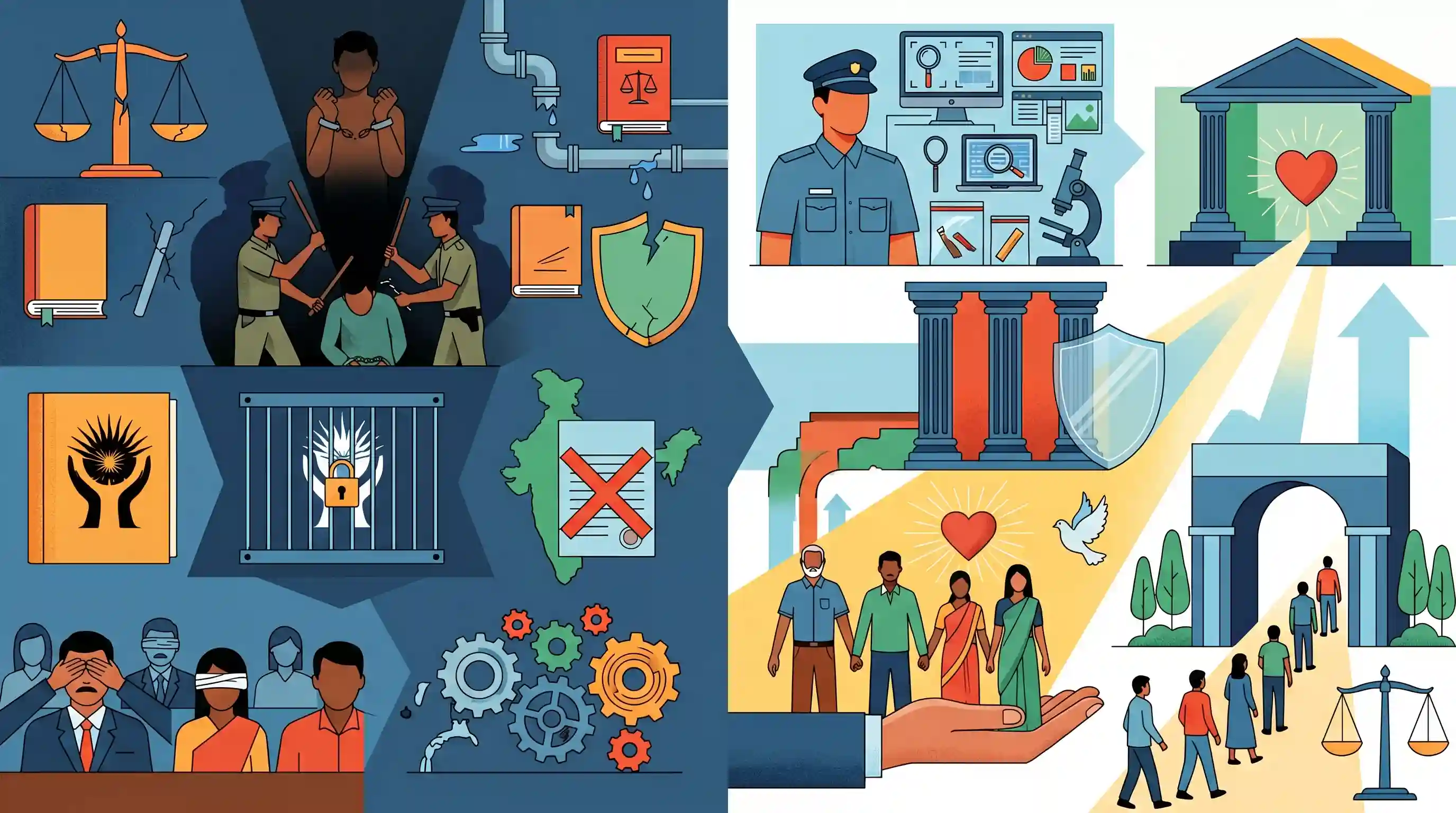
The article highlights the persistent and grim reality of torture in police custody across India, exposing critical flaws in the country's criminal justice system. It underscores that despite fundamental rights guarantees and Supreme Court guidelines, police brutality continues due to a lack of scientific investigation methods, poor police training, and weak accountability mechanisms. The piece emphasizes the structural limitations of the National Human Rights Commission (NHRC) in curbing abuses and points to India's ongoing failure to ratify the UN Convention Against Torture (UNCAT). It calls for urgent, systemic police reforms to replace coerced confessions with evidence-based investigations, thereby upholding the rule of law and human dignity.
Key Points
- Despite constitutional safeguards under Article 21 and clear Supreme Court directives like the D.K. Basu guidelines, custodial torture remains a systemic plague in India.
- Overburdened police forces lacking proper training in modern, scientific investigation techniques frequently resort to coercive 'third-degree' methods to extract confessions.
- The National Human Rights Commission (NHRC) often struggles to enforce strict accountability or adequately penalize errant officials due to structural and practical limitations.
- India's failure to ratify the UN Convention Against Torture (UNCAT) despite signing it has delayed the enactment of a robust domestic anti-torture law.
- Comprehensive police reforms, including separating law and order from investigation, are crucial for modernizing the criminal justice system and protecting human rights.
Important Terms
UN Convention Against Torture (UNCAT)

A 1984 UN treaty prohibiting torture and cruel treatment. India signed it in 1997 but remains one of the few nations yet to ratify it, hindering international extradition and human rights credibility.
UPSC context
GS Paper II: International Relations/Governance. Tests India's compliance with global human rights standards and impact on criminal justice.
National Human Rights Commission (NHRC)
A statutory body established in 1993 to protect rights related to life, liberty, equality, and dignity. It acts as a human rights "watchdog" but has limited, non-binding recommendatory powers.
UPSC context
GS Paper II: Statutory Bodies. Tests understanding of institutional safeguards, structural limitations, and the "toothless tiger" critique.
Protection of Human Rights Act (1993)
The 1993 legislation providing the legal framework for the NHRC and SHRCs. It defines human rights as those guaranteed by the Constitution or international covenants enforceable by Indian courts.
UPSC context
GS Paper II: Governance/Polity. Tests knowledge of statutory provisions for protecting fundamental liberties against State excesses.
D.K. Basu Guidelines
Landmark Supreme Court directives (1997) mandating procedures for arrest and detention—such as preparing arrest memos and medical exams—to prevent custodial torture and ensure police accountability.
UPSC context
GS Paper II/IV: Judiciary/Ethics. Critical for answers on police brutality, custodial deaths, and judicial activism.
Article 21
Fundamental Right guaranteeing that "no person shall be deprived of his life or personal liberty except according to procedure established by law," interpreted to include the right against torture.
UPSC context
GS Paper II: Polity. The most frequently cited article for rights-based questions; central to the "Right to Dignity."
Police Reforms
Structural changes aimed at making the police force professional, accountable, and evidence-driven rather than confession-reliant. Often references the 2006 Prakash Singh vs. Union of India judgment.
UPSC context
GS Paper II/III: Governance/Internal Security. Tests understanding of systemic fixes for custodial violence and criminal justice delays.
Prelims Trap
"India ratified the UN Convention Against Torture (UNCAT) in 1997 and established a standalone domestic anti-torture law."
India merely signed the UNCAT in 1997; it has never ratified it. Furthermore, India lacks a specific, standalone domestic anti-torture legislation.
Static Concepts Connected
What are the key statutory limitations of the NHRC in addressing human rights violations?
- Recommendatory Nature: NHRC findings are recommendatory. It cannot legally bind the government or directly penalize errant police officers.
- One-Year Time Bar: The NHRC cannot inquire into any matter after the expiry of one year from the date on which the human rights violation occurred.
- Armed Forces Limitation: It has restricted powers regarding the armed forces, relying largely on reports from the Central Government rather than conducting independent investigations.
What Constitutional and judicial safeguards protect individuals against custodial torture in India?
- Article 20(3): Protects individuals from being compelled to be a witness against themselves, barring forced confessions.
- Article 21: The Supreme Court has interpreted the right to life and personal liberty to implicitly include protection against torture and cruel, inhuman, or degrading treatment.
- D.K. Basu Guidelines: Mandated by the Supreme Court (1997), these rules require police to wear name tags, prepare arrest memos, and conduct regular medical exams of detainees.
Cross-Topic Patterns
Forensics replacing police coercion
Under the new Bharatiya Nagarik Suraksha Sanhita (BNSS), mandating forensic evidence for crimes punishable by 7+ years aims to reduce police reliance on coerced confessions and third-degree methods.
Dualist system and treaty ratification
India's pending UNCAT ratification highlights its dualist legal system. Under Article 253, Parliament must enact domestic legislation to give effect to international treaties, which India hasn't enacted for UNCAT.

Expect a multi-statement Prelims question mixing NHRC's statutory limits (the 1-year rule) with constitutional safeguards under Art 20(3).
Linked PYQs · 3
Linked PYQs · 3
- 2021MainsGS2
Though the Human Rights Commissions have contributed immensely to the protection of human rights in India, yet they have failed to assert themselves against the mighty and powerful. Analyzing their structural and practical limitations, suggest remedial measures.
- 2023PrelimsGS1
Consider the following organizations/bodies in India: 1. The National Commission for Backward Classes 2. The National Human Rights Commission 3. The National Law Commission 4. The National Consumer Disputes Redressal Commission How many of the above are constitutional bodies?
- 2023PrelimsGS1
Consider the following statements: 1. According to the Constitution of India, the Central Government has a duty to protect States from internal disturbances. 2. The Constitution of India exempts the States from providing legal counsel to a person being held for preventive detention. 3. According to the Prevention of Terrorism Act, 2002, confession of the accused before the police cannot be used as evidence. How many of the above statements are correct?
