Tribal Welfare Schemes and Rural Infrastructure in Andhra Pradesh
Source:new-indian-express ↗
ఇది ఎందుకు ముఖ్యం
Issues related to tribal welfare, specific Central and State schemes (PM-JANMAN, Jal Jeevan Mission), and historical tribal movements are essential topics for APPSC Group 1 Prelims, testing knowledge on social development and vulnerable sections.
సారాంశం
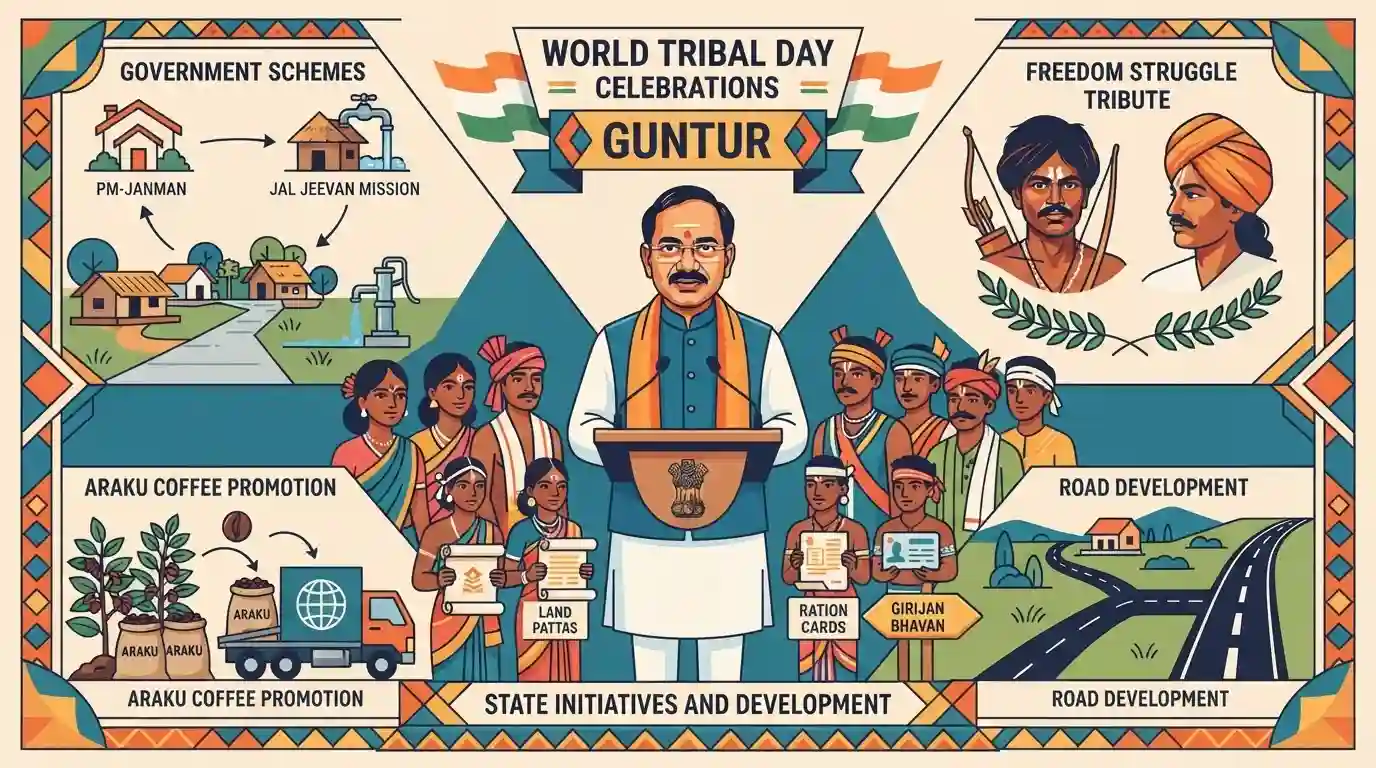
During the World Tribal Day celebrations in Guntur, Union Minister of State for Rural Development and Communications Pemmasani Chandra Sekhar emphasized the government's commitment to tribal upliftment. He noted that Central schemes like PM-JANMAN and the Jal Jeevan Mission are prioritizing basic infrastructure, such as road connectivity and drinking water, in remote tribal areas. Paying tribute to freedom fighters like Birsa Munda and Alluri Sitarama Raju, he highlighted state-level initiatives, including the global promotion of Araku coffee and substantial investments in roadworks. Tribal representatives also presented demands for land pattas, ration cards, and a dedicated Girijan Bhavan.
ముఖ్య అంశాలు
- The AP Tribal Welfare Department hosted World Tribal Day celebrations in Guntur to honour the heritage and sacrifices of tribal leaders like Birsa Munda and Alluri Sitarama Raju.
- Union Minister Pemmasani Chandra Sekhar highlighted that Central initiatives, specifically PM-JANMAN and Jal Jeevan Mission, are focusing on providing drinking water and road connectivity to remote tribal habitations.
- The State government is actively promoting Araku coffee on a global scale and has sanctioned road infrastructure works worth Rs 1,120 crore for tribal regions.
- Tribal leaders and representatives requested the government to address issues concerning land pattas under the Forest Rights Act, issuance of ration cards, and the construction of a Girijan Bhavan.
ముఖ్యమైన పదాలు
PM-JANMAN

Pradhan Mantri Janjati Adivasi Nyaya Maha Abhiyan is a major socio-economic initiative launched in 2023 to improve living conditions and basic infrastructure (housing, water, roads) for 75 Particularly Vulnerable Tribal Groups (PVTGs) across India.
UPSC context
Important for GS-2 (Welfare Schemes). Tests knowledge of PVTGs and targeted inter-ministerial developmental interventions.
Jal Jeevan Mission
Launched in 2019, this flagship central scheme aims to provide safe, adequate drinking water through Functional Household Tap Connections to every rural household. It emphasizes community participation and sustainable water management.
UPSC context
Crucial for GS-2 (Government Policies) and GS-3. Tests rural development, water security, and decentralised governance.
Forest Rights Act
The Scheduled Tribes and Other Traditional Forest Dwellers Act, 2006 recognizes customary land and resource rights of forest communities, addressing historical injustices and empowering Gram Sabhas in forest governance.
UPSC context
Highly relevant for GS-2 and GS-3. Tests tribal empowerment, land reforms, and community-led ecological conservation.
ప్రిలిమ్స్ ఉచ్చు
"PM-JANMAN aims to provide basic socio-economic facilities and infrastructure to all Scheduled Tribes across India."
PM-JANMAN is exclusively designed for the socio-economic upliftment of the 75 Particularly Vulnerable Tribal Groups (PVTGs), not the broader Scheduled Tribe population.
అనుసంధానమైన స్థిర భావనలు
What triggered the 1922 Rampa Rebellion in the Madras Presidency?
- Podu cultivation: The 1882 Madras Forest Act heavily restricted 'podu' (shifting agriculture) and minor forest produce collection, devastating tribal livelihoods.
- Muttadar exploitation: Tribals harbored deep resentment against extreme exploitation by colonial-appointed revenue collectors and contractors.
- Charismatic leadership: Alluri Sitarama Raju, a non-tribal ascetic, united the tribes and employed effective guerrilla warfare against the British.
What are the key land and authority provisions of the Forest Rights Act (FRA), 2006?
- Gram Sabha: It acts as the primary, statutory authority to initiate the process of determining the nature and extent of Individual or Community Forest Rights.
- Land limit: Individual Forest Rights (IFR) for self-cultivation or habitation are strictly capped at a maximum of 4 hectares.
- Nodal agency: The Ministry of Tribal Affairs (MoTA) acts as the central nodal agency for implementing the Act's provisions.
అంతర-అంశ నమూనాలు
Colonial Forest Acts & Tribal Uprisings
The Rampa Rebellion (1922) highlights a recurring UPSC theme: how colonial restrictions on traditional shifting cultivation (podu/jhum) and forest access directly catalyzed major anti-British tribal mobilizations.
GI Tags for Tribal Agro-Forestry
Araku Valley Arabica's GI tag illustrates how organic agro-forestry by tribal communities is leveraged for global branding, intersecting vulnerable group welfare with agricultural export policies.

Expect a multi-statement question linking PM-JANMAN's criteria for PVTGs, the Gram Sabha's role in the FRA, and a tribal uprising.
అనుసంధాన PYQలు · 1
అనుసంధాన PYQలు · 1
- 2024APPSC_PRELIMSGS1
In the context of Central Government programmes, which one of following statement/statements is/are incorrect ? I. The objective of Pradhan Mantri Anusuchit Jaati Abhyuday Yojana (PM-AJAY) is aimed at reducing poverty of the ST communities by generating additional employment opportunities. II. Under the Pradhan Mantri Shram Yogi Maan-dhan Yojana (PM-SYM), monthly contribution is payable by the beneficiary, the State Government and the Central Government. III. Under the 'FutureSkills Prime' Programme, Centre for Development of Advanced Computing (C-DAC) is the key implementing agency. IV. Mission Karmayogi comprises of eight key pillars that are intended to create functional and behavioural competencies among the civil servants. Select the answer using the codes given below :
