Meerut Metro Launch and Cyber Crime Digital Arrest Awareness
Source:The Hindu ↗
Why It Matters
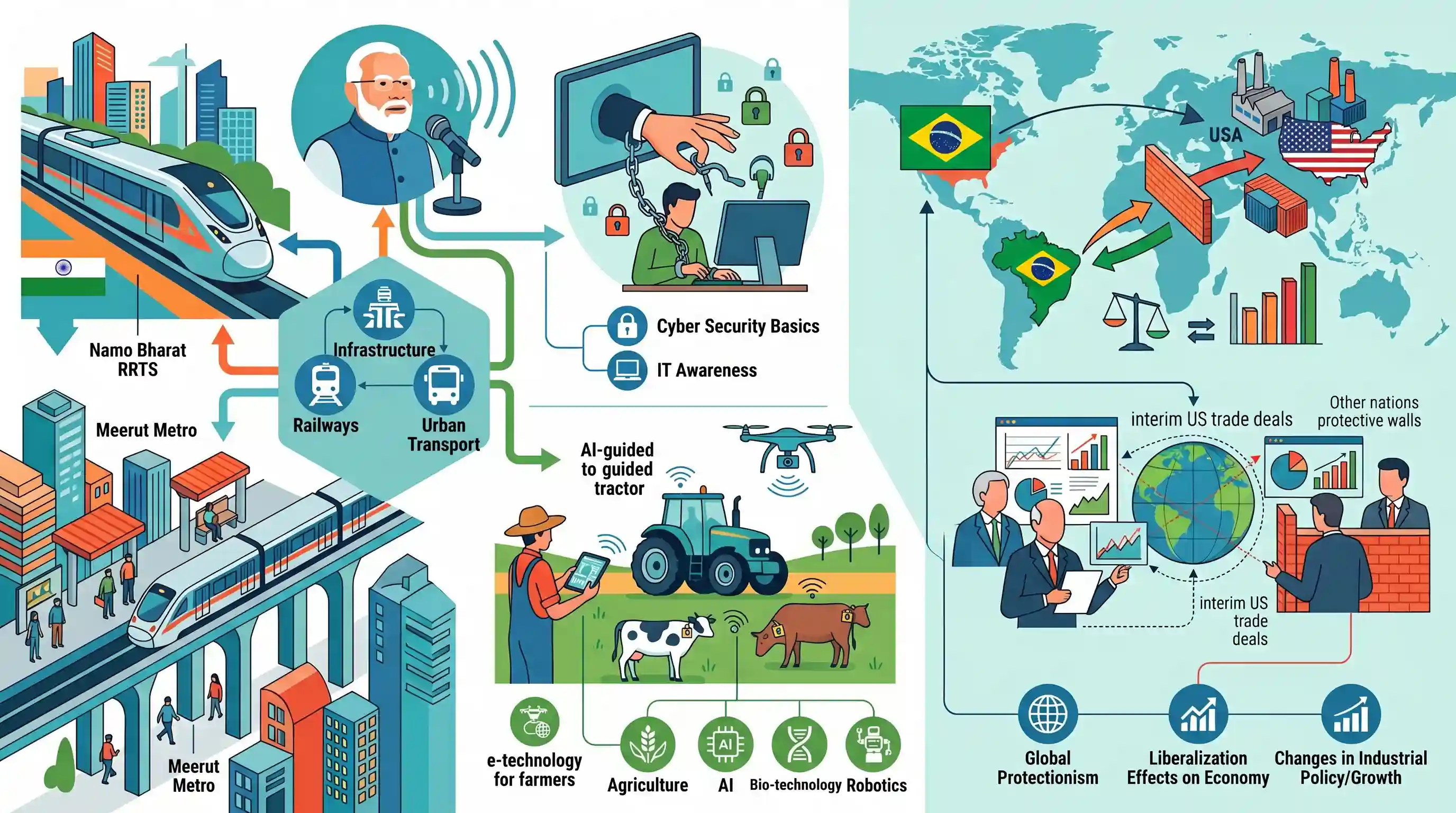
The developments cover multiple core areas of the GS3 syllabus: the completion of the RRTS corridor is a prime case study for regional infrastructure and urban transport modernization. The mention of 'digital arrest scams' highlights the evolving nature of cybercrimes targeting citizens, requiring policy and awareness interventions. AI applications in livestock management connect emerging technologies with agriculture. Additionally, the U.S. tariff disputes reflect the global trend towards protectionism, directly impacting international trade dynamics and macro-economic stability.
Summary
A compilation of major daily news highlights domestic developments in India and shifting international dynamics. Key domestic events include the inauguration of the Delhi-Meerut Namo Bharat RRTS and Meerut Metro, representing a significant boost to urban infrastructure. The Prime Minister's 'Mann Ki Baat' address cautioned against the rising threat of 'digital arrest' cyber fraud while highlighting the integration of Artificial Intelligence in agriculture and livestock management. On the global front, international trade tensions persist as Brazil calls for equitable treatment following U.S. tariff proposals, and domestic politics sees Congress critiquing interim U.S. trade deals amid rising global protectionism.
Key Points
- Prime Minister Narendra Modi inaugurated the Meerut Metro and dedicated the Delhi-Meerut Namo Bharat Rapid Rail Transit System (RRTS) corridor, significantly enhancing regional infrastructure and urban mobility.
- During 'Mann Ki Baat', PM Modi warned citizens about rising cyber crimes, specifically 'digital arrest scams', stressing the critical need for public awareness and cybersecurity measures.
- The potential of Artificial Intelligence (AI) was highlighted for innovative applications in non-traditional areas like agriculture, specifically for treating animals and tracking livestock.
- Global trade and diplomatic dynamics were brought into focus as Brazil's President Lula urged the U.S. to ensure equal treatment for all countries in response to the newly proposed 15% U.S. tariffs, while the Congress party in India criticized interim U.S. trade deals.
- Security operations continued in Jammu and Kashmir, with forces neutralizing two terrorists in the Kishtwar district, reinforcing ongoing counter-terrorism efforts in the region.
Important Terms
Namo Bharat

Branding for India's first Regional Rapid Transit System (RRTS) trains, providing high-speed (180 kmph) regional rail connectivity between Delhi, Ghaziabad, and Meerut.
UPSC context
GS Paper III: Infrastructure (Railways). Focuses on urban mobility, semi-high-speed rail technology, and regional connectivity in the NCR.
Rapid Rail Transit System (RRTS)
A high-speed, high-capacity commuter rail service for regional nodes, distinct from Metros (longer distances/fewer stops) and conventional rail (higher frequency/dedicated tracks).
UPSC context
GS Paper III: Infrastructure. Relevant for sustainable urban development, deurbanization of Delhi, and multimodal transport integration.
Digital Arrest
A cyber-scam where fraudsters impersonate law enforcement (CBI, Police) via video calls to falsely accuse and virtually 'detain' victims for financial extortion.
UPSC context
GS Paper III: Cyber Security. Concerns internal security, psychological manipulation in cybercrime, and the role of agencies like I4C and CERT-In.
AI in Agriculture
Integration of machine learning, computer vision, and IoT to optimize soil health, pest detection (National Pest Surveillance System), and yield estimation for farmers.
UPSC context
GS Paper III: e-technology in the aid of farmers. Covers precision farming, climate-smart agriculture, and doubling farmers' income.
World Trade Organisation (WTO)
Global intergovernmental organization that regulates and facilitates international trade, operating on principles of non-discrimination, transparency, and rules-based dispute settlement.
UPSC context
GS Paper II & III: International Institutions and Effects of Liberalization. Tests knowledge on trade disputes and multilateralism.
Protectionism
Economic policy of shielding domestic industries from foreign competition through tariffs, quotas, or subsidies, often challenging the WTO's free-trade mandate.
UPSC context
GS Paper III: Economy/Liberalization. Evaluates shifts in global trade dynamics and impact on India’s export competitiveness.
Prelims Trap
"Digital arrest is a statutory provision under the Information Technology Act for preventive detention."
'Digital arrest' is not a legal or statutory term; it is entirely a cyber extortion scam tactic where fraudsters impersonate law enforcement to isolate and extort victims.
Static Concepts Connected
How does the RRTS differ administratively and technically from conventional Metros?
- Speed & Scope: RRTS is built for regional, inter-city commutes with fewer stops and higher operational speeds (up to 160 kmph), unlike slower intra-city metros.
- Joint Ownership: It is implemented by the NCRTC, a joint venture between the Union Government and the states of Delhi, Haryana, Rajasthan, and Uttar Pradesh.
What is the institutional framework for tackling cyber financial frauds in India?
- Nodal Agency: The Indian Cyber Crime Coordination Centre (I4C), operating under the Ministry of Home Affairs, serves as the nodal agency for tackling transnational and organized cybercrime.
- Reporting Mechanisms: The I4C manages the National Cyber Crime Reporting Portal and the '1930' toll-free helpline to ensure swift freezing of defrauded funds.
Cross-Topic Patterns
AI + Precision Agriculture
Using AI for predictive livestock disease tracking merges cutting-edge emerging technologies with core agricultural economics (livestock productivity), a highly favored UPSC crossover theme in Mains Paper 3.
Protectionism vs. WTO Multilateralism
Proposed blanket U.S. tariffs reflect a structural shift from WTO-led free trade to unilateral protectionism, impacting supply chains and developing economies like India.

Expect a 2026 prelims question pairing emerging cyber threats (Digital Arrest, Deepfakes) with the institutional mandate of I4C under MHA.
Linked PYQs · 5
Linked PYQs · 5
- 2021MainsGS3
“Investment in infrastructure is essential for more rapid and inclusive economic growth.” Discuss in the light of India's experience.
- 2023MainsGS3
How does e-Technology help farmers in production and marketing of agricultural produce? Explain it.
- 2023MainsGS3
Introduce the concept of Artificial Intelligence (AI). How does Al help clinical diagnosis? Do you perceive any threat to privacy of the individual in the use of Al in healthcare?
- 2020MainsGS3
Discuss different types of cyber crimes and measures required to be taken to fight the menace.
- 2025MainsGS3
What are the challenges before the Indian economy when the world is moving away from free trade and multilateralism to protectionism and bilateralism? How can these challenges be met?
