Implementation of Four Labour Codes and Other Major Events
Source:The Hindu ↗
Why It Matters
The implementation of the four Labour Codes is a watershed moment for India's economic and regulatory landscape, directly relevant to GS3 (Economy). The push for Chabahar Port highlights India's strategic footprint in Central Asia (GS2 IR), while the MGNREGS protests underscore ongoing grassroots challenges in social welfare delivery (GS2 Social Justice).
Summary
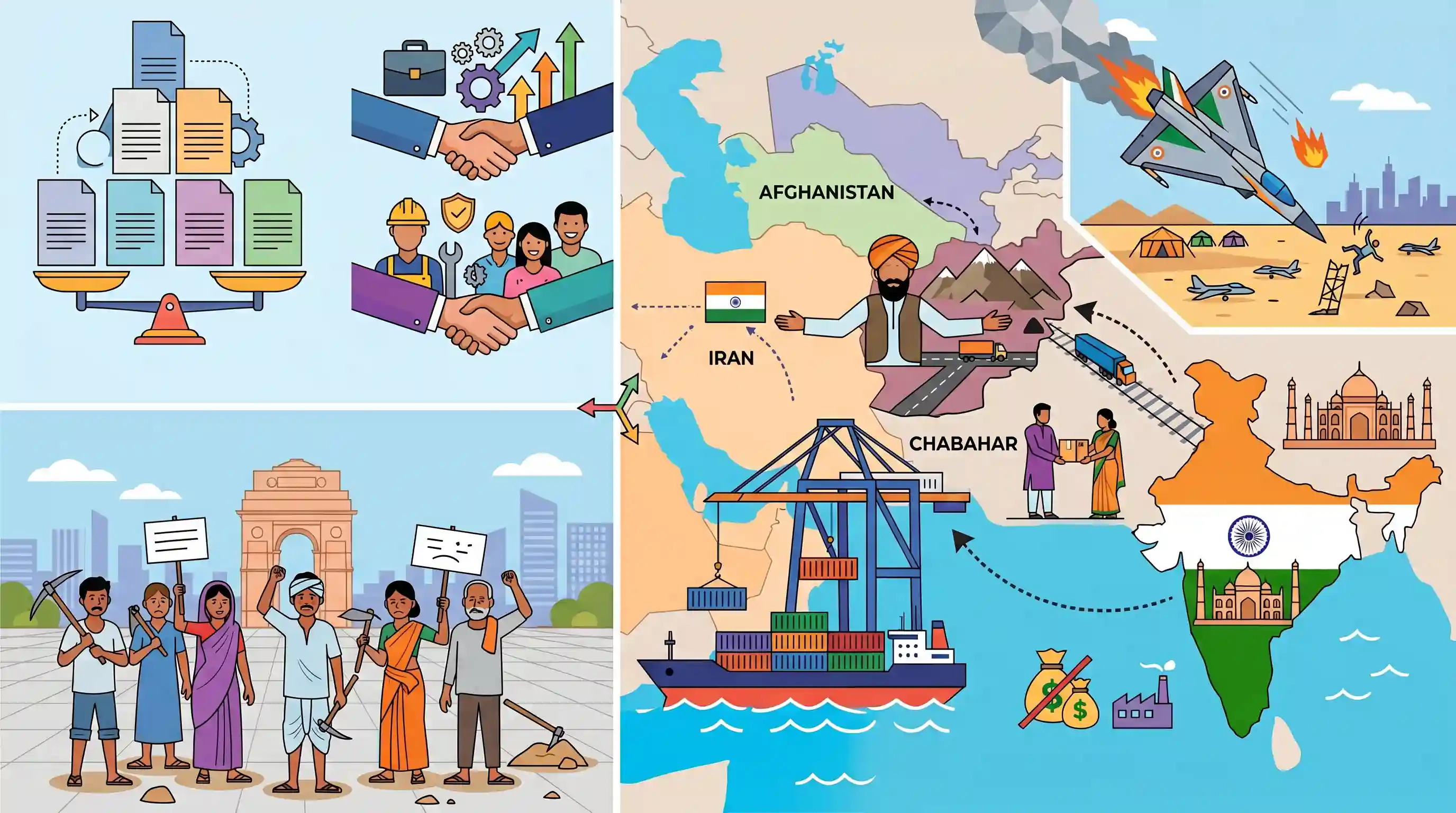
This news digest covers significant domestic and international developments. Domestically, the four long-pending Labour Codes passed in 2020 have been implemented to boost ease of doing business and worker welfare. Meanwhile, MGNREGS workers protested in Delhi over reduced employment opportunities, and an IAF Tejas jet crashed at the Dubai Airshow, killing the pilot. On the international front, Afghanistan urged India to maximize the use of the Chabahar Port for trade, proposing tax exemptions to attract industrial investments.
Key Points
- The four comprehensive Labour Codes passed by Parliament in 2020 have officially come into effect, aimed at simplifying compliance, empowering workers, and promoting the Ease of Doing Business.
- Afghanistan's Commerce Minister urged India to expand the use of the Chabahar Port to maintain competitive trade routes, proposing a five-year tax exemption for arriving industries.
- MGNREGS workers from Haryana protested at Jantar Mantar over shrinking employment opportunities and the removal of certain tasks from the scheme's permissible works list.
- An IAF LCA Tejas fighter jet tragically crashed during a flying display at the Dubai Airshow 2025, resulting in the death of the pilot.
- Delhi's Education Minister mandated that all schools report on their compliance with CBSE guidelines concerning students' psychological well-being following a student's suicide.
Important Terms
Four Labour Codes

A legislative framework consolidating 29 central labor laws into four codes: Wages, Industrial Relations, Social Security, and Occupational Safety (OSHWC). They aim to simplify compliance and expand social security.
UPSC context
GS-II (Governance) and GS-III (Economy); tests labor market reforms, ease of doing business, and worker welfare.
MGNREGS
A 2005 social security act guaranteeing 100 days of annual wage employment to rural households, recently facing protests over reduced persondays and potential replacement by newer statutory missions.
UPSC context
GS-II (Social Justice) and GS-III (Economy); tests poverty alleviation, rural development, and statutory rights.
Chabahar Port
A deep-water port in Iran’s Sistan-Baluchestan province, strategically vital for India to access Afghanistan and Central Asia while bypassing Pakistan’s land routes.
UPSC context
GS-II (International Relations); tests strategic connectivity, trade diplomacy, and regional geopolitical interests.
LCA Tejas
India’s indigenously developed 4.5-generation, single-engine, delta-wing Light Combat Aircraft (LCA) designed by ADA and manufactured by HAL for the Indian Air Force.
UPSC context
GS-III (Science and Technology); tests indigenization of defense technology and "Aatmanirbhar Bharat" initiatives.
PHD Chamber of Commerce and Industry (PHDCCI)
A multi-state premier industry association established in 1905 that facilitates trade, investment, and policy advocacy between the government and private sector.
UPSC context
GS-III (Economy); tests the role of industry bodies in trade facilitation and economic diplomacy.
Prelims Trap
The four Labour Codes automatically replace all State-level labour laws and apply uniformly across India immediately upon Central notification.
Labour is in the Concurrent List. While the Centre enacted the Codes, State governments must also frame and notify their own rules for the Codes to be fully operationalized in their jurisdictions.
Static Concepts Connected
What are the core reform pillars introduced by India's newly implemented Labour Codes?
- Code on Wages: Universalizes minimum wages and timely payment for all workers, including those in the unorganized sector.
- Industrial Relations: Raises the threshold for establishments to lay off workers or close operations without prior government permission from 100 to 300 workers.
- Social Security: Provides a statutory framework to extend social safety nets (like ESIC and EPFO) to gig, platform, and unorganized workers.
What is the strategic significance of the Chabahar Port for India?
- Geographic Location: Located in Iran's Sistan-Baluchistan province on the Gulf of Oman, outside the Strait of Hormuz.
- Strategic Bypass: Provides India with a direct sea-land route to Afghanistan and Central Asia, completely bypassing Pakistani territory.
- INSTC Integration: Serves as a crucial node integrating with the International North-South Transport Corridor (INSTC) to reach Russian and European markets.
Cross-Topic Patterns
Social Security & the Gig Economy
The new Social Security Code uniquely targets the gig and platform economy, bridging traditional industrial relations with modern digital labour markets—a frequent Mains theme.
Ports as Geostrategic Leverage
Afghanistan's push for Chabahar highlights how strategic infrastructure (Chabahar/INSTC) acts as India's primary tool to circumvent hostile transit geographies (Pakistan) and counter China's BRI.
Defence Indigenization & Export Push
Showcasing the LCA Tejas at international venues like the Dubai Airshow reflects India's policy shift from being a primary arms importer to a net defence exporter targeting the Global South.

Expect a multi-statement question in 2026 testing specific provisions of the Social Security Code, particularly for gig/platform workers.
Linked PYQs · 5
Linked PYQs · 5
- 2024MainsGS3
Discuss the merits and demerits of the four 'Labour Codes' in the context of labour market reforms in India. What has been the progress so far in this regard?
- 2022MainsGS3
Economic growth in the recent past has been led by increase in labour productivity." Explain this statement. Suggest the growth pattern that will lead to creation of more jobs without compromising labour productivity.
- 2024MainsGS2
Critically analyse India's evolving diplomatic, economic and strategic relations with the Central Asian Republics (CARs) highlighting their increasing significance in regional and global geopolitics.
- 2018MainsGS2
A number of outside powers have entrenched themselves in Central Asia, which is a zone of interest to India. Discuss the implications, in this context, of India's joining the Ashgabat Agreement, 2018.
- 2014MainsGS2
The penetration of Self Help Groups (SHGs) in rural areas in promoting participation in development programmes is facing socio-cultural hurdles. Examine.
