Supreme Court Rules on Advisory Jurisdiction for Bills
Source:The Hindu ↗
Why It Matters
The article touches upon core polity issues frequently tested in UPSC, specifically the friction between State governments and Governors over pending bills and the limits of the Supreme Court's advisory jurisdiction. It also underscores internal security measures undertaken by central agencies like the NIA.
Summary
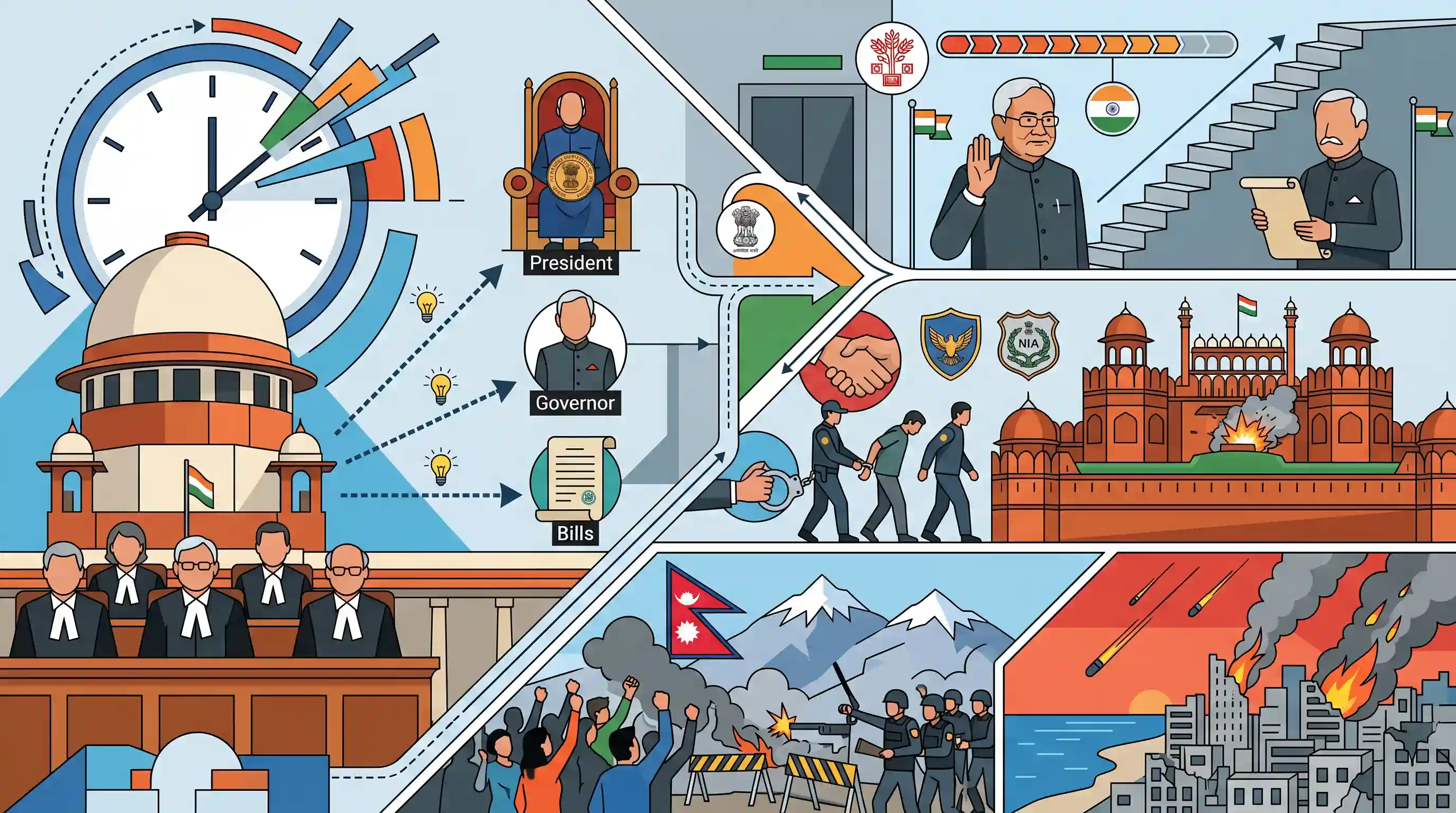
A round-up of the day's top news highlights the Supreme Court's stance that any timeline it suggests for the President and Governors to clear State Bills will be advisory under Article 143. Meanwhile, the NIA made significant arrests in the recent Red Fort blast case, and Nitish Kumar took oath as Bihar Chief Minister for the 10th time. International developments included unrest in Nepal and continued strikes in Gaza.
Key Points
- The Supreme Court stated that any opinion it gives on fixing a timeframe for the President and Governors to decide on State Bills will be advisory, as it falls under its advisory jurisdiction (Article 143).
- The National Investigation Agency (NIA) arrested four prime accused in connection with the November 10 blast outside the Red Fort, targeting terror financing and logistics networks.
- Nitish Kumar was sworn in as the Chief Minister of Bihar for a record 10th time.
- International events included the reimposition of curfew in Nepal's Sunsari district after community clashes and the death of four Palestinians in an Israeli strike in Gaza.
Important Terms
Article 143 of the Constitution of India

Article 143 empowers the President of India to refer significant questions of law or fact to the Supreme Court for its advisory opinion, which is not legally binding.
UPSC context
GS Paper II (Polity); tests understanding of the Judiciary’s advisory role and Executive-Judiciary relations.
Article 200 of the Constitution of India
Outlines the Governor's options when a State Bill is presented: granting assent, withholding it (must return for reconsideration), or reserving it for the President’s consideration.
UPSC context
GS Paper II; critical for Center-State relations and the discretionary powers of the Governor.
Article 201 of the Constitution of India
Specific powers of the President regarding State Bills reserved by a Governor; the President may grant assent, withhold it, or direct the Governor to return the Bill.
UPSC context
GS Paper II; relates to the federal balance and the President's role in the legislative process.
National Investigation Agency (NIA)
India’s premier central counter-terrorism agency, established under the NIA Act, 2008, to investigate offenses affecting national security across states without needing specific state consent.
UPSC context
GS Paper III (Internal Security); tests knowledge of institutional frameworks for counter-terrorism and federal investigative powers.
Deemed Assent
A legal doctrine, recently rejected by the Supreme Court, which would have automatically treated a Bill as approved if constitutional authorities failed to act within a specific timeframe.
UPSC context
GS Paper II; relevant for debates on judicial activism vs. judicial restraint and the legislative process.
Separation of Powers
A constitutional principle ensuring the three branches of government—Legislature, Executive, and Judiciary—operate independently to prevent the concentration of power and maintain checks and balances.
UPSC context
GS Paper II; fundamental concept in the Indian Constitution’s basic structure and inter-organ relationships.
Prelims Trap
The Constitution prescribes a fixed timeline for the Governor to either grant assent or reserve a State Bill for the President.
Article 200 uses 'as soon as possible' only for returning non-money bills, but sets absolutely no quantifiable timeline for granting, withholding, or reserving assent.
Static Concepts Connected
What are the key features of the Supreme Court's Advisory Jurisdiction (Article 143)?
- Presidential Reference: The President can refer questions of law or fact of public importance, or disputes arising out of pre-constitution treaties, to the Supreme Court.
- Non-binding nature: The opinion delivered by the Supreme Court is strictly advisory and does not legally bind the President or the Government.
- Refusal to opine: The SC may decline to opine on general public importance questions, but it is constitutionally bound to opine on pre-constitution treaty disputes.
How did the 2019 NIA Amendment Act expand the agency's jurisdiction?
- Extraterritorial reach: Empowered the NIA to investigate scheduled terror offences committed against Indian interests outside India, subject to international treaties and domestic laws of other countries.
- New scheduled offences: Added cyber-terrorism, human trafficking, counterfeit currency, and Explosive Substances Act violations to its scheduled list of offences.
- Suo motu power: Retains the original 2008 power to investigate scheduled offences across India without requiring prior permission or consent from state governments.
Cross-Topic Patterns
Governor's discretion vs. State Federalism
The friction over Article 200 is often linked to Sarkaria and Punchhi Commission recommendations on federalism, where indefinitely pending state bills stall state legislative agendas and welfare schemes.
Central Agencies vs. Police (State List)
The NIA's suo motu powers without state consent consistently clash with exclusive state police jurisdictions (Entry 2, State List), making internal security a hotspot for constitutional federalism debates.

Expect a multi-statement question on Articles 200/201 and 143, focusing on the absence of constitutional timelines for Governor assent.
Linked PYQs · 3
Linked PYQs · 3
- 2019MainsGS3
Indian Government has recently strengthened the anti-terrorism laws by amending the Unlawful Activities (Prevention) Act (UAPA), 1967 and the NIA Act. Analyze the changes in the context of prevailing security environment while discussing the scope and reasons for opposing the UAPA by human rights organizations.
- 2025PrelimsGS1
Consider the following statements : I. The Constitution of India explicitly mentions that in certain spheres the Governor of a State acts in his/her own discretion. II. The President of India can, of his/her own, reserve a bill passed by a State Legislature for his/her consideration without it being forwarded by the Governor of the State concerned. Which of the statements given above is/are correct?
- 2025PrelimsGS1
Consider the following subjects under the Constitution of India : I. List I-Union List, in the Seventh Schedule II. Extent of the executive power of a State III. Conditions of the Governor's office For a constitutional amendment with respect to which of the above, ratification by the Legislatures of not less than one-half of the States is required before presenting the bill to the President of India for assent?
