Industrial Disputes Act definition and preventive detention updates
Source:The Hindu ↗
Why It Matters
This daily brief encapsulates critical intersections of domestic governance (preventive detention laws, labour law interpretations by a Constitution Bench) and strategic international relations (energy security vulnerabilities linked to the Strait of Hormuz). It provides direct case studies for GS2 Polity and IR, as well as GS3 Energy Security topics.
Summary
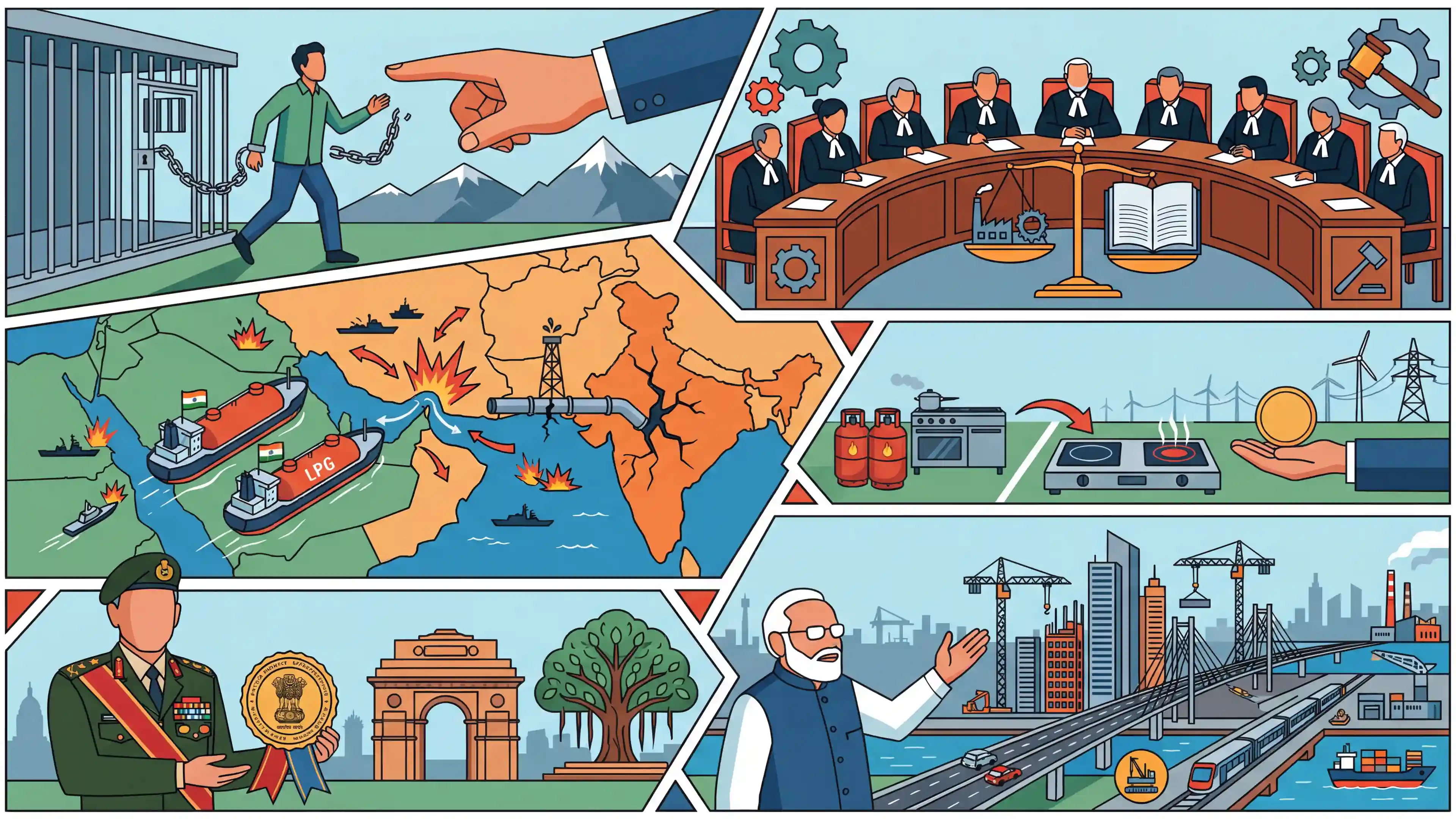
The day's top news covers a wide spectrum of national and international developments with significant governance and strategic implications. Domestically, the Central Government revoked the NSA detention of Sonam Wangchuk, and a nine-judge Supreme Court bench began deliberating the definition of 'industry' under the Industrial Disputes Act. Meanwhile, India's energy security faced a stress test as two Indian LPG vessels navigated the volatile Strait of Hormuz amid Middle East tensions. Responding to the LPG crisis, Tamil Nadu offered electricity subsidies to commercial kitchens adopting electric stoves. In political developments, Lt Gen (Retd) Syed Ata Hasnain became Bihar's Governor, and PM Modi launched major infrastructure projects in West Bengal.
Key Points
- The Central Government revoked the preventive detention of Sonam Wangchuk under the National Security Act (NSA).
- Two Indian LPG vessels safely navigated the Strait of Hormuz despite geopolitical tensions in the Middle East, averting an immediate supply crisis.
- A nine-judge Supreme Court Constitution Bench began hearing arguments to clarify the definition of 'industry' under the Industrial Disputes Act.
- Tamil Nadu announced a ₹2-per-unit electricity subsidy for hotels and cloud kitchens transitioning to electric stoves due to the ongoing LPG crisis.
- Lt Gen (Retd) Syed Ata Hasnain was sworn in as the Governor of Bihar.
Important Terms
National Security Act (NSA)

A 1980 law empowering governments to detain individuals without trial for up to 12 months to prevent actions prejudicial to national security, public order, or essential supplies.
UPSC context
GS-II/III: Rights vs. State security. Tests understanding of preventive detention, Article 22 safeguards, and judicial oversight of executive power.
Industrial Disputes Act
A 1947 law regulating the investigation and settlement of disputes between employers and workers, focusing on industrial harmony, layoffs, and the legal definition of "industry."
UPSC context
GS-II/III: Social Justice/Economy. Vital for understanding labor reforms, administrative law, and the shifting judicial definitions of "industry."
Strait of Hormuz
A strategic maritime choke point between the Persian Gulf and the Gulf of Oman, through which nearly 20% of global oil and major Indian LPG/LNG imports pass.
UPSC context
GS-I/II: Geography & IR. Essential for analyzing India's energy security vulnerabilities and its strategic posture in the Middle East.
Preventive Detention
Detention without trial to prevent future offenses rather than punish past ones; restricted under Article 22 but allowed for reasons of national security and public order.
UPSC context
GS-II: Fundamental Rights. Tests the constitutional limits of state power (Article 22) and judicial protection of personal liberty.
Energy Security
The reliable and affordable supply of energy resources necessary for economic stability, often requiring the protection of global supply routes like maritime choke points.
UPSC context
GS-III: Economy/Security. Analyzes risks from geopolitical tensions, the importance of strategic reserves, and diversification of energy sources.
Governor
The President-appointed constitutional head of a state who acts as the executive head of the state government and a vital link between the Union and states.
UPSC context
GS-II: Federalism. Focuses on appointment (Article 155), discretionary powers, and the dual role of the Governor in Union-State relations.
Prelims Trap
The maximum period a person can be detained under the National Security Act is indefinite.
Article 22 mandates an Advisory Board review within three months. Furthermore, the NSA specifically caps the maximum period of preventive detention at 12 months.
Static Concepts Connected
What are the key geographical features of the Strait of Hormuz?
- Water bodies: It acts as a strategic maritime chokepoint connecting the Persian Gulf in the west to the Gulf of Oman and the Arabian Sea in the southeast.
- Bordering nations: The strait is bounded by Iran to the north and the Musandam Peninsula (shared by Oman and the UAE) to the south.
What constitutes the 'Triple Test' for an industry under the Industrial Disputes Act?
- Systematic activity: The enterprise must involve a systematic and organized activity, not merely a casual or isolated venture.
- Mutual cooperation: There must be active cooperation between the employer and employees to carry out the operations.
- Goods and services: The primary objective must be the production and distribution of goods or services to satisfy human wants.
Cross-Topic Patterns
Geopolitics forcing state energy shifts
The Strait of Hormuz LPG disruption directly triggered Tamil Nadu's subsidy for commercial electric stoves, linking international maritime security to sub-national energy transitions.
Labour codes and gig economy
The SC revisiting the 'industry' definition could dramatically alter modern employer-employee relationships, impacting the implementation of new Labour Codes and gig worker protections.

Middle East maritime chokepoints (Hormuz/Bab-el-Mandeb) paired with India's strategic petroleum reserves is a probable 2026 Prelims MCQ.
Linked PYQs · 5
Linked PYQs · 5
- 2023PrelimsGS1
Consider the following statements: 1. According to the Constitution of India, the Central Government has a duty to protect States from internal disturbances. 2. The Constitution of India exempts the States from providing legal counsel to a person being held for preventive detention. 3. According to the Prevention of Terrorism Act, 2002, confession of the accused before the police cannot be used as evidence. How many of the above statements are correct?
- 2025MainsGS2
"Energy security constitutes the dominant kingpin of India's foreign policy, and is linked with India's overarching influence in Middle Eastern countries.” How would you integrate energy security with India's foreign policy trajectories in the coming years?
- 2017MainsGS2
The question of India's Energy Security constitutes the most important part of India's economic progress. Analyze India's energy policy cooperation with West Asian countries.
- 2022PrelimsGS1
In India, which one of the following compiles information on industrial disputes, closures, retrenchments and lay-offs in factories employing workers ?
- 2017PrelimsGS1
The Trade Disputes Act of 1929 provided for
