Mexican Military Operation Eliminates Jalisco Cartel Leader
Source:The Hindu ↗
Why It Matters
This event is highly relevant for GS-3 Internal Security, providing a real-world case study of the complex nexus between transnational organized crime and terrorism (narco-terrorism). It also illustrates the critical role of international intelligence sharing in countering global drug cartels trafficking lethal substances like fentanyl, a growing geopolitical and security concern.
Summary
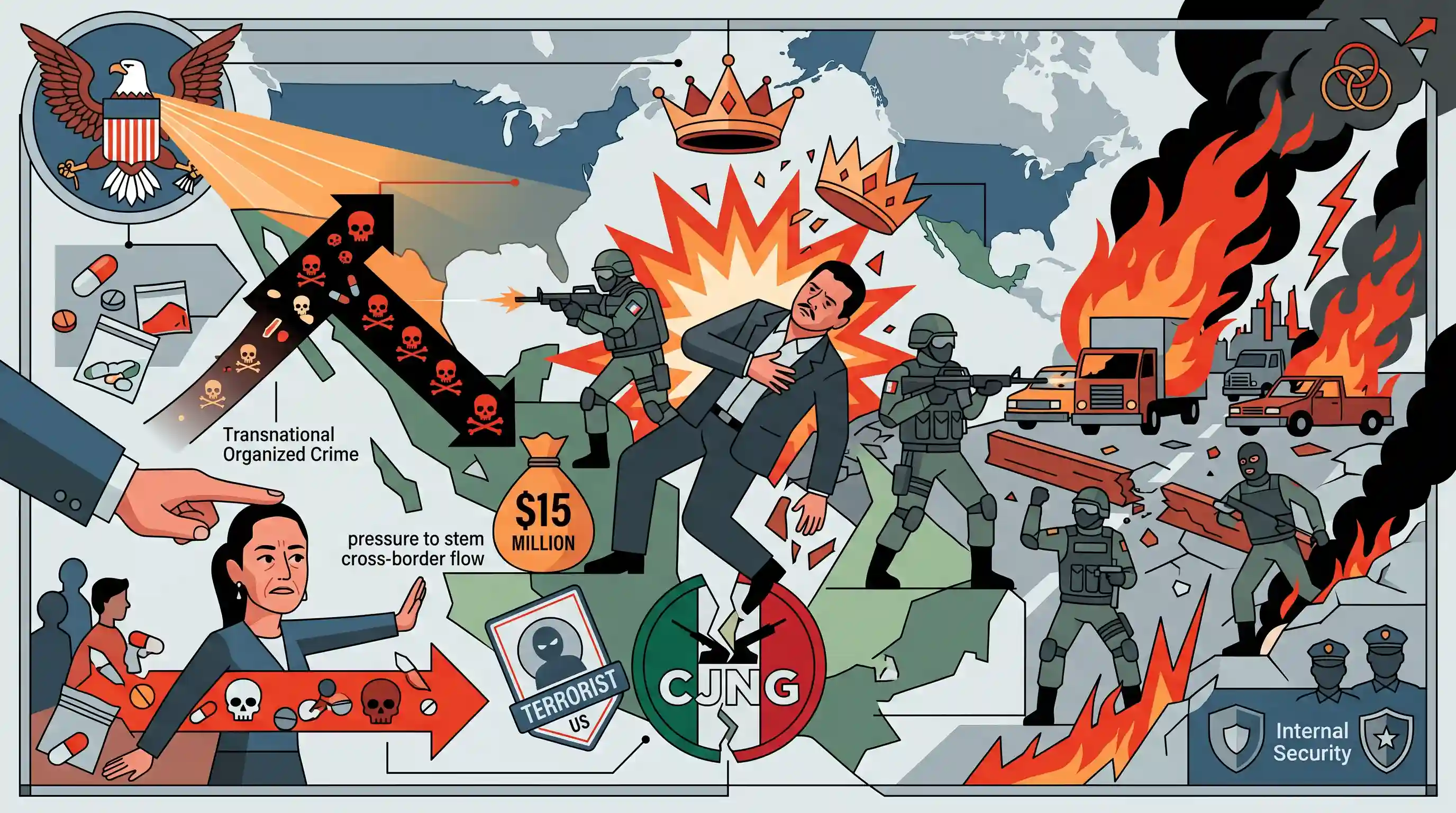
Nemesio Oseguera (alias 'El Mencho'), the leader of Mexico's powerful Jalisco New Generation Cartel (CJNG), was killed in a clash with Mexican soldiers. One of the most wanted fugitives with a $15 million US bounty, his death represents a massive blow to the cartel responsible for flooding the United States with deadly fentanyl. The military operation, which utilized intelligence shared by US authorities, sparked immediate narco-terrorist retaliation by cartel members who blockaded roads and torched vehicles. The US has designated the CJNG as a terrorist organization, highlighting the grave threat of transnational organized crime. The incident occurs against a backdrop of increasing US pressure on Mexican President Claudia Sheinbaum to stem the cross-border flow of illicit drugs and migrants.
Key Points
- Nemesio Oseguera, the elusive leader of the Jalisco New Generation Cartel (CJNG), was killed during a confrontation with the Mexican military.
- The CJNG is a major player in the global illicit drug trade, prominently trafficking fentanyl, cocaine, and methamphetamine into the United States.
- Cartel members employed narco-terrorism tactics in response to the military operation, blocking roads and setting vehicles on fire in multiple states.
- The successful military strike underscored the importance of cross-border intelligence sharing, as the operation utilized information provided by US authorities.
- The US classifies the CJNG as a terrorist organization, exemplifying the blending lines between transnational organized crime and terrorism.
Important Terms
Jalisco New Generation Cartel (CJNG)

A militarized Mexican criminal syndicate, designated as a terrorist organization, known for extreme violence and the mass production of synthetic drugs like fentanyl.
UPSC context
GS Paper 3: Internal Security. Tests knowledge of non-state actors, transnational threats, and challenges to state sovereignty.
Nemesio Oseguera ('El Mencho')
The co-founder and leader of the CJNG, killed in 2026; his death represents a critical turning point in global counter-narcotics efforts.
UPSC context
GS Paper 3: Internal Security. Relevant for case studies on kingpin strategies and their impact on organized crime stability.
Narco-terrorism
The nexus where drug trafficking funds terrorist activities or where traffickers use terror tactics to undermine government authority and protect illicit profits.
UPSC context
GS Paper 3: Linkages between organized crime and terrorism. A recurring theme in security-related questions.
Transnational Organized Crime (TOC)
Self-perpetuating criminal associations operating across borders to seek illegal profits, involving activities like drug smuggling, human trafficking, and money laundering.
UPSC context
GS Paper 3: Internal Security. Tests understanding of global security frameworks like UNTOC and cross-border crime linkages.
International Intelligence Cooperation
The collaborative sharing of sensitive data and strategic assets between national agencies to neutralize global security threats and high-value criminal targets.
UPSC context
GS Paper 2 & 3: International Relations/Internal Security. Examines bilateral security ties and multi-agency coordination in counter-terrorism.
Sinaloa Cartel
Historically Mexico's most powerful drug trafficking group and the primary rival of the CJNG, often cited in discussions on cartel fragmentation.
UPSC context
GS Paper 3: Internal Security. Useful for understanding the competitive dynamics of international drug networks.
Prelims Trap
Fentanyl is a highly potent plant-based opioid extracted from the opium poppy.
Fentanyl is a fully synthetic opioid manufactured in laboratories using precursor chemicals, unlike heroin or morphine which are naturally derived from the opium poppy.
Static Concepts Connected
What defines the 'Crime-Terror Nexus' in security parlance?
- Mutual Benefit: Terrorists gain autonomous funding via smuggling/extortion, while criminal syndicates gain access to military-grade weapons and tactical expertise.
- Tactic Blending: Cartels adopt terrorist tactics (narco-terrorism, mass arson) to paralyze governance, while terrorists use established organized crime networks for clandestine logistics.
- Exploiting Voids: Both thrive in ungoverned spaces and exploit porous borders, overwhelming conventional law enforcement frameworks.
How do synthetic drugs like Fentanyl differ from traditional narcotics?
- Lab-Manufactured: They are synthesized entirely in laboratories using dual-use precursor chemicals, severing reliance on crop cultivation and seasonal vulnerabilities.
- Hyper-Potency: Drugs like Fentanyl are 50-100 times more potent than morphine, triggering severe overdose epidemics even in micro-doses.
- Smuggling Logistics: Smaller physical volumes yield massive profits, making cross-border smuggling vastly easier to conceal from customs authorities.
Cross-Topic Patterns
Precursor diversion & API supply chains
The rise of synthetic drugs highlights the vulnerability of pharmaceutical supply chains. India’s vast API sector faces similar regulatory burdens under the NDPS Act to prevent dual-use chemical diversion.
Narco-terrorism & asymmetric warfare
Cartels adopting road blockades and arson mirror asymmetric tactics used in Left-Wing Extremism (LWE). Profit-driven syndicates increasingly deploy political terror to erode state authority and secure illicit corridors.

Expect a GS3 Mains question on how the shift from plant-based narcotics to synthetic drugs alters border management and the crime-terror nexus.
Linked PYQs · 2
Linked PYQs · 2
- 2022MainsGS3
Discuss the types of organised crimes. Describe the linkages between terrorists and organised crime that exist at the national and transnational levels.
- 2024MainsGS3
Explain how narco-terrorism has emerged as a serious threat across the country. Suggest suitable measures to counter narco-terrorism.
