Security Forces Neutralize Senior Maoist Leader in Bastar Division
Source:Indian Express ↗
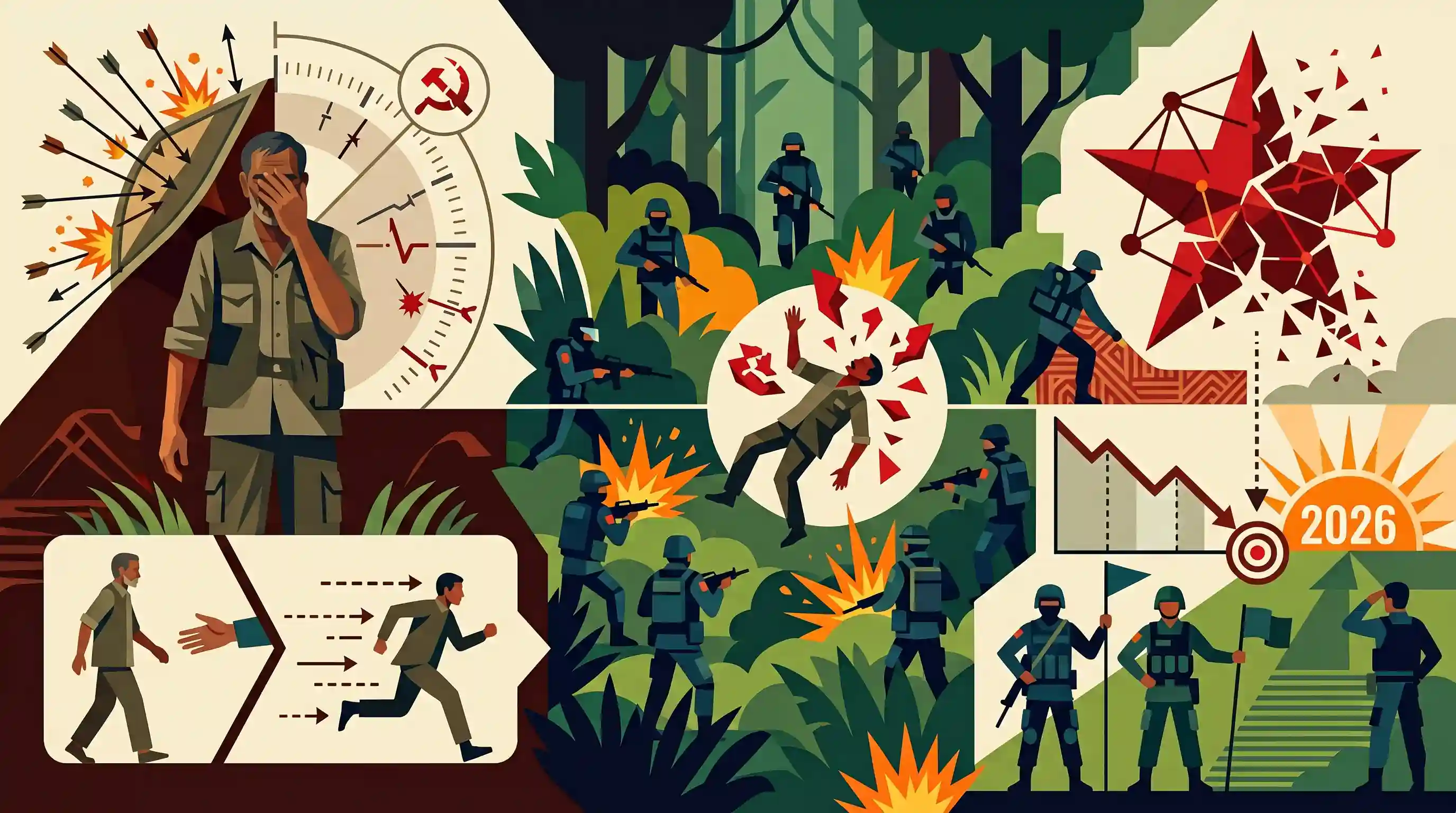
Why It Matters
This event is a live case study of the challenges in counter-insurgency operations (the geographical hurdle of Abujhmarh) and the practical difficulties of executing Surrender and Rehabilitation policies for hardcore Maoists. It is highly relevant for GS3 Internal Security questions regarding the government's strategy to eradicate LWE by 2026.
Summary
Top Maoist leader Prabhakar, alias 'Padakala Swamy', was killed in an encounter in the Abujhmarh region of Chhattisgarh. A hardened veteran who had survived 40 ambushes, Prabhakar had surprisingly attempted to surrender in 2025 but fled before the process could be finalized. His death deals a severe blow to the Maoist insurgency in the Dandakaranya region and represents a major operational success for security forces as they push to meet the government's target of eliminating Left Wing Extremism (LWE) by 2026.
Key Points
- Prabhakar, a high-ranking Maoist leader who had survived around 40 ambushes over decades, was killed in an operation in Chhattisgarh's Abujhmarh region.
- Known by his alias 'Padakala Swamy', the Maoist veteran was a significant figure in the Left Wing Extremism (LWE) leadership.
- He had reportedly initiated a surrender process in 2025 but fled instead, shedding light on the complexities and trust deficits involved in the surrender and rehabilitation framework.
- His elimination is a major strategic victory for security forces operating in unmapped strongholds like Abujhmarh, aligning with the Union Government's goal to eliminate LWE by 2026.
Important Terms
Left Wing Extremism (LWE)

Armed insurgency by groups like CPI (Maoist) aiming to overthrow the Indian state through violent revolution, rooted in socio-economic grievances and Maoist ideology.
UPSC context
GS III Internal Security; tests understanding of the 'Red Corridor,' its causes, and the government's multi-pronged response strategy.
Surrender and Rehabilitation Policy
A government framework offering incentives like cash, land, and vocational training to encourage insurgents to renounce violence and reintegrate into mainstream society.
UPSC context
GS III Internal Security; relevant for 'winning hearts and minds' strategies and socio-economic measures to counter extremism.
Abujhmarh
A rugged, unsurveyed forest region in Chhattisgarh's Bastar division; historically an impregnable 'liberated zone' and a central logistics base for top Maoist leadership.
UPSC context
GS III Internal Security; signifies geographical challenges in counter-insurgency and the shift toward proactive ingress by security forces.
Dandakaranya
A vast forest region spanning Chhattisgarh, Odisha, and Telangana; serves as a strategic guerrilla base and administrative unit for the Maoist insurgency.
UPSC context
GS III/Geography; tests knowledge of the historical heartland of Naxalism and challenges of inter-state security coordination.
Maoism
A revolutionary communist ideology emphasizing the capture of state power through 'protracted people's war,' armed peasant rebellion, and mass mobilization.
UPSC context
GS I World History/GS III Security; tests the ideological roots of internal threats and the evolution of the Naxalite movement.
Prelims Trap
"Abujhmarh is a highly strategic plateau region situated in the Eastern Ghats of Andhra Pradesh."
Aspirants confuse the broader inter-state spread of the Dandakaranya region with Abujhmarh. Abujhmarh is specifically located in the Bastar division of southern Chhattisgarh.
Static Concepts Connected
What is the SAMADHAN doctrine for combating Left Wing Extremism?
- S-A-M-A: Smart Leadership, Aggressive Strategy, Motivation and Training, and Actionable Intelligence.
- D-H-A-N: Dashboard Based KPIs, Harnessing Technology, Action plan for each Theatre, and No access to Financing.
- Strategic Shift: Represents a shift from purely reactive military operations to a proactive, integrated security-and-development governance approach.
What is the geographical and demographic significance of the Abujhmarh region?
- Geography: A rugged, heavily forested 4,000 sq km plateau in Chhattisgarh's Bastar division, geographically isolated by the Indravati river.
- PVTG Demographics: Home to the Abujhmaria (or Hill Marias), recognized as one of India's 75 Particularly Vulnerable Tribal Groups (PVTGs).
- Administrative Void: Historically termed the 'unknown hill', it remained a revenue-unsurveyed territory for decades, providing natural cover for insurgents.
Cross-Topic Patterns
LWE Geography + Mineral Belts
The shrinking 'Red Corridor' precisely overlays India's richest iron ore and coal belts. UPSC often blends internal security queries with regional resource geography.
Counter-Insurgency vs. Tribal Rights (FRA/PESA)
Security operations in PVTG areas like Abujhmarh frequently overlap with debates on the Forest Rights Act (FRA 2006) and PESA, balancing state control with tribal autonomy.

Expect a 2026 Prelims question mapping LWE eradication targets (SAMADHAN), SRE scheme funding, and PVTG geography like Abujhmarh.
Linked PYQs · 4
Linked PYQs · 4
- 2025MainsGS3
The Government of India recently stated that Left Wing Extremism (LWE) will be eliminated by 2026. What do you understand by LWE and how are the people affected by it? What measures have been taken by the government to eliminate LWE?
- 2022MainsGS3
Naxalism is a social, economic and developmental issue manifesting as a violent internal security threat. In this context, discuss the emerging issues and suggest a multilayered strategy to tackle the menace of Naxalism.
- 2018MainsGS3
Left Wing Extremism (LWE) is showing a downward trend, but still affects many parts of the country. Briefly explain the Government of India's approach to counter the challenges posed by LWE.
- 2015MainsGS3
The persisting drives of the Government for development of large industries in backward areas have resulted in isolating the tribal population and the farmers who face multiple displacements. With Malkangiri and Naxalbari foci, discuss the corrective strategies needed to win the Left Wing Extremism (LWE) doctrine affected citizens back into the mainstream of social and economic growth.
