Union Budget 2026 Focuses on Infrastructure and Growth
Source:Indian Express ↗
Why It Matters
The Union Budget is a foundational policy document for UPSC aspirants. It highlights the government's economic priorities, capital expenditure trends, schemes for MSMEs and marginalized sections, and emerging focus areas like CCUS and traditional medicine, which are frequently tested across Prelims and Mains (GS2 and GS3).
Summary
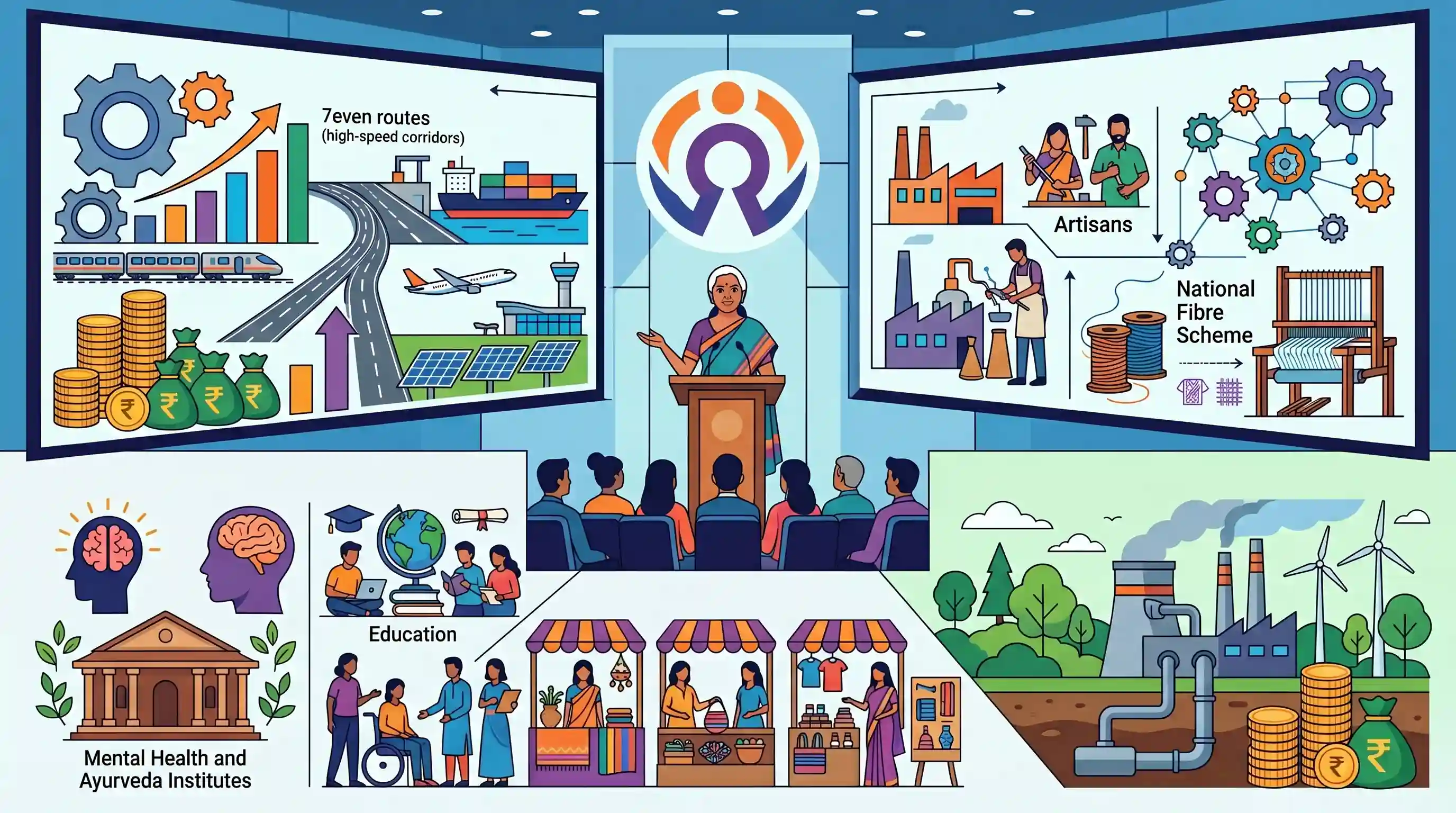
Finance Minister Nirmala Sitharaman presented the Union Budget 2026-27, outlining key interventions across manufacturing, legacy industries, MSMEs, and infrastructure. Major announcements included a boost in public capital expenditure to Rs 12.2 lakh crore, the development of seven high-speed corridors, and significant investments in MSME support like the National Fibre Scheme. The budget also focused on human development and sustainability through the establishment of new Ayurveda and mental health institutes, the creation of Self-Help Entrepreneur (SHE) Marts for women, and a Rs 20,000 crore allocation for Carbon Capture Utilization and Storage (CCUS).
Key Points
- The Union Budget 2026-27 prioritizes three 'Kartavyas': economic growth, capacity building, and inclusive access to resources.
- Public capital expenditure has been raised to Rs 12.2 lakh crore, with announcements of seven high-speed intercity corridors.
- Support for MSMEs includes a Rs 4,000 crore top-up for the Self Reliance India Fund and the launch of the National Fibre Scheme.
- Significant health and social initiatives include three new All India Institutes of Ayurveda, Nimhans-2 in North India, and a girls' hostel in every district.
- Rs 20,000 crores have been allocated towards Carbon Capture Utilization and Storage (CCUS) technologies.
Important Terms
National Fibre Scheme

A Budget 2026-27 initiative aiming for self-reliance in natural (silk, wool, cotton) and man-made fibers. It seeks to reduce imports by 22% by FY31 through fiscal incentives and duty rationalization.
UPSC context
GS Paper III: Indian Economy/Industry. Relevant for industrial policy, import substitution, and the textile sector's role in global manufacturing.
Self-Help Entrepreneur (SHE) Marts
Community-owned retail outlets established within Cluster-Level Federations (CLFs) for women SHG members. They facilitate the transition from credit-based livelihoods to enterprise ownership through direct market access and branding support.
UPSC context
GS Paper II: Social Justice/Women Empowerment. Tests knowledge of women-led development and institutional frameworks for rural financial independence.
Mahatma Gandhi Gram Swaraj Initiative
A 2026-27 Budget umbrella framework designed to revitalize khadi, handloom, and handicrafts. It focuses on modernizing production, global branding, and creating market linkages for rural artisans and youth.
UPSC context
GS Paper III: Rural Development. Tests understanding of Gandhian economic principles, rural livelihoods, and the modernization of traditional cottage industries.
Carbon Capture Utilization and Storage (CCUS)
Technology that captures CO2 emissions from industrial sources for reuse or permanent underground storage. Budget 2026-27 allocated ₹20,000 crore to scale this in "hard-to-abate" sectors like steel and cement.
UPSC context
GS Paper III: Environment/Climate Change. Crucial for understanding industrial decarbonization strategies and India's commitment to "Net Zero 2070."
Self-Reliant India (SRI) Fund
A ₹50,000 crore Category-II Alternative Investment Fund (AIF) providing equity infusion to high-potential MSMEs. It uses a "Mother-Daughter" fund structure to help units graduate into large-scale enterprises.
UPSC context
GS Paper III: Economy. Relevant for MSME financing, equity instruments, and the Atmanirbhar Bharat industrial strategy.
MSME
Enterprises classified by investment and turnover (e.g., Small: investment ≤₹10cr, turnover ≤₹50cr). Budget 2026-27 doubled their allocation and introduced a ₹10,000 crore SME Growth Fund.
UPSC context
GS Paper III: Economy. A core pillar of growth, employment generation, and India's export-led industrial policy.
All India Institute of Ayurveda
An apex autonomous institute under the Ministry of Ayush. The 2026-27 Budget proposed new regional institutes to integrate traditional medicine with modern healthcare research and clinical standards.
UPSC context
GS Paper II: Social Sector/Health. Tests knowledge of pluralistic healthcare systems and the institutionalization of traditional medicine.
Prelims Trap
The Self Reliance India (SRI) Fund was created to provide sovereign debt restructuring for large public sector enterprises.
The SRI Fund is specifically designed to provide equity funding to MSMEs using a mother-daughter fund structure, not for rescuing large corporate or sovereign debt.
Static Concepts Connected
What constitutes Capital Expenditure (Capex) in the Union Budget?
- Asset Creation: Expenditure resulting in the creation of physical, financial, or intellectual assets (e.g., roads, hospitals, machinery, equity shares).
- Liability Reduction: Funds utilized for the repayment of past loans and borrowings taken by the government.
- Macroeconomic Impact: Capex has a higher multiplier effect on long-term economic growth compared to revenue expenditure, which covers daily administration.
How does Carbon Capture, Utilization, and Storage (CCUS) work?
- Capture: Separating CO2 from emissions at large industrial point sources like steel, cement, and power plants (hard-to-abate sectors).
- Utilization: Converting captured CO2 into commercially viable products, such as urea, synthetic fuels, or building materials.
- Storage: Injecting the remaining CO2 deep underground into geological formations for permanent sequestration and isolation from the atmosphere.
Cross-Topic Patterns
MSME equity & Alternative Investment Funds (AIFs)
The SRI fund relies on SEBI-regulated Alternative Investment Funds. UPSC increasingly links MSME policy interventions with capital market instruments, moving beyond traditional Priority Sector Lending.
SHGs transitioning to rural market nodes
Self-Help Entrepreneur (SHE) Marts reflect a policy shift from merely providing micro-credit to SHGs (like Lakhpati Didi) toward creating dedicated forward market linkages.
CCUS & hard-to-abate industrial sectors
The massive ₹20,000 crore CCUS push links India's climate commitments (Panchamrit) directly to industrial policy, specifically targeting heavy industries like steel and cement.

CCUS applications in hard-to-abate sectors and the 'mother-daughter' AIF structure of the SRI Fund are prime targets for 2026 Prelims.
Linked PYQs · 5
Linked PYQs · 5
- 2023MainsGS3
Faster economic growth requires increased share of the manufacturing sector in GDP, particularly of MSMEs. Comment on the present policies of the Government in this regard.
- 2021MainsGS3
“Investment in infrastructure is essential for more rapid and inclusive economic growth.” Discuss in the light of India's experience.
- 2023PrelimsGS1
Consider the following activities: 1. Spreading finely ground basalt rock on farmlands extensively 2. Increasing the alkalinity of oceans by adding lime 3. Capturing carbon dioxide released by various industries and pumping it into abandoned subterranean mines in the form of carbonated waters How many of the above activities are often considered and discussed for carbon capture and sequestration?
- 2025PrelimsGS1
With reference to 'Direct Air Capture', an emerging technology, which of the following statements is/are correct? I. It can be used as a way of carbon sequestration. II. It can be a valuable approach for plastic production and in food processing. III. In aviation, it can be a source of carbon for combining with hydrogen to create synthetic low-carbon fuel. Select the correct answer using the code given below.
- 2023MainsGS2
The crucial aspect of development process has been the inadequate attention paid to Human Resource Development in India. Suggest measures that can address this inadequacy.
