Corporate Concentration and Market Power of Family Businesses
Source:The Hindu ↗
આ શા માટે મહત્વનું છે
This article provides crucial empirical evidence for the mains economy syllabus regarding the structure of corporate India, the impact of economic reforms/liberalization, and the ongoing debate surrounding wealth concentration versus rapid industrial growth. It directly links to the constitutional ideal of preventing the concentration of wealth to the common detriment (Article 39(c)) and raises critical questions about competition regulations and the efficacy of 'national champion' economic policies in India.
સારાંશ
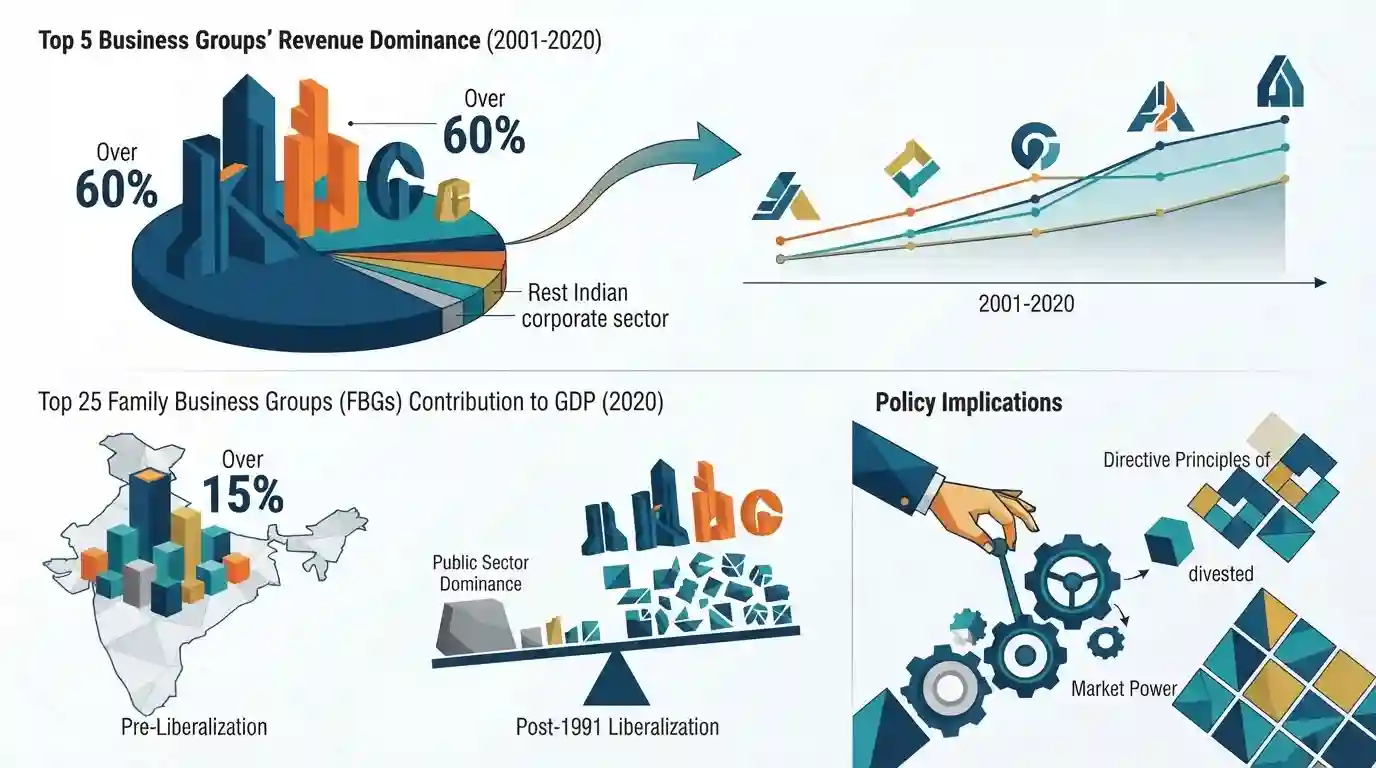
A study published in the World Bank Economic Review titled 'Business Groups, Concentration and Market Power in India' reveals that the top five family business groups—Reliance, Adani, Birla, Om Prakash Jindal, and Tata—controlled over 60% of India's corporate business revenue between 2001 and 2020. Although post-1991 economic liberalisation and the shrinkage of the public sector reduced aggregate market concentration, large family business groups (FBGs) continue to dominate, with the top 25 FBGs constituting over 15% of India's GDP in 2020. The authors highlight the role of the government's 'national champions' policies and suggest setting strict limits on market shares combined with mandatory divestment to curb entrenched market power.
મુખ્ય મુદ્દા
- The study 'Business Groups, Concentration and Market Power in India', published in the World Bank Economic Review, shows that five major family business groups (Reliance, Adani, Birla, Om Prakash Jindal, and Tata) controlled more than 60% of corporate business revenue between 2001 and 2020.
- Between 2001 and 2020, the income shares of Reliance and Adani Groups consistently remained above 20%, whereas the shares of Om Prakash Jindal and Tata Groups grew steadily but remained below 10%. Conversely, Birla Group's share steadily declined.
- Economic liberalisation has successfully introduced competitiveness and reduced overall market concentration, primarily due to the shrinking footprint of the public sector. However, the top 25 family business groups still accounted for more than 15% of India's GDP in 2020.
- At the subsector level (NIC-3 classification), high corporate concentration persists, with the top five firms controlling more than half of the revenues in approximately 74% of industries.
- The study points to the government's policy of promoting 'national champions' (specifically during the 2000-2013 period) as a major driver behind the concentration of market power.
- Conventional regulatory remedies such as competition policy and taxation have shown limited effectiveness. The authors suggest exploring structural options, including placing hard limits on maximum market shares and enforcing mandatory divestment when those limits are exceeded.
મહત્વપૂર્ણ શબ્દો
National Champions Policy

An industrial strategy where the government actively supports select large domestic business groups, helping them dominate the domestic market and compete globally. The study notes this may have fueled market concentration in India.
UPSC context
GS3 (Industrial Policy) & GS2 (DPSP Art 39c). Tests understanding of market monopolies versus inclusive economic competition.
National Industrial Classification (NIC-3)
India's official statistical framework for categorizing economic activities. 'NIC-3' refers to the three-digit level of this code, widely used by researchers to analyze specific industrial sectors and measure market concentration.
UPSC context
GS3 (Indian Economy). Relevant for understanding how the government statistically measures sectoral growth, GDP, and industrial dominance.
World Bank
An international financial institution providing loans and expertise to developing nations. It publishes the World Bank Economic Review, a leading peer-reviewed journal featuring rigorous quantitative research on development economics and market structures.
UPSC context
GS2 (Important International Institutions). Tests awareness of major global agencies, their structural mandates, and authoritative reports influencing economic policy.
Tata Group
One of India's largest and oldest multinational conglomerates. It was identified in the study as one of the top five family business groups controlling over 60% of corporate business revenue between 2001 and 2020.
UPSC context
GS3 (Indian Economy). Acts as a primary case study for understanding the dominance of family business groups (FBGs) and market monopolization.
પ્રિલિમ્સ ટ્રેપ
The top five family business groups in India control over 60% of the country's Gross Domestic Product (GDP).
The 60% figure applies strictly to corporate business revenue, not GDP. The top 25 family groups account for 15% of India's GDP.
સંલગ્ન સ્થિર ખ્યાલો
How did the Competition Act, 2002 shift India's regulatory philosophy from the MRTP Act, 1969?
- Philosophy Shift: MRTP targeted firm size and penalized monopolies per se; the Competition Act permits size but prohibits 'abuse of dominant position'.
- Institutional Change: Replaced the MRTP Commission with the Competition Commission of India (CCI) possessing modern regulatory and extraterritorial powers.
- Three Pillars: Focuses on anti-competitive agreements, abuse of dominance, and regulating combinations (mergers & acquisitions) above specified thresholds.
What is the constitutional scope and legal status of Article 39(c) of the DPSP?
- Core Mandate: Mandates the State to secure that the operation of the economic system does not result in the concentration of wealth.
- Means of Production: Requires the State to prevent the concentration of means of production to the common detriment.
- Article 31C Shield: Under Article 31C, laws giving effect to Article 39(b) and (c) cannot be declared void for violating Articles 14 or 19.
આંતર-વિષય પેટર્ન
DPSP Article 39(c) vs Fundamental Rights
Connects wealth-concentration limits to the constitutional history of Article 31C, property rights, and the judicial review of welfare legislation.
National Champions & systemic banking risks
Examines how concentrated infrastructure ownership creates 'too-big-to-fail' entities, amplifying public sector bank exposure to corporate debt defaults.

Mains questions may contrast Article 39(c) goals with CCI’s regulatory shift from targeting size to penalizing abuse of dominance.
સંલગ્ન PYQ · 3
સંલગ્ન PYQ · 3
- 2021PrelimsGS1
Under the Indian Constitution, concentration of wealth violates
- 2013MainsGS3
Examine the impact of liberalization on companies owned by Indians. Are they competing with the MNCs satisfactorily? Discuss.
- 2017MainsGS3
What are the salient features of 'inclusive growth'? Has India been experiencing such a growth process? Analyse and suggest measures for inclusive growth.
