Judicial Intervention in Biodiversity and Renewable Energy Conflicts
Source:The Hindu ↗
Why It Matters
This article is critical for understanding the 'green vs. green' debate (renewable energy expansion vs. biodiversity conservation) and the broader implications of judicial activism in environmental policymaking. It provides excellent fodder for GS2 (Judicial functioning, Constitutionalization of environmental problems) and GS3 (Conservation, Climate Change).
Summary
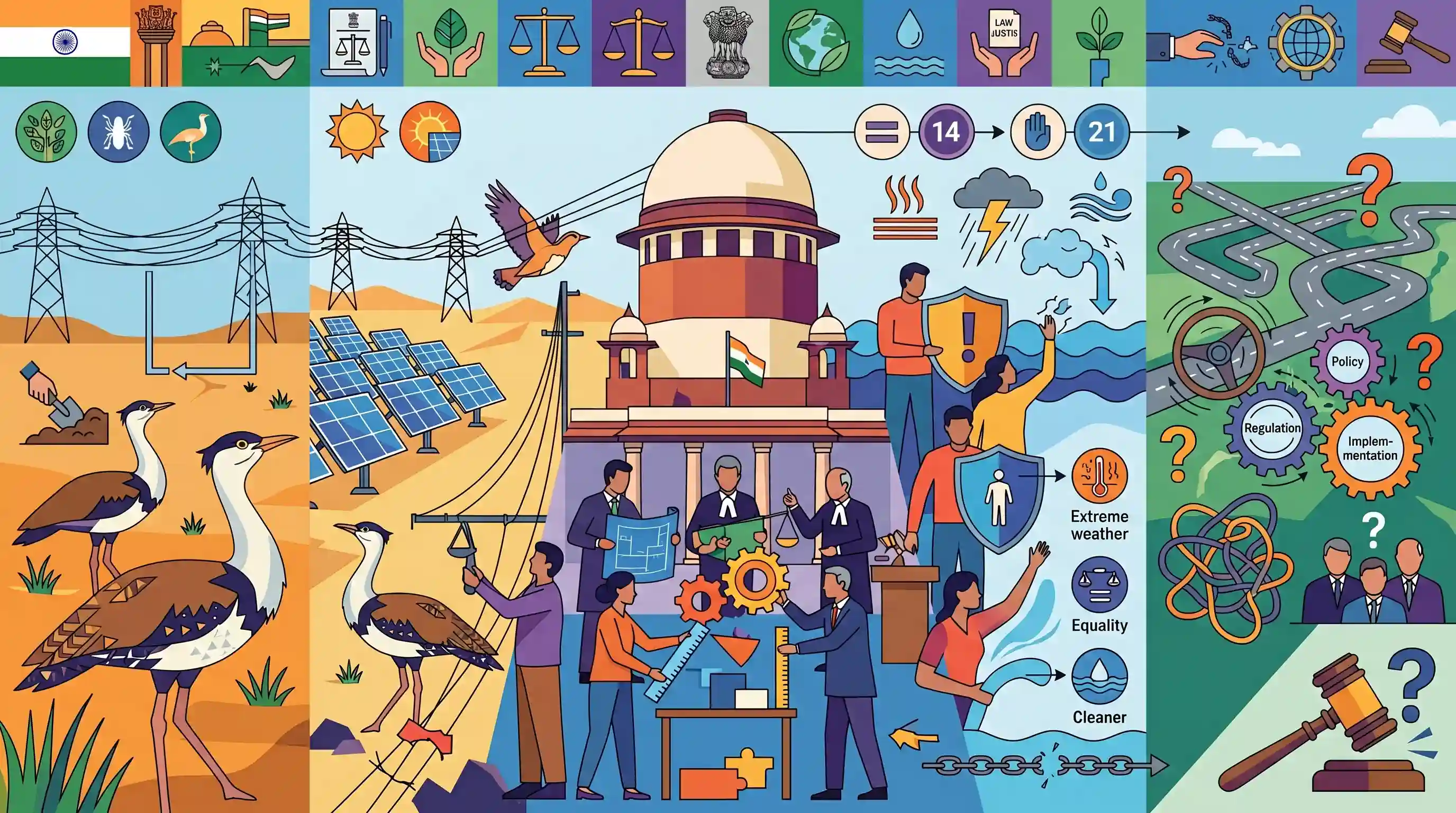
The article analyzes the Supreme Court of India's evolving environmental jurisprudence, prompted by a recent landmark ruling that recognized the right against the adverse effects of climate change. The case centered on a conflict between biodiversity conservation (protecting the critically endangered Great Indian Bustard) and climate change mitigation (expanding solar power infrastructure in Rajasthan and Gujarat). The Court opted to modify its earlier order requiring the undergrounding of power lines, instead appointing a committee to balance these competing 'green' interests. While the expansion of rights under Articles 14 and 21 is notable, the article contends that such judicial interventions in complex executive policy matters generate regulatory uncertainty and unpredictability in India's environmental governance.
Key Points
- The Supreme Court's recent judgment recognized the fundamental right against the adverse effects of climate change, anchoring it within Articles 14 (Right to Equality) and 21 (Right to Life) of the Constitution.
- The ruling emerged from a 'green vs. green' dilemma, requiring the Court to balance the conservation of the critically endangered Great Indian Bustard with the development of solar energy infrastructure in Rajasthan and Gujarat.
- By modifying a prior mandate to underground all high-voltage power lines, the Court accommodated the practical and financial realities of solar power producers and India's international climate commitments.
- The author argues that frequent judicial shifts and ad-hoc interventions in complex environmental policymaking create regulatory unpredictability and uncertainty for stakeholders.
- The Court's reliance on a newly constituted expert committee underscores the ongoing trend of judicial overreach into executive domains concerning environmental and economic governance.
Important Terms
Right against the adverse effects of climate change

A fundamental right recognized by the Supreme Court in 2024, derived from Articles 21 and 14, asserting constitutional protection against climate-related health, livelihood, and environmental risks.
UPSC context
GS Paper 2/3: Tests understanding of the 'living constitution' and the judiciary’s role in addressing global environmental crises.
Article 21 (Right to Life)
Guarantees the right to life and personal liberty. The Supreme Court interprets this broadly to include the right to a clean environment and protection from climate impacts.
UPSC context
GS Paper 2 (Fundamental Rights): Essential for understanding environmental jurisprudence and the expansion of the 'Right to Life' doctrine.
Great Indian Bustard (GIB)
A 'Critically Endangered' bird species (IUCN) native to India. Its conservation involves restricting overhead power lines, creating a conflict with renewable energy expansion in Rajasthan and Gujarat.
UPSC context
GS Paper 3 (Biodiversity): Tests knowledge of endangered species, conservation challenges, and human-wildlife-infrastructure conflicts.
Judicial Activism
A philosophy where the judiciary takes a proactive role in policy-making to protect fundamental rights, often stepping in when the executive or legislature fails to act.
UPSC context
GS Paper 2 (Judiciary): Critical for analyzing the separation of powers and the court’s impact on administrative predictability.
Article 14 (Right to Equality)
Guarantees equality before the law. In environmental cases, it ensures that the state’s climate and developmental policies are not arbitrary and protect all citizens equitably.
UPSC context
GS Paper 2 (Fundamental Rights): Tests the principle of non-arbitrariness in state environmental and developmental policy-making.
Paris Agreement
A 2015 global treaty to limit global warming to 1.5°C or 2°C. It drives India's solar energy goals, leading to the current 'green vs. green' conservation dilemma.
UPSC context
GS Paper 3 (Environment): Fundamental for discussing India's international climate commitments (NDCs) and energy transition.
Prelims Trap
The Constitution of India explicitly guarantees the right against the adverse effects of climate change.
The Supreme Court judicially interpreted this right as inherent under Articles 14 and 21. It is not explicitly mentioned or written in the constitutional text itself.
Static Concepts Connected
What is the conservation status and core habitat of the Great Indian Bustard (GIB)?
- Conservation Status: It is listed as Critically Endangered on the IUCN Red List and protected under Schedule I of the Wildlife Protection Act, 1972.
- Core Habitat: It is an indicator species for dry grasslands and scrublands. Desert National Park (Rajasthan) is its most prominent stronghold.
- Primary Threat: Collisions with overhead high-voltage power transmission lines, particularly from renewable energy projects in its habitat.
What distinguishes Judicial Activism from Judicial Overreach?
- Judicial Activism: The proactive role of the judiciary in protecting citizen rights and promoting justice, often utilizing tools like Public Interest Litigation (PIL) to expand Article 21.
- Judicial Overreach: Occurs when the judiciary arbitrarily interferes in executive or legislative domains (e.g., dictating complex technical or environmental policies), violating the doctrine of Separation of Powers.
Cross-Topic Patterns
Renewable targets vs. Biodiversity conservation
India's Panchamrit target of 500 GW non-fossil capacity by 2030 increasingly clashes with wildlife conservation (like the GIB). This necessitates strategic spatial planning and robust Environmental Impact Assessments (EIA).
Evolution of Article 21 in green governance
The Supreme Court continues to stretch Article 21. What started as the right to a clean environment (Subhash Kumar case) has now formally evolved to include the right against climate change.

Expect a 2026 Mains GS-II/III question on 'Green vs Green' dilemmas, analyzing judicial overreach in climate policy and GIB conservation.
Linked PYQs · 4
Linked PYQs · 4
- 2022MainsGS2
“The most significant achievement of modern law in India is the constitutionalization of environmental problems by the Supreme Court.” Discuss this statement with the help of relevant case laws.
- 2018MainsGS2
“Policy contradictions among various competing sectors and stakeholders have resulted in inadequate 'protection and prevention of degradation' to environment.” Comment with relevant illustrations.
- 2020PrelimsGS1
With reference to India's Desert National Park, which of the following statements are correct? 1. It is spread over two districts. 2. There is no human habitation inside the Park. 3. It is one of the natural habitats of Great Indian Bustard. Select the correct answer using the code given below:
- 2025PrelimsGS1
Consider the following statements : Statement I: Article 6 of the Paris Agreement on climate change is frequently discussed in global discussions on sustainable development and climate change. Statement II: Article 6 of the Paris Agreement on climate change sets out the principles of carbon markets. Statement III : Article 6 of the Paris Agreement on climate change intends to promote inter-country non-market strategies to reach their climate targets. Which one of the following is correct in respect of the above statements?
