Corporate Profits Surge and Private Capital Formation Stagnation
Source:Indian Express ↗
Why It Matters
It directly links macroeconomic concepts (REER, capital formation) with contemporary geopolitical trade dynamics (Chinese decrees, supply chain decoupling), which are crucial for GS-3 Economy and GS-2 International Relations.
Summary
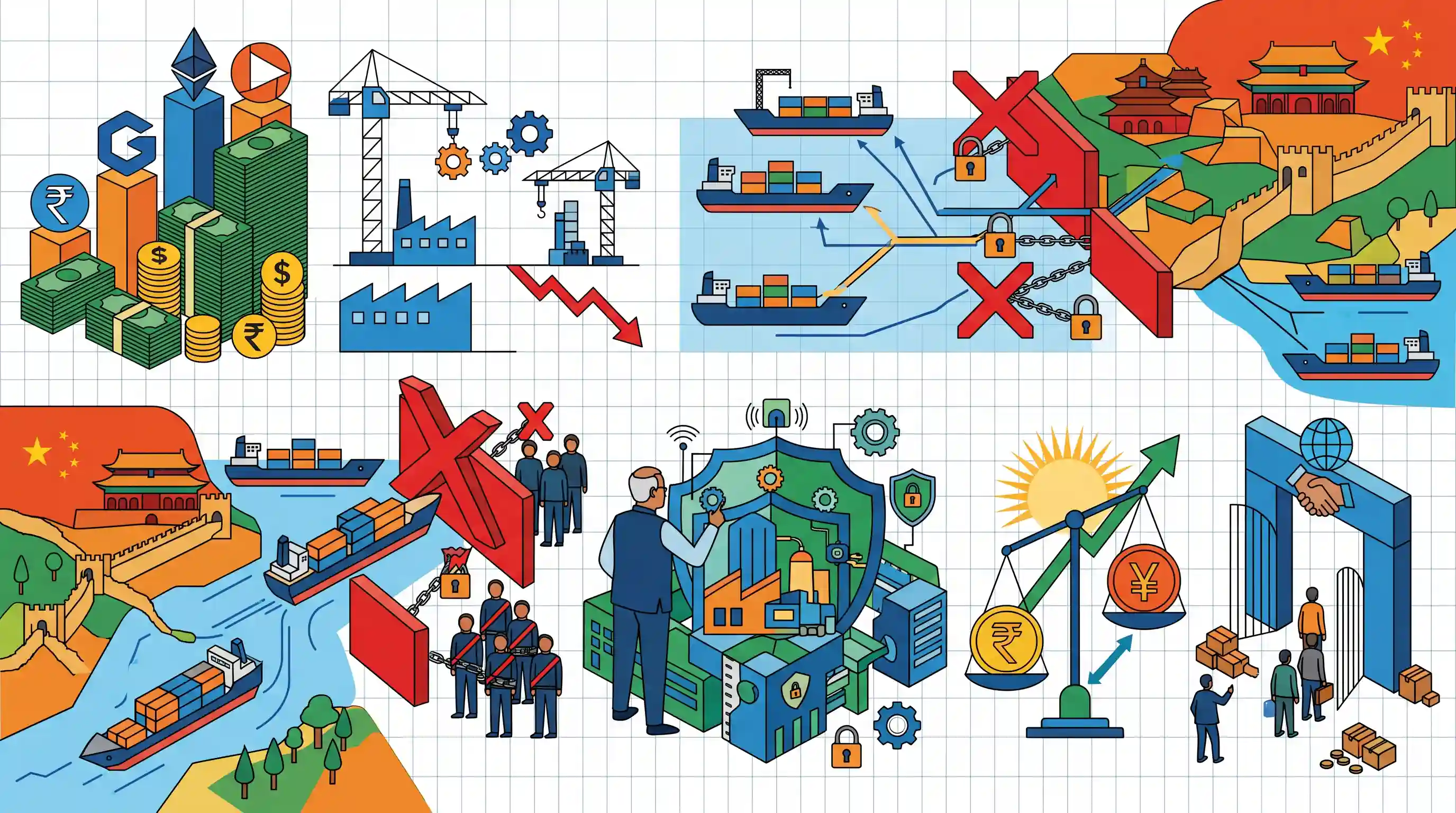
Chief Economic Advisor V Anantha Nageswaran has highlighted a significant gap in the Indian economy: while top companies experienced a 30% surge in profits post-Covid, this has not translated into domestic capital formation or investment in real assets. He pointed out external constraints to the 'China Plus One' strategy, notably China's Decrees 834 and 835, which penalize foreign entities for moving supply chains. To safeguard economic interests, Nageswaran advocated for an Indian supply chain security framework modeled on the US CFIUS. Additionally, he noted that the closing gap in the Real Effective Exchange Rate (REER) between the Indian rupee and the Chinese yuan enhances India's export competitiveness, though poor utilization of Free Trade Agreements (FTAs) remains a challenge.
Key Points
- Despite a 30.8% increase in corporate profits post-Covid, the private sector is lagging in domestic capital formation and real asset investment, instead setting up family offices abroad.
- China has introduced Decree 834 and Decree 835 to actively penalize companies attempting to relocate their supply chains out of the country, challenging the global 'China Plus One' strategy.
- The Chief Economic Advisor emphasized the need for India to develop a robust supply chain security framework similar to the US Committee on Foreign Investment (CFIUS).
- The narrowing gap between the Real Effective Exchange Rate (REER) of the Indian rupee and the Chinese yuan makes Indian exports more price-competitive and aids in supply source diversification.
- India's utilization rate of Free Trade Agreements (FTAs) remains notably poor compared to other nations, hindering potential export growth.
Important Terms
China Plus One Strategy

A global business strategy where companies diversify their supply chains by moving some production away from China to other countries, like India, to reduce over-dependence and mitigate geopolitical risks.
UPSC context
GS Paper 2 & 3: Crucial for discussing supply chain resilience, 'Atmanirbhar Bharat,' and India's competitive positioning against China in global manufacturing.
Free Trade Agreements (FTAs)
Pacts between two or more nations to reduce or eliminate trade barriers, such as tariffs and quotas, on goods and services to increase cross-border economic activity.
UPSC context
GS Paper 3: Core topic for Indian Economy; tests understanding of trade deficits, 'inverted duty structures,' and recent pacts like the India-UAE CEPA.
Real Effective Exchange Rate (REER)
The weighted average of a country's currency relative to a basket of major trading partners, adjusted for inflation; it measures a nation's true international price competitiveness.
UPSC context
GS Paper 3: Frequently appearing in Prelims; tests ability to analyze how currency valuation impacts export-import balance and economic stability.
Committee on Foreign Investment in the United States (CFIUS)
An interagency committee in the U.S. that reviews foreign investments in domestic businesses for potential national security risks, with the power to block or unwind transactions.
UPSC context
GS Paper 2 & 3: Serves as a reference model for India's proposed 'Supply Chain Security Framework' to screen sensitive foreign direct investment.
Decree 834 (China)
Chinese 'Regulations on the Security of Industrial and Supply Chains' that restrict the collection of supply chain data and penalize entities for moving operations out of China.
UPSC context
GS Paper 2: International Relations; highlights 'lawfare' and the legal barriers China uses to prevent companies from adopting 'China Plus One' strategies.
Decree 835 (China)
Chinese 'Regulations on Countering Foreign Improper Extraterritorial Jurisdiction' designed to punish organizations that comply with foreign sanctions or directives that China deems harmful to its interests.
UPSC context
GS Paper 2: Significant for understanding global trade friction and how domestic laws are used as retaliatory tools in geopolitical rivalries.
Prelims Trap
"A post-Covid surge in corporate profits led to a proportional increase in India's Gross Capital Formation."
High profits do not equal capital formation. GCF requires investment in physical assets; profits hoarded as cash or diverted to foreign financial assets do not increase domestic GCF.
Static Concepts Connected
What is the Real Effective Exchange Rate (REER) and its significance?
- NEER vs REER: REER is the Nominal Effective Exchange Rate (NEER) adjusted for inflation differentials between a home country and its trading partners.
- Competitiveness Indicator: A decrease (depreciation) in REER indicates that a country's exports are becoming relatively cheaper and more competitive in the global market.
- Trade Weighting: It relies on a trade-weighted basket of currencies (e.g., RBI uses a 40-currency basket) to reflect actual global trade dynamics.
What defines Gross Capital Formation (GCF) in macroeconomics?
- Physical Assets: It represents the creation of physical assets (machinery, infrastructure) rather than financial investments, savings, or corporate cash accumulation.
- Core Component: Gross Fixed Capital Formation (GFCF) is its largest component, acting as a direct proxy for private and public investment in the economy.
- Economic Growth: High GCF indicates expanding productive capacity, which is essential for sustained long-term GDP growth and job creation.
Cross-Topic Patterns
FDI Screening & National Security
The push for a CFIUS-like body connects to India's Press Note 3 (2020), which required prior government approval for FDI from land-border sharing nations to prevent opportunistic corporate takeovers.
Rules of Origin & FTA Friction
Poor FTA utilization (roughly 25%) directly links to complex 'Rules of Origin' compliance (CAROTAR 2020), which structurally hinders Indian exporters from accessing tariff benefits compared to ASEAN peers.
Geoeconomic Weaponization & Supply Chains
China’s Decrees 834/835 penalizing supply chain relocation mirror global geoeconomic fragmentation, testing WTO frameworks and accelerating minilateral 'friend-shoring' initiatives like the Indo-Pacific Economic Framework (IPEF).

Expect a 2026 Prelims question linking REER trends, export competitiveness, and Gross Capital Formation in a single multi-statement item.
Linked PYQs · 5
Linked PYQs · 5
- 2022PrelimsGS1
With reference to the Indian economy, consider the following statements: 1. An increase in Nominal Effective Exchange Rate (NEER) indicates the appreciation of rupee. 2. An increase in the Real Effective Exchange Rate (REER) indicates an improvement in trade competitiveness. 3. An increasing trend in domestic inflation relative to inflation in other countries is likely to cause an increasing divergence between NEER and REER. Which of the above statements are correct?
- 2022PrelimsGS1
With reference to the Indian economy, consider the following statements: 1. If the inflation is too high, Reserve Bank of India (RBI) is likely to buy government securities. 2. If the rupee is rapidly depreciating, RBI is likely to sell dollars in the market. 3. If interest rates in the USA or European Union were to fall, that is likely to induce RBI to buy dollars. Which of the statements given above are correct?
- 2021PrelimsGS1
Consider the following statements : The effect of devaluation of a currency is that it necessarily 1. improves the competitiveness of the domestic exports in the foreign markets 2. increases the foreign value of domestic currency 3. improves the trade balance Which of the above statements is/are correct?
- 2020MainsGS3
Explain the meaning of investment in an economy in terms of capital formation. Discuss the factors to be considered while designing a concession agreement between a public entity and a private entity.
- 2013MainsGS3
Discuss the impact of FDI entry into Multi-trade retail sector on supply chain management in commodity trade pattern of the economy.
