Air Quality Index Crisis and Stubble Burning Drivers in North India
Source:Indian Express ↗
Why It Matters
Air pollution is a recurring and severe environmental crisis in North India. Understanding the parameters of the Air Quality Index (AQI), meteorological factors causing winter smog, and the socio-economic drivers of stubble burning is crucial for both Prelims and Mains (GS1 Geography, GS3 Environment).
Summary
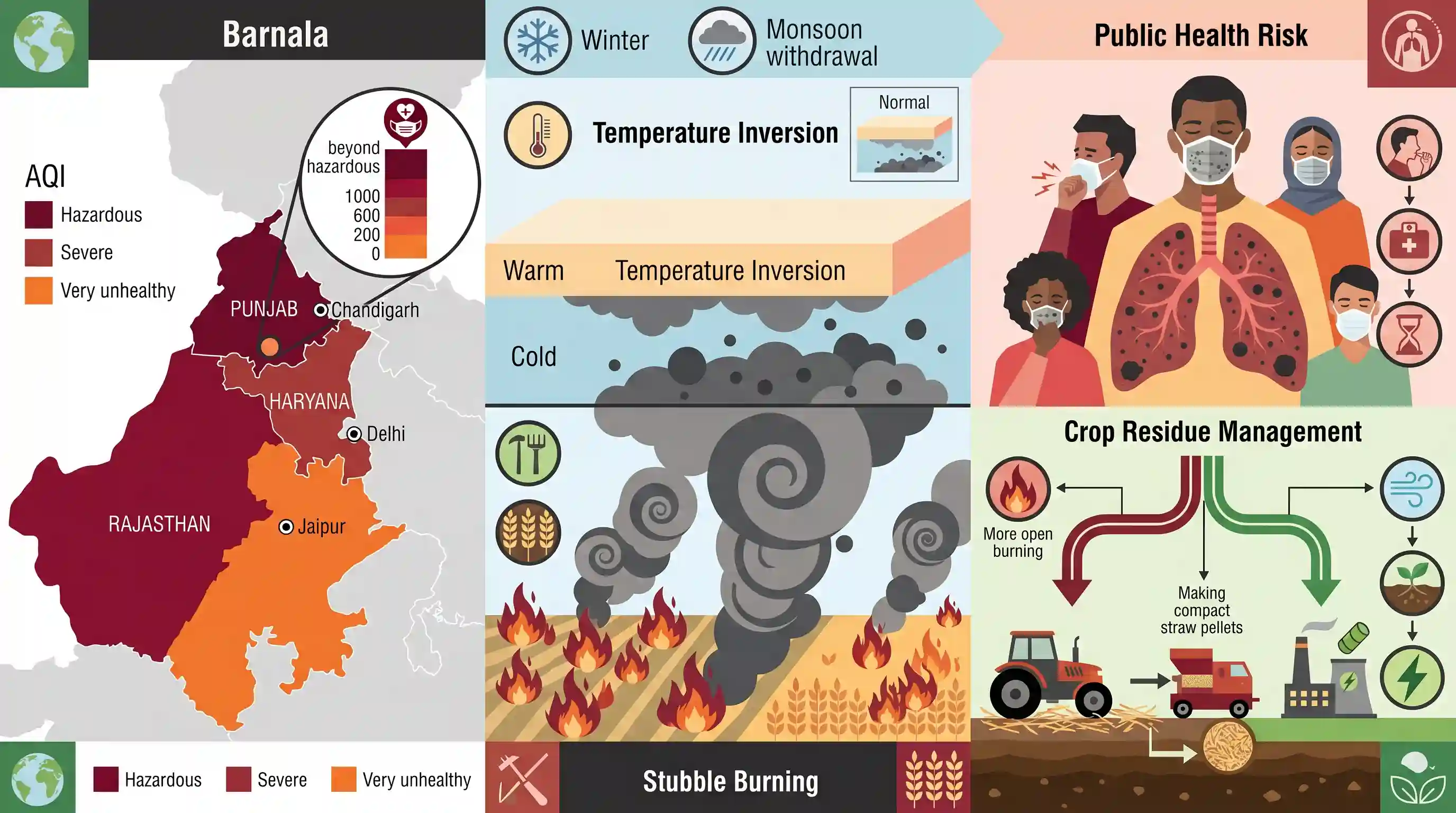
The air quality across major cities in Northern India has deteriorated significantly, with Punjab's Barnala recording a staggering Air Quality Index (AQI) of 890, the worst in the country. Cities in Haryana, Rajasthan, and Punjab have logged 'Severe' or 'Hazardous' levels of pollution. According to the Central Pollution Control Board (CPCB), this sharp spike in pollutants is attributed to a combination of meteorological factors—such as the withdrawal of the monsoon and the onset of winter temperature inversions—and anthropogenic emissions, predominantly the seasonal peak of stubble burning in agrarian states. This recurring environmental crisis poses severe public health risks and highlights systemic challenges in air shed management and agricultural residue disposal.
Key Points
- Several cities in Northern India entered the "Severe" and "Hazardous" AQI categories, with Barnala (Punjab) recording an extreme AQI of 890.
- The sharp deterioration in air quality is driven by seasonal factors, including the withdrawal of the monsoon and the onset of winter, which create atmospheric conditions that trap pollutants.
- Stubble burning in agrarian states like Punjab, Haryana, and Uttar Pradesh remains a primary anthropogenic contributor to the smog in the National Capital Region and surrounding areas.
- The Central Pollution Control Board (CPCB) categorizes AQI to inform public health advisories, highlighting severe risks of prolonged exposure.
Important Terms
Air Quality Index (AQI)

A "One Number-One Color-One Description" system to communicate daily air quality. It monitors eight pollutants: PM10, PM2.5, NO2, SO2, CO, O3, NH3, and Pb.
UPSC context
GS Paper III (Environment); vital for Prelims (pollutants/categories) and Mains (urban pollution/health).
Central Pollution Control Board (CPCB)
A statutory body under MoEFCC, established via the Water Act (1974). It sets national pollution standards and monitors air/water quality under the Air Act (1981).
UPSC context
GS Paper II (Statutory Bodies) and GS III (Environment); tests regulatory frameworks for pollution control.
Stubble Burning
The seasonal burning of paddy residue (parali) by farmers to clear fields quickly. It is a major contributor to winter smog in the Indo-Gangetic Plain.
UPSC context
GS Paper III (Agriculture/Pollution); relevant for agrarian crisis, technological solutions (In-situ/Ex-situ), and environmental degradation.
Temperature Inversion
A weather condition where warm air sits above cool air near the ground, trapping pollutants and preventing vertical dispersion, worsening surface-level pollution in winter.
UPSC context
GS Paper I (Geography/Climatology) and GS III (Environment); explains seasonal pollution spikes in North India.
Air Shed Management
A regional approach to pollution control based on geographic areas where air masses share similar characteristics, rather than following state or administrative boundaries.
UPSC context
GS Paper III (Environment/Governance); tests understanding of transboundary pollution and collaborative policy frameworks like NCAP.
PM 2.5
Fine particles with a diameter <2.5 micrometers. They penetrate deep into the lungs and bloodstream, posing the highest risk to human health during smog episodes.
UPSC context
GS Paper III (Science & Technology/Environment); critical for understanding health impacts and air quality standards.
Commission for Air Quality Management (CAQM)
A powerful statutory body established in 2021 to oversee air quality in Delhi-NCR and adjoining areas, transcending state jurisdictions of Punjab, Haryana, Rajasthan, and UP.
UPSC context
GS Paper II/III (Governance/Environment); significant for recent legal/institutional measures to combat transboundary pollution.
Prelims Trap
"The National Air Quality Index (AQI) accounts for Carbon Dioxide (CO2) levels to measure urban pollution."
CO2 is a greenhouse gas, not a criteria pollutant. AQI measures 8 specific pollutants including Carbon Monoxide (CO), but strictly excludes Carbon Dioxide (CO2).
Static Concepts Connected
What are the 8 pollutants measured by the National Air Quality Index (AQI)?
- Particulates & Gases: Measures PM10, PM2.5, Nitrogen Dioxide (NO2), Sulphur Dioxide (SO2), and Carbon Monoxide (CO).
- Secondary & Others: Tracks ground-level Ozone (O3), Ammonia (NH3), and Lead (Pb).
- Notable Exclusions: Carbon Dioxide (CO2) and Methane (CH4) are excluded from AQI calculations, a frequent UPSC trap.
How does Temperature Inversion exacerbate winter smog in Northern India?
- Thermal Reversal: Rapid winter ground cooling creates a dense, cold air layer trapped beneath a warmer atmospheric layer, reversing the normal temperature lapse rate.
- Lack of Dispersion: This inversion suppresses vertical wind mixing, acting as a "lid" that traps agricultural stubble smoke and urban vehicular emissions near the surface.
Cross-Topic Patterns
Paddy MSP + Power Subsidies
Open-ended procurement and free electricity incentivize water-guzzling paddy in Punjab, shrinking the harvest-sowing window and directly forcing farmers into stubble burning.
In-situ vs Ex-situ Crop Residue Management
Connecting agricultural tech (Happy Seeders) with biotechnology (PUSA bio-decomposer enzymes) as competing/complementary solutions to the short 15-day crop transition window.

Expect a multi-statement Prelims question merging AQI criteria pollutants, WHO air quality standards, and PUSA decomposer fungal action.
Linked PYQs · 4
Linked PYQs · 4
- 2016PrelimsGS1
In the cities of our country, which among the following atmospheric gases are normally considered in calculating the value of Air Quality Index? 1. Carbon dioxide 2. Carbon monoxide 3. Nitrogen dioxide 4. Sulfur dioxide 5. Methane Select the correct answer using the code given below.
- 2022PrelimsGS1
In the context of WHO Air Quality Guidelines, consider the following statements: 1. The 24-hour mean of PM2.5 should not exceed 15 µg/m³ and annual mean of PM2.5 should not exceed 5 µg/m³. 2. In a year, the highest levels of ozone pollution occur during the periods of inclement weather. 3. PM10 can penetrate the lung barrier and enter the bloodstream. 4. Excessive ozone in the air can trigger asthma. Which of the statements given above are correct?
- 2025PrelimsGS1
Artificial way of causing rainfall to reduce air pollution makes use of
- 2015MainsGS1
Mumbai, Delhi and Kolkata are the three mega cities of the country but the air pollution is much more serious problem in Delhi as compared to the other two. Why is this so?
