Institutional fragmentation and accountability deficits in governance
Source:The Hindu ↗
Why It Matters
Understanding the pitfalls of institutional fragmentation is crucial for UPSC aspirants, as administrative reforms, the role of local bodies, and mechanisms to ensure governmental accountability are core components of the GS Paper 2 syllabus.
Summary
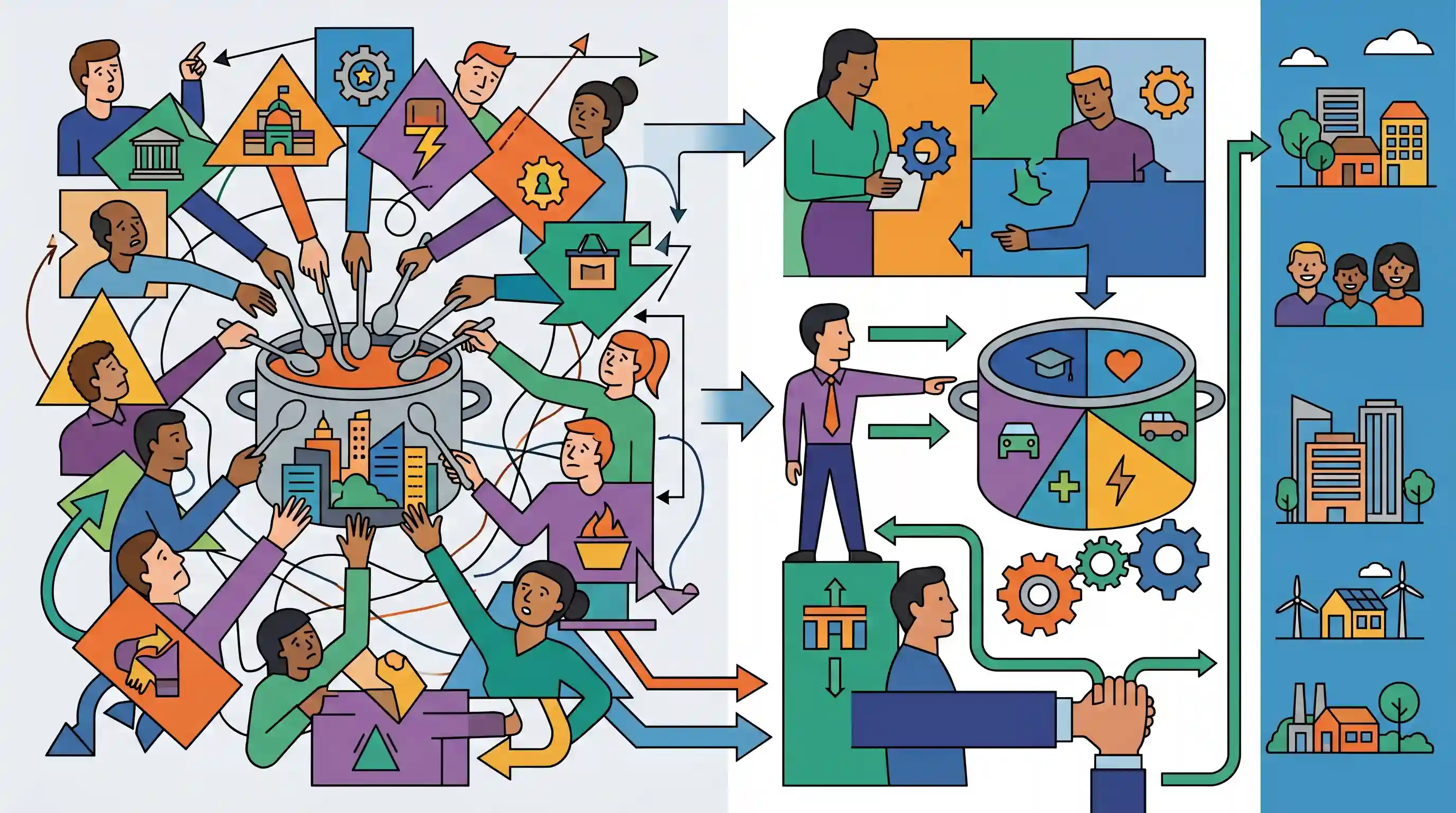
The article critiques the pervasive issue of institutional fragmentation and overlapping jurisdictions within India's governance architecture. Using the metaphor "too many cooks, no one stirring the pot," it highlights how the proliferation of ministries, departments, and parastatal agencies without clear lines of accountability leads to policy paralysis and poor implementation. When multiple bodies are responsible for overlapping sectors, coordination deficits emerge, and no single entity takes decisive ownership of outcomes. The piece advocates for systemic administrative reforms—specifically the convergence of related departments, elimination of institutional silos, and the empowerment of nodal agencies—to ensure effective public service delivery and accountable governance.
Key Points
- Institutional fragmentation and the existence of multiple agencies with overlapping mandates lead to a severe dilution of accountability.
- The lack of a single nodal authority ("no one stirring the pot") creates coordination deficits, policy paralysis, and bureaucratic bottlenecks.
- Multiplicity of parastatal bodies, particularly in urban governance and welfare implementation, undermines effective multi-level planning and service delivery.
- Administrative reforms focusing on convergence, clear demarcation of responsibilities, and robust accountability frameworks are urgently required to streamline governance.
Important Terms
Parastatal Agencies

Semi-autonomous, government-controlled organizations (e.g., Development Authorities) established to perform specific technical or service delivery functions, often operating outside the direct control of elected local bodies.
UPSC context
GS Paper II: Governance; crucial for understanding 'multiplicity of authorities' and accountability gaps in urban administrative structures.
Institutional Fragmentation
A governance condition where multiple ministries, departments, or agencies have overlapping jurisdictions, leading to a lack of clear ownership, coordination deficits, and policy paralysis.
UPSC context
GS Paper II: Governance; tests ability to analyze systemic inefficiencies and propose administrative convergence for better public service delivery.
Urban Local Bodies (ULBs)
The third tier of government in India (Municipal Corporations, Councils, Nagar Panchayats) constitutionalized via the 74th Amendment to manage urban areas.
UPSC context
GS Paper II: Polity & Governance; focuses on decentralization, the '3Fs' (Funds, Functions, Functionaries), and challenges from parallel agencies.
NITI Aayog
The premier policy think tank of the Government of India that promotes cooperative federalism and provides strategic and technical advice to both Central and State governments.
UPSC context
GS Paper II: Statutory/Regulatory Bodies; focuses on its role in administrative reforms, competitive federalism, and the shift to bottom-up planning.
Nodal Agency
A lead department or organization designated to coordinate the activities of multiple agencies involved in a common project or policy to ensure accountability.
UPSC context
GS Paper II: Governance; relevant for solutions to departmental silos and improving inter-agency coordination (e.g., PRAGATI framework).
74th Constitutional Amendment Act
Enacted in 1992, it granted constitutional status to Urban Local Bodies and mandated the devolution of 18 functional items listed in the Twelfth Schedule.
UPSC context
GS Paper II: Polity; fundamental for questions on local self-government, decentralization, and the empowerment of city-level administration.
Prelims Trap
"The 74th Amendment constitutionally subordinates urban parastatal bodies (like water boards) to the elected Urban Local Bodies."
False. Parastatals are statutory bodies created by State legislatures. They operate independently of ULBs, often encroaching upon the 18 local functions listed in the 12th Schedule.
Static Concepts Connected
How do parastatal bodies conflict with the 74th Amendment Act?
- 12th Schedule: Contains 18 functional items intended for municipalities. Parastatals (like urban development authorities or water boards) often usurp these specific functions.
- State control: Parastatals are directly accountable to state governments, bypassing democratically elected municipal bodies and severely weakening grassroots decentralization.
What did the 2nd ARC recommend for structural governance reforms?
- Ministry rationalization: Merging overlapping ministries and departments to reduce institutional fragmentation and establish clear, unified mandates for public service delivery.
- Policy vs Execution: A strict demarcation between policy formulation (State Secretariats) and executive implementation (Directorates) to avoid bureaucratic micromanagement and red tape.
Cross-Topic Patterns
Smart City SPVs vs ULBs
The Smart Cities Mission relies heavily on Special Purpose Vehicles (SPVs) for execution, which critics argue creates parallel governance structures that dilute the constitutional authority of elected ULBs.
Regulatory Overlap: Environment
Institutional fragmentation mirrors the environmental sector, where overlapping mandates between the CPCB, State Pollution Control Boards, and the NGT frequently lead to jurisdictional friction and enforcement delays.

Expect a GS-II Mains question evaluating how the proliferation of state-run parastatals and SPVs undermines the 74th CAA and ULB autonomy.
Linked PYQs · 4
Linked PYQs · 4
- 2019MainsGS2
From the resolution of contentious issues regarding distribution of legislative powers by the courts, 'Principle of Federal Supremacy' and 'Harmonious Construction' have emerged. Explain.
- 2024MainsGS2
Analyse the role of local bodies in providing good governance at local level and bring out the pros and cons merging the rural local bodies with the urban local bodies.
- 2019MainsGS2
‘In the context of neo-liberal paradigm of development planning, multi-level planning is expected to make operations cost-effective and remove many implementation blockages.’ - Discuss.
- 2023MainsGS2
e-governance, as a critical tool of governance, has ushered in effectiveness, transparency and accountability in governments. What inadequacies hamper the enhancement of these features ?
