Commerce Ministry reviews global impact of US blanket import tariffs
Source:The Hindu ↗
Why It Matters
Understanding the shift from multilateral free trade to protectionism and bilateralism is critical for UPSC aspirants. Changes in US tariff policies directly impact India's exports and macroeconomic stability, making India's strategy of diversifying trade via FTAs a highly relevant topic for GS-2 (International Relations) and GS-3 (Economy).
Summary
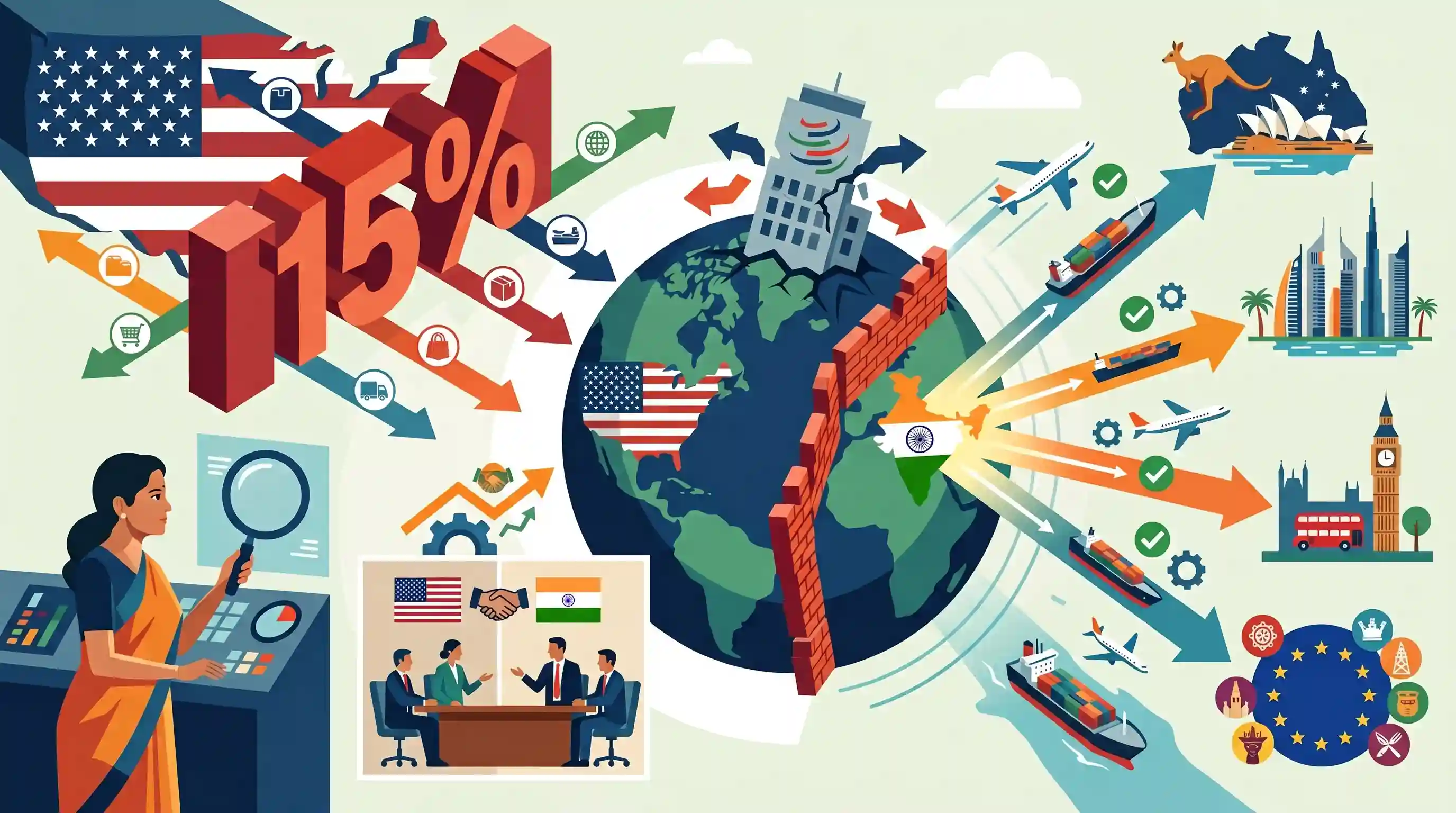
Finance Minister Nirmala Sitharaman stated that the Commerce Ministry is closely reviewing the impact of the newly imposed 15% blanket tariff by the US Trump administration on global imports, including those from India. While deeming it "too early to comment" on the specific economic consequences, she emphasized India's ongoing efforts to finalize an interim trade pact with the US, with chief negotiators scheduled to meet soon. Additionally, she underscored India's strategy to mitigate global trade uncertainties by aggressively pursuing bilateral Free Trade Agreements (FTAs) and recently sealing pacts with Australia, the UAE, the UK, the EU, and others. The situation highlights the broader shift from global multilateralism to rising trade protectionism.
Key Points
- The Commerce Ministry is evaluating the potential economic fallout of the newly implemented 15% blanket tariff by the Trump administration on all imports to the US.
- India and the US have rescheduled discussions between their chief trade negotiators to establish an interim bilateral trade pact.
- Finance Minister Nirmala Sitharaman highlighted that India has proactively diversified its trade relations by securing Free Trade Agreements with regions including Australia, the UAE, the EU, and the UK.
- The developments reflect an increasing global trend of trade protectionism, compelling nations to rely heavily on bilateral and regional economic agreements.
Important Terms
Free Trade Agreements (FTAs)

Formal pacts between two or more countries to reduce or eliminate tariffs and non-tariff barriers, facilitating the free flow of goods and services across borders.
UPSC context
GS Papers II & III; tests India's trade strategy, market access, and strategic diversification amidst global trade shifts.
Trade Protectionism
Government policy restricting imports through tariffs, quotas, or subsidies to shield domestic industries and workers from foreign competition.
UPSC context
GS Paper III (Economy); tests knowledge of trade wars, macroeconomic stability, and the tension between globalization and domestic interests.
Interim Trade Pact
A temporary, outcome-oriented trade arrangement (often called an 'Early Harvest Scheme') providing immediate commercial gains while full bilateral trade agreement negotiations continue.
UPSC context
GS Paper II (Bilateral Relations); tests understanding of incremental trade diplomacy and de-escalation of trade tensions.
Comprehensive Economic Partnership Agreement (CEPA)
A deep form of FTA covering goods, services, investment, intellectual property, and regulatory cooperation, aiming for comprehensive economic integration.
UPSC context
GS Papers II & III; tests detailed knowledge of India's most advanced bilateral trade models (e.g., India-UAE CEPA).
Multilateralism
Global coordination of trade and diplomacy via international institutions (like the WTO) based on rules-based order and non-discrimination.
UPSC context
GS Paper II (International Relations); tests understanding of global governance challenges vs. the rise of plurilateral and bilateral deals.
Ministry of Commerce and Industry
The nodal Indian ministry responsible for formulating foreign trade policy, managing Special Economic Zones, and leading international trade negotiations.
UPSC context
GS Paper II (Governance); tests institutional frameworks for trade and the executive's role in safeguarding commercial interests.
Prelims Trap
India has recently operationalized full Comprehensive Economic Partnership Agreements (CEPA) with both the UAE and Australia.
India signed a CEPA with the UAE, but the pact with Australia is an Economic Cooperation and Trade Agreement (ECTA), which is an 'early harvest' interim pact, not a full CEPA.
Static Concepts Connected
What is the difference between an Early Harvest Scheme and a CEPA?
- Early Harvest Scheme: A precursor to a full FTA where trading partners reduce or eliminate tariffs on a limited, pre-decided set of goods first.
- CEPA/CECA: A comprehensive, broader agreement covering not just goods, but trade in services, investments, intellectual property rights, and competition policies.
- WTO Compliance: Early harvest schemes must eventually be formalized into broader FTAs to comply with WTO's Article XXIV concerning regional trade agreements.
What are the valid exceptions to the WTO's Most-Favoured-Nation (MFN) principle?
- Regional Trade Agreements: Nations can establish Free Trade Agreements or customs unions, granting exclusive lower tariffs to each other without extending them to all WTO members.
- Developing Nations Exception: The Generalized System of Preferences (GSP) allows developed countries to grant special, non-reciprocal tariff access to developing and least developed nations.
- Trade Remedies: Countries can impose specific, discriminatory punitive tariffs to counter unfair trade practices, subsidies, or sudden import surges.
Cross-Topic Patterns
Protectionism & Rupee Depreciation
High US tariffs suppress Indian exports, directly widening the Current Account Deficit (CAD) and placing downward depreciation pressure on the Indian Rupee, requiring RBI interventions.
WTO Dispute Settlement Paralysis
Rising unilateral tariffs are exacerbated by the ongoing paralysis of the WTO's Appellate Body, forcing export-oriented nations to abandon multilateralism for bilateral FTAs.

Expect a matched-pair Prelims question linking recent trade agreements (UAE-CEPA, Australia-ECTA) or a Mains Q on bilateralism vs WTO.
Linked PYQs · 2
Linked PYQs · 2
- 2025MainsGS3
What are the challenges before the Indian economy when the world is moving away from free trade and multilateralism to protectionism and bilateralism? How can these challenges be met?
- 2018PrelimsGS1
Consider the following countries: 1. Australia 2. Canada 3. China 4. India 5. Japan 6. USA Which of the above are among the 'free-trade partners' of ASEAN?
