India Trade Policy and Ministry Review of United States Tariffs
Source:The Hindu ↗
Why It Matters
The evolving U.S. trade policy directly impacts India's export competitiveness and ongoing bilateral negotiations. Understanding protectionism, FTA dynamics, and the role of the judiciary in executive decisions provides critical insights for GS-2 (International Relations and Polity) and GS-3 (Economy).
Summary
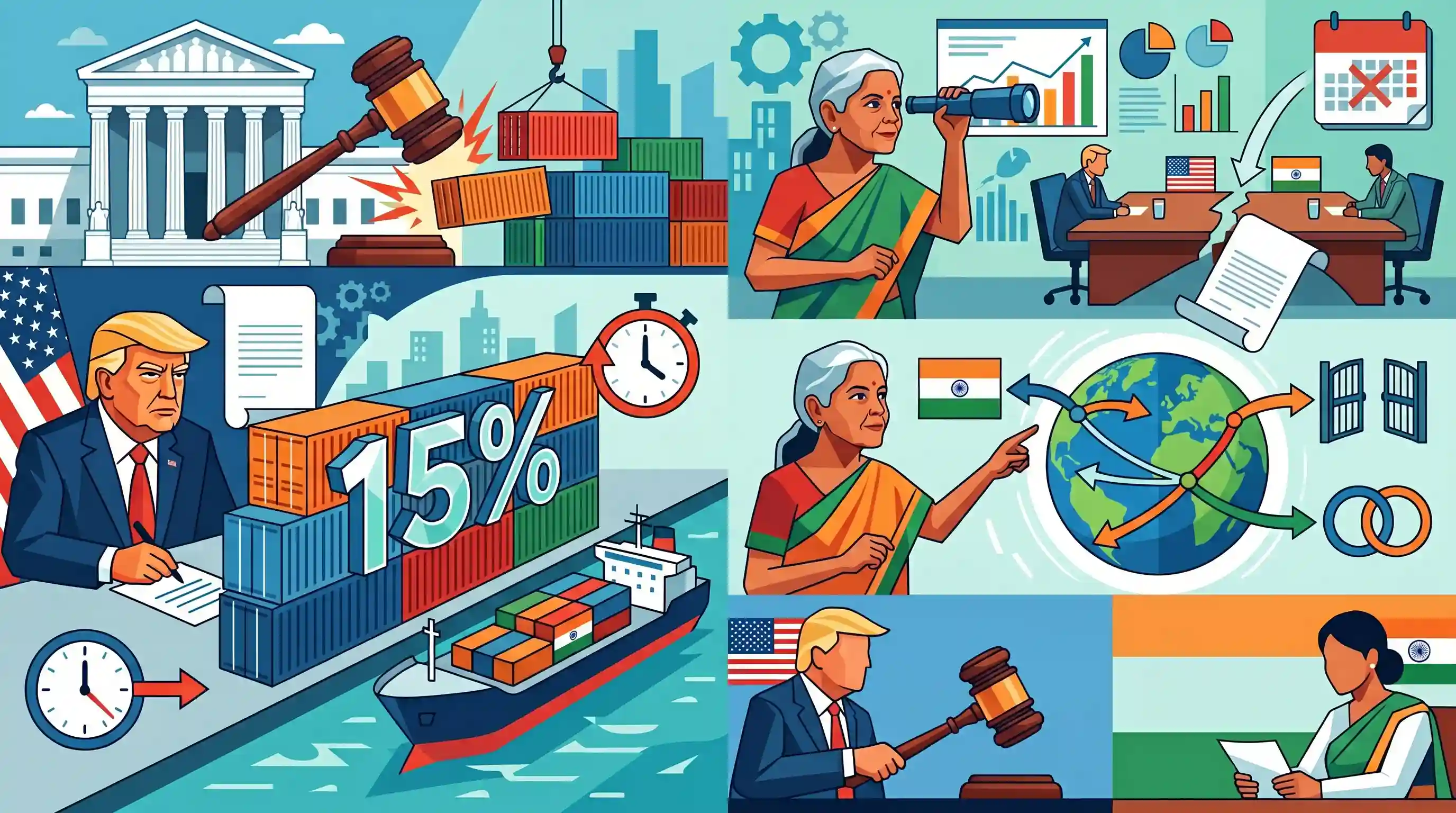
Finance Minister Nirmala Sitharaman announced that the Commerce Ministry is reviewing the impact of recent U.S. tariff hikes, triggered after the U.S. Supreme Court struck down previous sweeping import tariffs. In response to the SCOTUS ruling, President Donald Trump imposed a temporary 15% tariff on all trading partners, including India. Consequently, an upcoming meeting between India and the U.S. to finalize an interim trade pact has been rescheduled. Despite these bilateral hurdles, Sitharaman emphasized India's overarching strategy to pursue Free Trade Agreements (FTAs) globally to integrate the Indian economy with global markets. The situation also highlights the comparative separation of powers between the executive and judiciary in the U.S. and India regarding trade policy.
Key Points
- Finance Minister Nirmala Sitharaman stated it is premature to comment on the new U.S. tariff changes, noting the Commerce Ministry is actively reviewing the situation.
- Following a U.S. Supreme Court ruling against prior sweeping tariffs, President Donald Trump imposed a 10% tariff (later raised to 15%) on all countries, including India, for 150 days.
- India and the U.S. have rescheduled a planned meeting of their chief negotiators in Washington to finalize an interim trade pact.
- Sitharaman reaffirmed India's commitment to expanding global market access, highlighting existing trade agreements with several countries and regions including the UAE, Australia, and the EU.
- The recent SCOTUS ruling on U.S. tariffs invites a comparative constitutional analysis of the separation of powers jurisprudence between India and the United States.
Important Terms
Free Trade Agreement (FTA)

A formal pact between nations to reduce or eliminate tariffs and non-tariff barriers, enhancing market access and economic integration for goods and services.
UPSC context
GS Paper 2 & 3: Tests impact on Indian exports, domestic industry, and global supply chain integration.
Interim Trade Pact
A preliminary deal, often called an Early Harvest Scheme, liberalizing trade on a restricted list of goods before a comprehensive FTA is finalized.
UPSC context
GS Paper 3: Evaluates trade negotiation strategies and challenges of converting partial deals into full FTAs.
Ministry of Commerce and Industry
The nodal Indian ministry responsible for formulating foreign trade policy and leading bilateral trade negotiations through its Department of Commerce.
UPSC context
GS Paper 2: Tests knowledge of executive roles in economic governance and international trade diplomacy.
Protectionism
An economic policy of restricting imports through tariffs or quotas to shield domestic industries and workers from foreign competition.
UPSC context
GS Paper 3: Critically assesses the trade-off between protecting local manufacturers and participating in global free trade.
U.S. Supreme Court (SCOTUS)
The highest U.S. court, which exercises judicial review and can strike down executive actions, such as unilateral tariffs, if they exceed authorized powers.
UPSC context
GS Paper 2: Comparative Constitution; tests the scope of judicial oversight on executive trade policy vs. India.
Separation of Powers
A constitutional doctrine dividing government into legislative, executive, and judicial branches to ensure checks and balances and prevent arbitrary use of power.
UPSC context
GS Paper 2: Core concept for comparing Indian and U.S. constitutional schemes regarding executive authority and oversight.
Prelims Trap
The US President holds absolute constitutional authority to unilaterally levy sweeping import tariffs.
In the US, Article 1, Section 8 vests tariff powers exclusively in Congress. The President only uses delegated statutory authority, which SCOTUS can strike down if overstepped.
Static Concepts Connected
How do the US and Indian constitutional systems differ on trade and tariff powers?
- US strict separation: Under Article 1, Section 8 of the US Constitution, the power to levy tariffs is exclusively vested in Congress, heavily constraining the President.
- Indian parliamentary fusion: Operating on a parliamentary fusion model, India's executive enjoys broad delegated legislative authority (e.g., under the Customs Act) to modify trade policies dynamically.
- Judicial review scope: The US Supreme Court frequently limits executive overreach on trade, whereas Indian courts generally defer to the executive on macroeconomic policy implementation.
What is the difference between an FTA, PTA, and CECA/CEPA?
- PTA (Positive List): Preferential Trade Agreements (PTAs) reduce tariffs on a specific, limited positive list of goods traded between partner countries.
- FTA (Negative List): Free Trade Agreements (FTAs) eliminate tariffs on the majority of goods, maintaining only a limited negative list of protected items.
- CECA/CEPA (Comprehensive): Comprehensive Economic Partnership/Cooperation Agreements encompass goods, services, investments, IPRs, and regulatory cooperation (e.g., India-UAE CEPA).
Cross-Topic Patterns
Protectionism and Supply Chain Resilience
Unpredictable US tariffs accelerate the need for supply chain diversification. India's aggressive FTA push (UAE, Australia, EU) aims to capitalize on this by securing preferential global market access over ad-hoc regimes.
Comparative Constitution: Delegated Legislation
The US Supreme Court striking down tariffs highlights delegated legislation limits. This contrasts with India's parliamentary fusion, where executive tariff tweaks are routine under the Customs Act of 1962.

Expect a GS2 Mains question comparing the strict separation of powers in the US vs. India's parliamentary fusion, using trade as a hook.
Linked PYQs · 5
Linked PYQs · 5
- 2018MainsGS3
How would the recent phenomena of protectionism and currency manipulations in world trade affect macroeconomic stability of India?
- 2025MainsGS3
What are the challenges before the Indian economy when the world is moving away from free trade and multilateralism to protectionism and bilateralism? How can these challenges be met?
- 2025MainsGS2
India-Africa digital partnership is achieving mutual respect, co-development and long-term institutional partnerships. Elaborate.
- 2014MainsGS2
The aim of Information Technology Agreements (ITAs) is to lower all taxes and tariffs on information technology products by signatories to zero. What impact would such agreements have on India's interests?
- 2024MainsGS2
Discuss India as a secular state and compare with the secular principles of the US constitution.
