Seedance 2.0 AI Deepfake Video and Intellectual Property Rights
Source:Indian Express ↗
Why It Matters
The intersection of Generative AI, deepfakes, and copyright law is a highly anticipated topic for both GS-3 (Science & Technology and IPR) and GS-4 (Ethics in technology). It challenges existing legal paradigms regarding consent and digital identity.
Summary
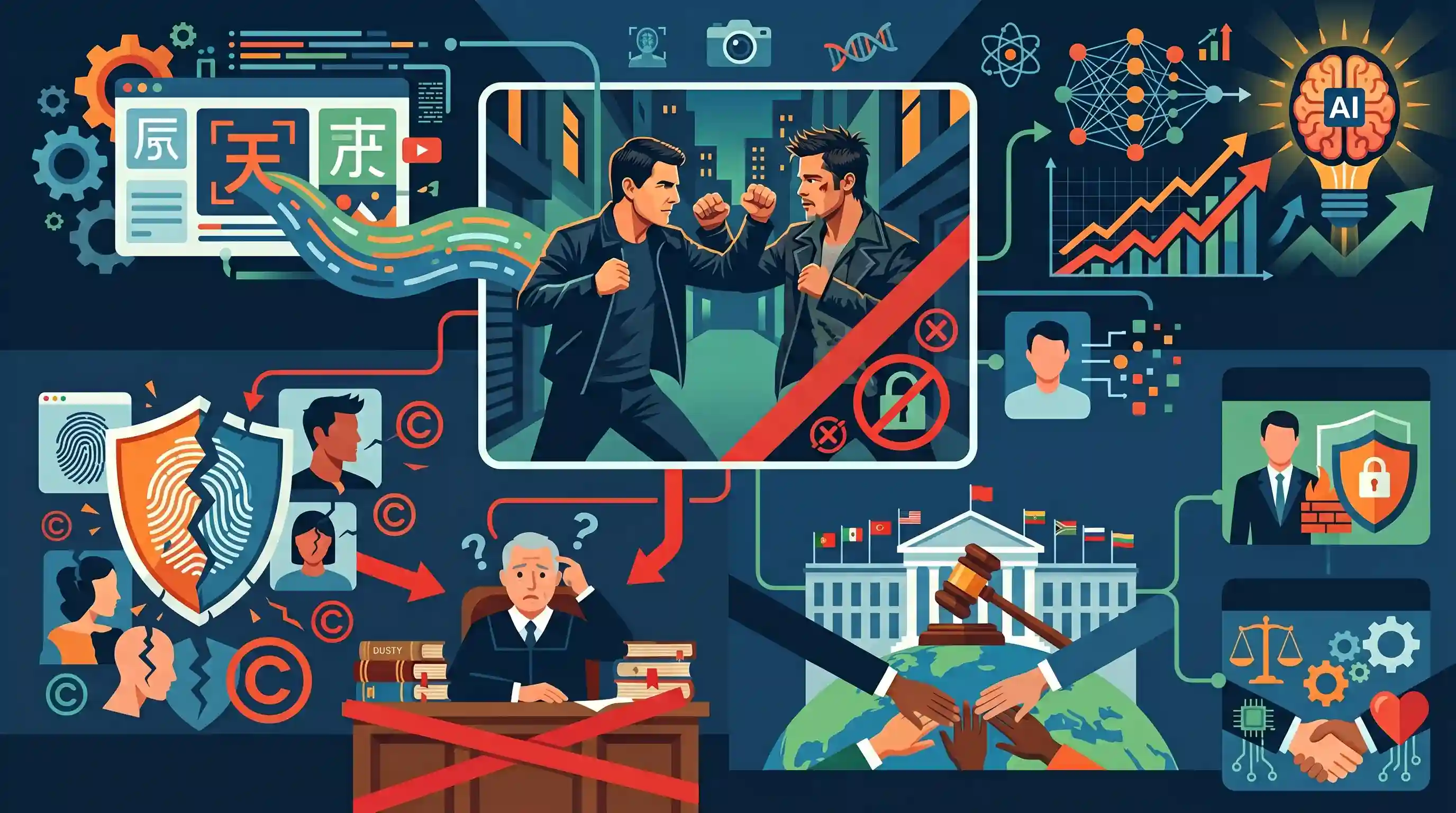
China's new AI video generation tool, Seedance 2.0, has sparked a fresh debate over copyright and digital rights by producing an unauthorized, hyper-realistic video of Tom Cruise and Brad Pitt fighting. The incident highlights the growing capabilities of generative AI and deepfake technology, while simultaneously exposing the inadequacies of current intellectual property laws in protecting individuals' likenesses and personas from unauthorized AI replication. It calls attention to the need for robust global AI regulation.
Key Points
- A new Chinese AI video generator, Seedance 2.0, recently produced a highly realistic, AI-generated fight scene between actors Tom Cruise and Brad Pitt.
- The video has reignited the global debate over deepfakes and the ethical implications of using generative AI to replicate real people's likenesses without consent.
- This development serves as a major test for existing intellectual property and copyright laws, as actors' personas and styles are used as training data and outputs for AI models.
- The incident underscores the urgent need for updated legal and regulatory frameworks to protect digital rights, privacy, and copyright in an era of rapidly advancing AI capabilities.
Important Terms
Personality Rights

Legal rights protecting an individual’s identity, including their name, image, and voice, from unauthorized commercial use or misrepresentation. Includes 'Right of Publicity' and 'Right to Privacy'.
UPSC context
GS Paper 2 (Judiciary) and GS Paper 3 (IPR). Tests understanding of digital identity and legal protections against AI-driven misuse.
Seedance 2.0
An advanced multimodal generative AI video model developed by ByteDance (released Feb 2026) capable of producing high-fidelity, cinematic multi-shot sequences with synchronized native audio.
UPSC context
GS Paper 3 (Science & Tech). Relevant to discussions on global AI competition and the disruption of creative industries.
Deepfake
Synthetic media created using Artificial Intelligence to realistically replace one person's likeness, voice, or actions with another, often leading to misinformation or unauthorized impersonation.
UPSC context
GS Paper 3 (Cyber Security) and GS Paper 4 (Ethics). Focuses on the security threats and ethical dilemmas posed by synthetic content.
Right of Publicity
A subset of personality rights granting individuals (primarily celebrities) the exclusive right to control and monetize the commercial exploitation of their persona and public image.
UPSC context
GS Paper 3 (Economy/IPR). Tested in the context of the commercial value of data and individual likeness in the digital economy.
Copyright Act, 1957
The primary Indian legislation governing the protection of original literary, artistic, and musical works; includes Sections 38A and 38B which protect 'Performer's Rights'.
UPSC context
GS Paper 2 (Governance) and GS Paper 3 (IPR). Essential for understanding India's legal framework for protecting creators and performers.
Intellectual Property Rights (IPR)
Legal protections for creations of the mind, such as inventions, literary works, and designs. In the AI context, it covers training data ownership and output ownership.
UPSC context
GS Paper 3 (Economy/S&T). A core topic for trade, innovation, and international technology standards.
Generative AI (GenAI)
AI systems, like Seedance or Sora, capable of generating new content (text, image, video) based on input prompts and vast training datasets.
UPSC context
GS Paper 3 (Science & Tech). Focuses on emerging technologies and their socio-economic and regulatory impacts.
Prelims Trap
"Personality rights in India are explicitly codified under a dedicated, standalone statute."
Personality rights are not codified in any single, standalone statute in India. They are jurisprudentially derived from Article 21 (Right to Privacy), alongside indirect protections in Trade Marks and Copyright laws.
Static Concepts Connected
What are "Personality Rights" and how are they protected in India?
- Definition: The right of a person to control the commercial exploitation of their name, image, likeness, or public persona.
- Constitutional Basis: It flows inherently from the Right to Privacy under Article 21 of the Constitution, as affirmed in the Puttaswamy judgment.
- Statutory Enforcement: While uncodified, these rights are defended through common law (passing off), the Trade Marks Act of 1999, and the Copyright Act of 1957.
Does the Indian Copyright Act grant authorship or protection to AI-generated content?
- Human-centric Authorship: Section 2(d) of the Act strictly recognizes a human being (a natural person) as the "author" of a work.
- No AI Recognition: Algorithms, machines, or AI models currently cannot be granted copyright ownership or co-authorship for their generative outputs in India.
Cross-Topic Patterns
Deepfakes + Liar's Dividend in GS4
The 'Liar’s Dividend'—where individuals dismiss genuine evidence as 'AI-generated'—links AI technological advancements directly to GS4 topics on the erosion of public trust and democratic integrity.
Generative AI + BNS 2023 provisions
Malicious deepfakes now attract specific clauses under the Bharatiya Nyaya Sanhita (Sec 111 for organized cybercrime), shifting the focus from mere IT Act violations to broader criminal jurisprudence.
Cross-border AI training + TRIPS vacuum
AI models trained in China using Hollywood or Indian data highlight the glaring vacuum in international IP frameworks like TRIPS regarding cross-border web scraping and training consent.

Expect a Prelims question combining Article 21 (Personality Rights) with IT Rules 2021 mandates for labeling synthetic AI content.
Linked PYQs · 3
Linked PYQs · 3
- 2014MainsGS3
In a globalized world, Intellectual Property Rights assume significance and are a source of litigation. Broadly distinguish between the terms-Copyrights, Patents and Trade Secrets.
- 2023MainsGS3
Introduce the concept of Artificial Intelligence (AI). How does Al help clinical diagnosis? Do you perceive any threat to privacy of the individual in the use of Al in healthcare?
- 2024MainsGS4
The application of Artificial Intelligence as a dependable source of input for administrative rational decision-making is a debatable issue. Critically examine the statement from the ethical point of view.
