Wildlife Behavioural Adaptations and Human Wildlife Conflict
Source:Indian Express ↗
Why It Matters
The article is relevant for GS3 Environment and Ecology, as it provides a modern, technology-driven approach (using GPS and data analytics) to understand and mitigate man-animal conflict—a persistent challenge in India's conservation efforts.
Summary
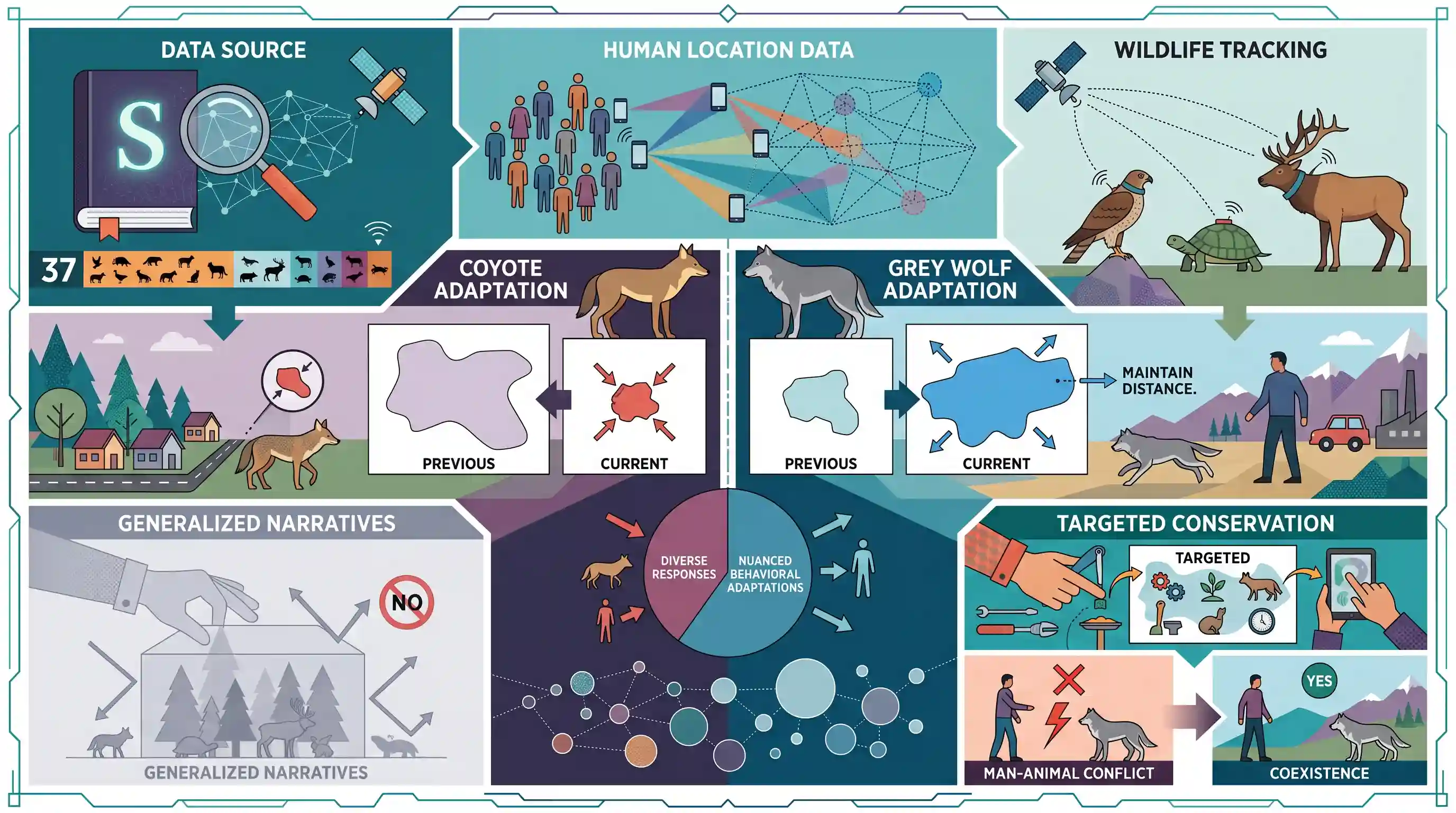
A recent study in the journal Science highlights how various wildlife species adapt their spatial behavior in response to human presence, utilizing GPS tracking of 37 species alongside human cellphone location data. The findings reveal diverse responses, from coyotes shrinking their roaming areas to grey wolves expanding theirs to maintain distance. The editorial emphasizes that understanding these nuanced behavioral adaptations is crucial for developing targeted conservation strategies and minimizing man-animal conflict, moving beyond generalized narratives about human impacts on ecosystems.
Key Points
- A recent study published in Science utilized GPS tracking on 37 species of birds and mammals, correlating it with cellphone location data to understand how human presence impacts wildlife behavior.
- The findings showed varied responses: species like coyotes and wild turkeys reduced their roaming areas in human-populated zones, while species like grey wolves expanded their ranges to avoid humans.
- Utilizing such spatial and behavioral data allows ecologists to design nuanced, granular strategies for wildlife conservation and man-animal conflict mitigation.
- The editorial cautions against simplistic narratives such as 'humans are the virus', emphasizing that effective biodiversity protection demands rigorous, data-driven approaches.
Important Terms
Anthropause

A period of significant global reduction in human activity, particularly during COVID-19 lockdowns, allowing scientists to study wildlife behavior in the absence of human interference.
UPSC context
Relevant for GS Paper III (Environment); used to discuss human impact on biodiversity and ecological research methodology.
Human-Wildlife Conflict (HWC)
Negative interactions between humans and wildlife that lead to resource competition, property damage, or loss of life, requiring management strategies to ensure shared space.
UPSC context
Core topic for GS Paper III (Environment and Disaster Management); tests understanding of conservation and community-led mitigation.
Bio-logging
The use of electronic tags (such as GPS collars) to monitor and record the movement, physiology, and behavior of animals in their natural habitats.
UPSC context
GS Paper III (Science & Technology); focuses on the application of technology in wildlife conservation and monitoring.
Landscape Modification
Human-induced physical changes to natural environments, such as urbanization, agriculture, and infrastructure development, which alter animal movement and habitat availability.
UPSC context
GS Paper III (Environment); relates to habitat fragmentation and its impact on ecosystem services and species survival.
Environmental Niche
The range of environmental conditions and resources within which a species can survive and reproduce; human presence can shrink or shift this spatial niche.
UPSC context
GS Paper III (Ecology); tests fundamental concepts of species interaction and adaptation in human-dominated landscapes.
Coexistence
A conservation approach that focuses on humans and wildlife sharing the same landscape through nuanced management, rather than total exclusion or removal of humans.
UPSC context
GS Paper I (Society) and III (Environment); examines the ethics and policy of balancing development with wildlife protection.
Science (journal)
A prestigious, peer-reviewed international scientific journal where the foundational study on wildlife's spatial response to human presence was published.
UPSC context
General awareness; often cited in UPSC Science & Tech for high-impact global research findings.
Prelims Trap
Human encroachment uniformly restricts the roaming ranges and territory size of all wildlife species.
Wildlife responses to human presence are highly species-specific. While some species shrink their territories, others (like grey wolves) actually expand their ranges to maintain distance.
Static Concepts Connected
How are modern technologies applied in wildlife monitoring and conservation?
- GPS Telemetry: Used to track real-time animal movement, spatial ecology, and behavioral adaptations in response to habitat changes.
- AI & Camera Traps: Pattern recognition software (e.g., used in M-STrIPES) conducts accurate species censuses by analyzing unique physical markings.
- GIS & Big Data: Overlaying habitat variables with human mobility data helps ecologists design dynamic wildlife corridors and mitigate conflict.
What are the behavioral categories of wildlife in human-dominated landscapes?
- Urban Avoiders: Species highly sensitive to human presence that require large pristine habitats to survive (e.g., large apex predators).
- Urban Adapters (Synanthropes): Species that thrive in human-modified environments, adjusting their diets and spatial navigation to coexist (e.g., coyotes, macaques).
Cross-Topic Patterns
Big Data in Species Conservation
Merging human cellphone location data with wildlife GPS coordinates exemplifies Big Data (GS-3 S&T) directly informing dynamic early warning systems for Man-Animal Conflict mitigation (GS-3 Environment).
Shift from Fortress Conservation
Nuanced tracking supports moving away from exclusionary 'fortress' protected areas towards dynamic coexistence models, aligning ecological protection with rights-based legislation like the Forest Rights Act (FRA 2006).

Expect a prelims statement testing if wildlife uniformly reduces roaming near humans, paired with applications of Big Data in conservation.
Linked PYQs · 1
Linked PYQs · 1
- 2017PrelimsGS1
The term 'M-STRIPES' is sometimes seen in the news in the context of
