Heatwave and Monsoon Weather Patterns Across Bihar Districts
Source:navbharat-times ↗
Why It Matters
BPSC frequently tests candidates on Bihar-specific geography, localized climate phenomena (like Loo, heatwaves, lightning), and the IMD's technical criteria for declaring meteorological events (e.g., heatwave thresholds for plains vs. hilly regions).
Summary
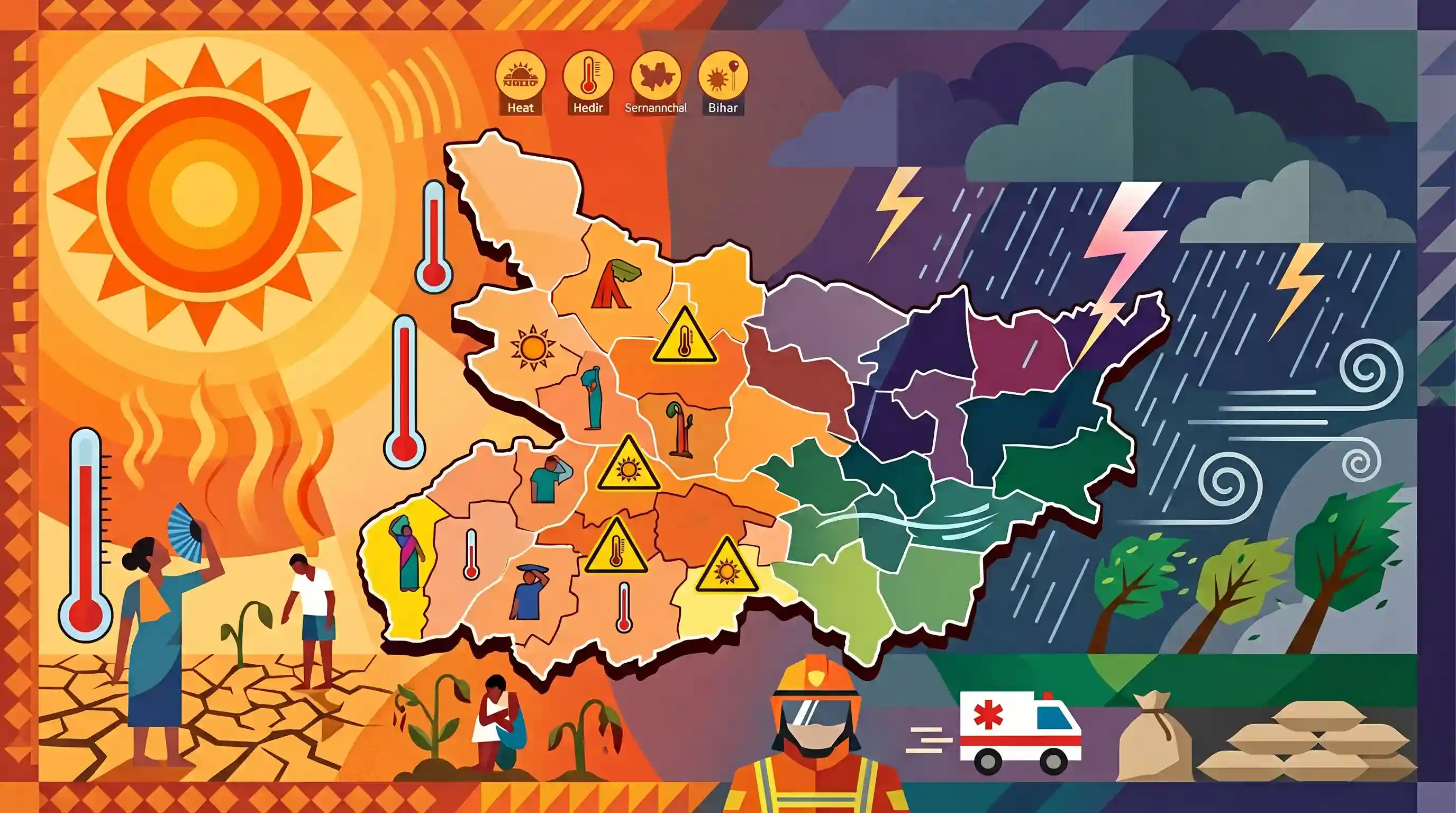
The article details the severe heatwave situation in Bihar in June 2026, where temperatures soared past 40°C in multiple cities. The Patna Meteorological Center issued a yellow heatwave alert for 11 districts, while simultaneously forecasting lightning and thunderstorms in the Kosi and Seemanchal regions, showcasing a contrasting subtropical monsoon climate dynamic across the state.
Key Points
- In early June 2026, Bihar experienced severe heatwave conditions with temperatures exceeding 40°C in Buxar, Dehri, Valmiki Nagar, and Kaimur (Bhabhua).
- The Patna Meteorological Center issued a yellow alert for heatwave (लू) for 11 districts, advising caution during peak afternoon hours.
- Simultaneously, a distinct contrasting weather pattern was observed as North-Eastern regions (Kosi, Seemanchal, and Mithila) experienced thunderstorms and lightning (Vajrapat) with localized moderate-to-heavy rainfall.
- Adhwara in Bhabhua recorded the highest rainfall of 55 mm, followed by Durgawati with 21 mm and Chenari in Rohtas with 18 mm, amidst the dry spell.
- IMD projected the heatwave to intensify further across South Bihar and parts of North Bihar from June 6 to June 8, before offering relief after June 9.
Important Terms
Indian Meteorological Department (IMD)

India's principal government agency under the Ministry of Earth Sciences, tasked with weather forecasting, meteorological observations, and early warnings for hazards.
UPSC context
GS Paper I (Geography) & GS III (Disaster Management); tests institutional knowledge of national weather warning agencies.
Heatwave
A period of abnormally high temperatures, declared in Indian plains when station temperatures reach 40°C or more, with a departure from normal of 4.5°C to 6.4°C.
UPSC context
GS Paper I (Climatology) & GS III (Disaster Management); tests knowledge of extreme climatic hazards and public health risks.
Yellow Alert
An early-warning weather advisory issued by the IMD instructing authorities and citizens to "be aware" of potential weather disruptions and prepare for deteriorating conditions.
UPSC context
GS Paper III (Disaster Management); tests understanding of emergency-response protocols and color-coded early-warning systems.
Subtropical Monsoon Climate (Cwa)
A climate type (classified as Cwa under Köppen's scheme) featuring dry winters, hot summers, and highly seasonal monsoonal rainfall that predominantly covers Bihar.
UPSC context
GS Paper I (Physical Geography); tests understanding of empirical climate classification systems and India's regional climate patterns.
Prelims Trap
IMD declares heatwaves solely based on absolute temperature thresholds across all Indian terrains.
IMD uses a dual criteria: absolute temperatures (e.g., >= 45°C) OR departure from normal (4.5°C to 6.4°C), provided minimum absolute thresholds of 40°C (plains) or 30°C (hills) are crossed.
Static Concepts Connected
What are the exact criteria used by the IMD to define and declare a Heatwave?
- Base Thresholds: Maximum temperature must reach at least 40°C in Plains, 37°C in Coastal regions, and 30°C in Hilly areas to qualify for consideration.
- Normal Departure: Declared when departure from normal is 4.5°C to 6.4°C; it is classified as a severe heatwave if the departure exceeds 6.4°C.
- Absolute Temperature: Regardless of normal departure, a heatwave is declared if the actual maximum temperature reaches 45°C, and severe if it touches 47°C.
What thermodynamic factors cause lightning (Vajrapat) to be highly frequent in Eastern India?
- Convective Instability: Intense pre-monsoon land heating creates strong convective updrafts that carry moisture high into the freezing zone of the atmosphere.
- Air Mass Collision: Warm, moist air from the Bay of Bengal collides with dry, cool winds from northern mountains, creating highly unstable thunderclouds.
- Charge Separation: Friction between upward-moving ice crystals and downward-moving hail separates electrical charges, generating massive cloud-to-ground discharges.
Cross-Topic Patterns
Wet-bulb limits and heat resilience
Rising heatwaves combined with high humidity in the Gangetic plains push wet-bulb temperatures toward human survivability limits, driving policy shifts in urban labor and cooling codes.
Lightning hazards and disaster governance
Increasing lightning frequency in Eastern India highlights the need to integrate localized early-warning apps with NDMA guidelines to classify lightning as a notified natural disaster.

IMD's terrain-specific heatwave criteria and thermodynamic conditions driving localized lightning (Vajrapat) are highly testable in Prelims 2026.
Linked PYQs · 3
Linked PYQs · 3
- 2023BPSC_PRELIMSGS1
Consider the following statements regarding ‘heat wave’: 1. Heat wave is considered if the maximum temperature of a station reaches at least 30 °C or more for plains. 2. Heat wave is considered if the maximum temperature of a station reaches at least 40 °C or more for hilly regions.
- 2025BPSC_PRELIMSGS1
Most of the Bihar comes under which of the following climate type?
- 2022BPSC_PRELIMSGS1
Which agroclimatic region of Bihar has the highest number of districts?
