Indo-US Strategic Divergence and Foreign Policy Autonomy
Source:Indian Express ↗
Why It Matters
The article critically reassesses the Indo-US strategic partnership, highlighting structural divergences, the risks of aligning with US geopolitical goals at the expense of strategic autonomy, and the economic vulnerabilities India faces regarding energy security and technology.
Summary
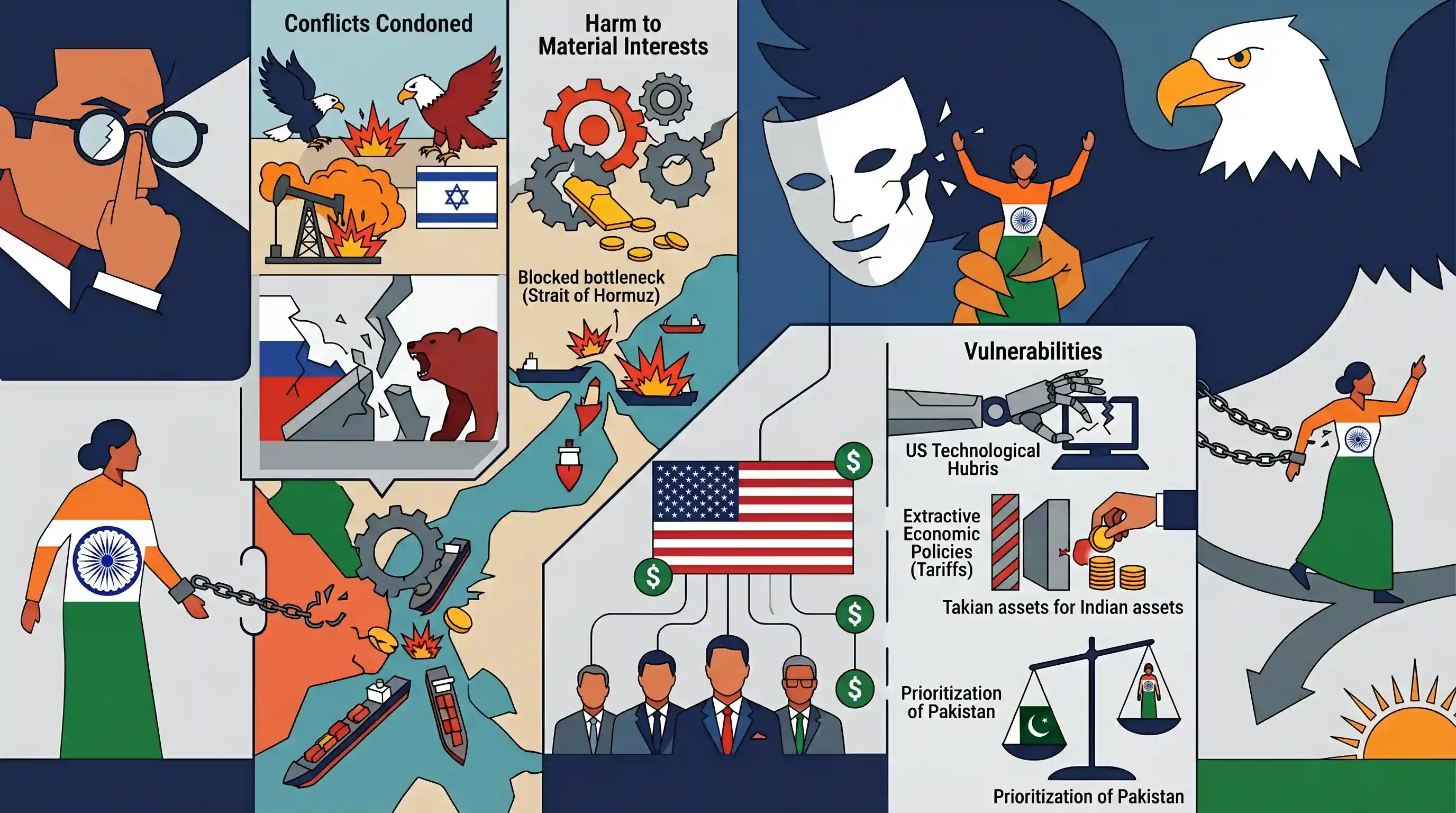
Pratap Bhanu Mehta critiques India's deepening alignment with the US, warning against America's imperial trajectory and unreliability as an ally. He argues India's foreign policy is becoming myopic by tacitly condoning conflicts (such as the US/Israel in the Middle East and Russia in Ukraine) which ultimately harm its long-term material interests—like potential economic damage from disruptions in the Strait of Hormuz. Despite superficial displays of strategic autonomy, India’s foreign policy establishment has dangerously tied its rise to American power. Mehta highlights vulnerabilities in this relationship, including US technological hubris, extractive economic policies (tariffs), and America's enduring prioritization of Pakistan as a regional arbiter, urging India to confront the reality that its interests do not easily align with Washington's.
Key Points
- Compromised Strategic Autonomy: Although India exercises superficial rituals of strategic autonomy, its foreign policy establishment has increasingly tied the nation's global rise to American power.
- Geopolitical Missteps and Energy Security: India's tacit endorsement of US and Israeli actions in the Middle East risks severe economic fallout, especially if vital trade and energy routes like the Strait of Hormuz are disrupted.
- The Enduring Pakistan Factor: The assumption that the US views Pakistan through an Indian lens is flawed; the US continues to treat Pakistan as crucial to its regional imperial interests.
- Economic and Technological Extraction: While deeper economic ties with the US could be beneficial, America's approach remains highly extractive, characterized by punitive tariffs and a hubristic belief in India's dependency on US technology.
- Critique of US Imperialism: The author portrays the US as an imperial power posing a threat to global stability, cautioning India against abandoning a genuinely multipolar vision for short-term tactical gains.
Important Terms
Operation Sindoor

A 2025 Indian tri-service military strike targeting nine terrorist camps in Pakistan and PoJK. It marked a significant shift toward proactive, conventional retaliation in India's counter-terrorism doctrine.
UPSC context
GS Paper II (IR) & III (Security). Tests understanding of India's evolving neighborhood policy and counter-terrorism strategies post-2025.
Strategic Autonomy
The pursuit of foreign policy interests without being forced into binding alliances or dependent on any single power. It remains the bedrock of India's non-aligned-plus posture.
UPSC context
GS Paper II (International Relations). Central to discussions on India-US ties and the challenge of balancing global powers.
US Supreme Court
The highest judicial body in the U.S. In the article's context, it struck down unilateral presidential tariffs, highlighting the legal constraints on American protectionism and trade policy.
UPSC context
GS Paper II (Comparison of Constitutions). Tests knowledge of separation of powers and its impact on international trade agreements.
Ambani and Adani Groups
Major Indian private conglomerates whose extensive economic footprint and global investment strategies are seen as influential factors—and potential vulnerabilities—in India’s strategic and political economy.
UPSC context
GS Paper III (Economy). Relates to the intersection of big capital, infrastructure, and national security in foreign policy.
Strait of Hormuz
A vital maritime chokepoint connecting the Persian Gulf and the Gulf of Oman. It is the world's most important oil transit route, critical for India's energy security.
UPSC context
GS Paper I (Geography) & II (IR). Focuses on energy security and the impact of Middle East conflicts on Indian trade.
Regional Arbiter
The role of an external power (like the US) mediating between regional rivals. India traditionally rejects this in favor of bilateralism, particularly regarding the Kashmir dispute.
UPSC context
GS Paper II (IR). Relevant to India-Pakistan relations and the influence of 'third parties' in South Asian stability.
Prelims Trap
The US has entirely de-hyphenated its foreign policy regarding India and Pakistan.
While diplomatic rhetoric emphasizes 'de-hyphenation', the US still structurally leverages Pakistan for its regional strategic and security interests, remaining a friction point.
Static Concepts Connected
How does 'Strategic Autonomy' differ from traditional 'Non-Alignment'?
- Non-Alignment: Rooted in Cold War bipolarity, it traditionally meant avoiding formal military alliances and maintaining a passive distance from superpower blocs.
- Strategic Autonomy: Involves active, issue-based alignment with multiple, often rival, powers (e.g., Quad and BRICS) to maximize national interests without rigid alliance constraints.
Why is the Strait of Hormuz geographically and economically critical to India?
- Geographic Location: It is a narrow maritime chokepoint connecting the Persian Gulf to the Gulf of Oman and the Arabian Sea.
- Global Energy Transit: It is the world's most vital oil transit chokepoint, handling roughly 20% of global petroleum consumption daily.
- India's Dependency: Serves as the primary artery for India's crude oil and LNG imports from major West Asian suppliers like Saudi Arabia, Iraq, and the UAE.
Cross-Topic Patterns
US Protectionism and WTO Gridlock
US reliance on punitive tariffs and domestic subsidies undercuts WTO principles, forcing India to navigate complex bilateral trade pacts while facing unpredictable export barriers.
iCET and Technological Dependency
Initiatives like iCET aim for joint S&T development but risk locking India into US tech ecosystems, sparking debates over true semiconductor and data sovereignty.

Expect a 2026 Mains question linking India's strategic autonomy to the economic vulnerabilities of maritime chokepoints and US protectionism.
Linked PYQs · 5
Linked PYQs · 5
- 2019MainsGS2
‘What introduces friction into the ties between India and the United States is that Washington is still unable to find for India a position in its global strategy, which would satisfy India's national self-esteem and ambitions.’ Explain with suitable examples.
- 2025MainsGS2
"Energy security constitutes the dominant kingpin of India's foreign policy, and is linked with India's overarching influence in Middle Eastern countries.” How would you integrate energy security with India's foreign policy trajectories in the coming years?
- 2025MainsGS3
What are the challenges before the Indian economy when the world is moving away from free trade and multilateralism to protectionism and bilateralism? How can these challenges be met?
- 2018MainsGS3
How would the recent phenomena of protectionism and currency manipulations in world trade affect macroeconomic stability of India?
- 2018MainsGS2
“India’s relations with Israel have, of late, acquired a depth and diversity, which cannot be rolled back.” Discuss.
