All-party delegations and domestic consensus on national security
Source:Indian Express ↗
Why It Matters
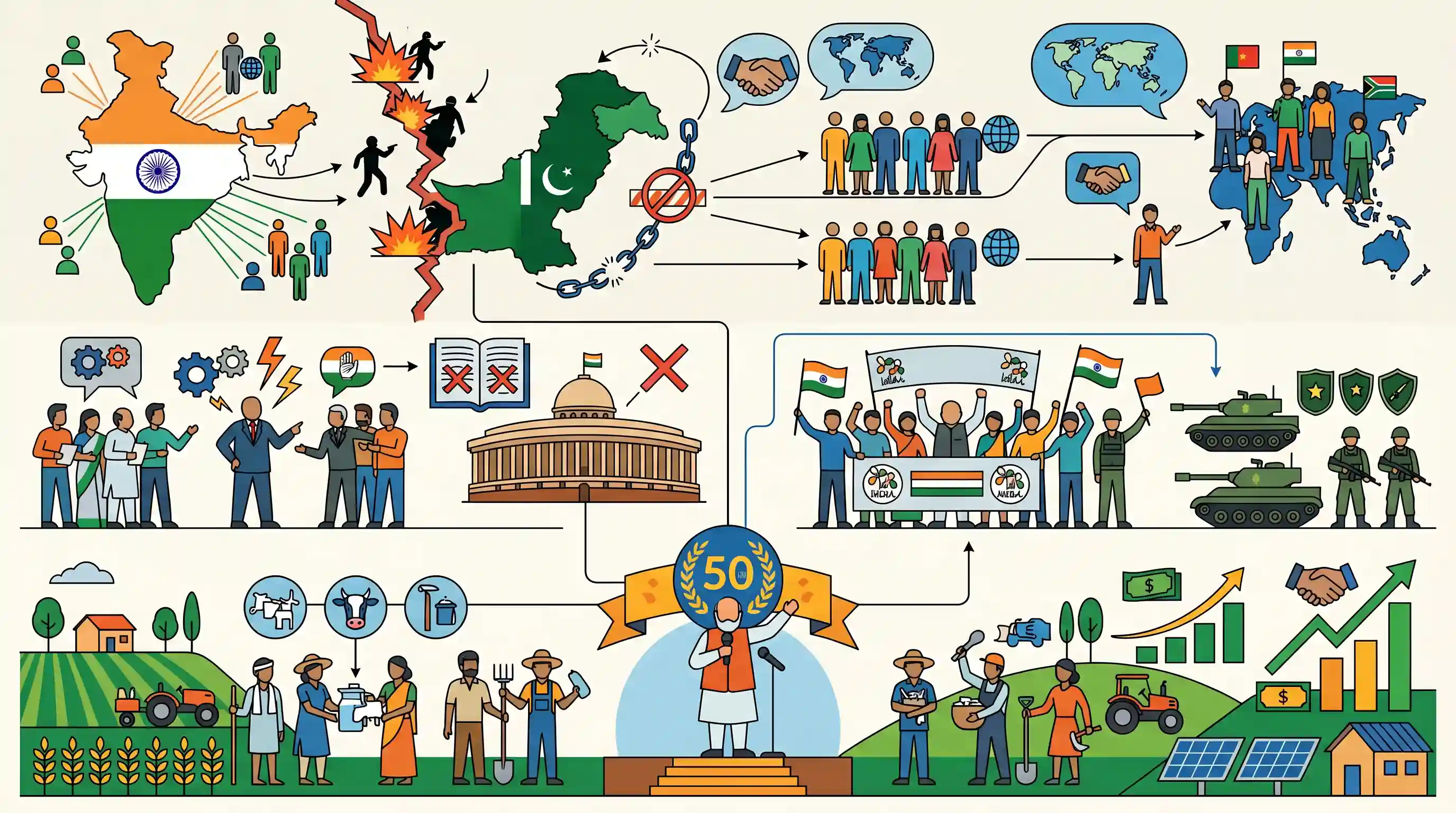
The article demonstrates the intersection of domestic politics and foreign policy during national security crises. It highlights mechanisms of diplomatic outreach (all-party delegations) to counter state-sponsored terrorism, the constitutional conventions of building political consensus, and also provides a minor update on the cooperative sector's role in rural development.
Summary
The Indian government has initiated a diplomatic offensive to isolate Pakistan internationally following the Pahalgam terror attack and 'Operation Sindoor', sending all-party delegations abroad to convey its stance against cross-border terrorism. The move has led to domestic political friction, with the Congress criticizing the Centre for bypassing conventions like all-party meetings or special parliamentary sessions. Meanwhile, the Trinamool Congress has launched public rallies to support the Armed Forces. Separately, Union Minister Amit Shah emphasized the role of cooperatives in rural development during the Golden Jubilee celebrations of the Gujarat State Co-operative Union.
Key Points
- Following the Pahalgam terror attack, India launched 'Operation Sindoor' and is now sending all-party delegations abroad to diplomatically isolate Pakistan over cross-border terrorism.
- The Congress party has criticized the Centre for forming global delegations without first holding a traditional all-party meeting or a special session of Parliament to discuss the security crisis.
- The Trinamool Congress (TMC) responded to the geopolitical situation by organizing statewide rallies in West Bengal to honour and support the Armed Forces.
- Union Minister Amit Shah attended the Golden Jubilee of the Gujarat State Co-operative Union, inaugurating a nursing college and a potato processing plant to boost the rural cooperative economy.
Important Terms
Operation Sindoor

Retaliatory precision strikes by the Indian Armed Forces in May 2025 targeting terrorist infrastructure in Pakistan and PoJK following the Pahalgam terror attack.
UPSC context
GS Paper III: Internal Security/Terrorism; tests understanding of India's evolving counter-terrorism doctrine and cross-border military responses.
Pahalgam Terror Attack
A 2025 terror strike in Kashmir's Baisaran Valley killing 26 tourists, attributed to 'The Resistance Front' (TRF), triggering 'Operation Sindoor' and the suspension of the Indus Waters Treaty.
UPSC context
GS Paper III: Security challenges in J&K; examines the impact of terrorism on tourism and regional stability.
All-party Delegation
A diplomatic outreach initiative where multi-party MPs are sent to global capitals to project a unified national stance on cross-border terrorism following major security incidents.
UPSC context
GS Paper II: Parliament/Foreign Policy; tests the role of parliamentary diplomacy and government-opposition consensus in international relations.
Banas Dairy
Asia’s largest dairy cooperative based in Gujarat, recognized for its 'circular economy' model and contributing to 'White Revolution 2.0' through livestock waste management.
UPSC context
GS Paper III: Agriculture/Economy; a case study for cooperative-led rural development and the dairy sector's role in doubling farmers' income.
Circular Economy (Dairy)
A waste-to-wealth economic model implemented at Banas Dairy, converting cattle dung into biogas and bio-fertilizer to increase dairy farmers' income by an estimated 20%.
UPSC context
GS Paper III: Environment/Economy; explores sustainable agriculture practices and resource efficiency in the primary sector.
Gujarat State Co-operative Union
A key body promoting the cooperative movement in Gujarat, focusing on revitalizing Primary Agricultural Credit Societies (PACS) and grassroots rural infrastructure.
UPSC context
GS Paper III: Indian Economy/Cooperatives; relevant for the 'Sahakar Se Samriddhi' initiative and the institutional framework of cooperatives.
Prelims Trap
All-party meetings are a statutory mandate during national security crises.
All-party meetings operate purely as a political convention to foster consensus. They have no statutory, legal, or constitutional backing in India's parliamentary framework.
Static Concepts Connected
How did the 97th Amendment alter the constitutional status of cooperatives?
- Fundamental Right: Article 19(1)(c) was amended to explicitly include the right to form cooperative societies.
- Directive Principle: Article 43B was added, directing the State to promote the voluntary formation, autonomous functioning, and democratic control of cooperatives.
- Part IXB: Inserted to provide a detailed constitutional framework for the incorporation, board structure, and regulation of multi-state and state-level cooperatives.
What is the role of Parliamentary Diplomacy in foreign policy?
- Mechanism: It leverages lawmakers via all-party delegations and friendship groups to project democratic consensus and build international legislative networks.
- Complementary Diplomacy: It acts as a soft-power tool, complementing formal executive-led diplomacy (like the MEA) by engaging foreign parliaments and civil society.
Cross-Topic Patterns
National Security & Executive Dominance
Bypassing conventions like all-party meetings during 'Op Sindoor' illustrates the centralization of foreign policy and security decisions in the executive branch, bypassing legislative oversight conventions.
Cooperatives in Agro-Processing
Linking cooperative unions to potato processing plants bridges Part IXB of the Constitution (Polity) with agricultural value addition and rural employment (GS3 Economy).

Expect a multi-statement Prelims question testing the constitutional backing of Cooperatives (97th CAA) alongside their economic mandate.
Linked PYQs · 3
Linked PYQs · 3
- 2016MainsGS2
Increasing cross-border terrorist attacks in India and growing interference in the internal affairs of several member-states by Pakistan are not conducive for the future of SAARC (South Asian Association for Regional Cooperation)." Explain with suitable examples.
- 2015MainsGS2
Terrorist activities and mutual distrust have clouded India-Pakistan relations. To what extent the use of soft power like sports and cultural exchanges could help generate goodwill between the two countries? Discuss with suitable examples.
- 2014MainsGS3
In the villages itself no form of credit organization will be suitable except the cooperative society. -All India Rural Credit Survey. Discuss this statement in the background of agricultural finance in India. What constraints and challenges do financial institutions supplying agricultural finance face? How can technology be used to better reach and serve rural clients?
