Uttarakhand Uniform Civil Code Ensures Women Security
Source:economic-times ↗
Why It Matters
The passage of the Uniform Civil Code by Uttarakhand is a historic legislative milestone in independent India. It is highly relevant for UKPSC PCS Prelims as it touches upon constitutional provisions (Article 44), state governance, and crucial social justice issues like women's rights and gender equality.
Summary
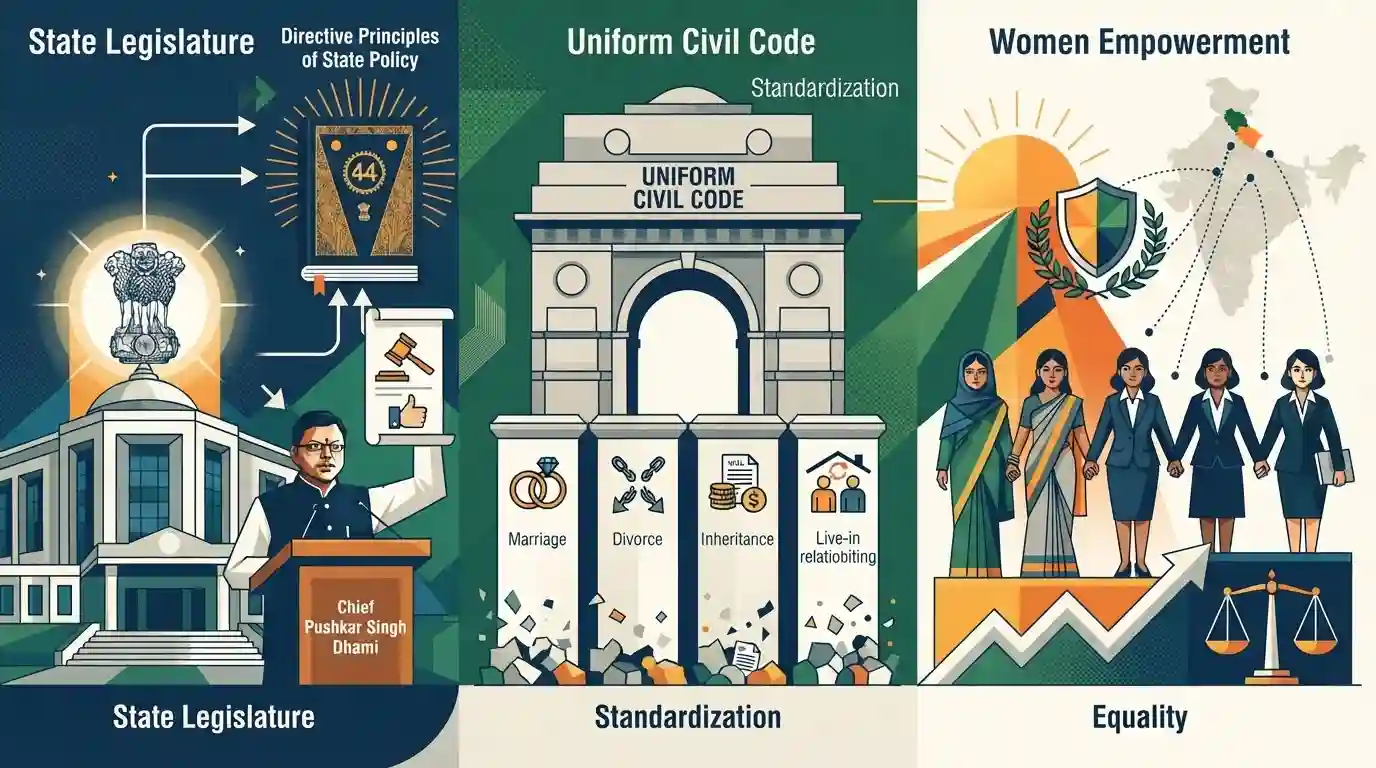
Uttarakhand Chief Minister Pushkar Singh Dhami has highlighted the state's Uniform Civil Code (UCC) as a landmark legislation that guarantees complete security and empowerment for women. By standardizing laws related to marriage, divorce, inheritance, and live-in relationships across all religious communities, the UCC aims to eliminate discriminatory practices present in various personal laws. Uttarakhand's move to become the first state in independent India to pass a UCC bill represents a significant step towards fulfilling the constitutional vision of Article 44 under the Directive Principles of State Policy, serving as a potential model for nationwide implementation.
Key Points
- Uttarakhand Chief Minister Pushkar Singh Dhami stated that the Uniform Civil Code (UCC) is the most comprehensive law ensuring 100% security and empowerment for women.
- Uttarakhand is the first state in independent India to pass a UCC bill, aiming to regulate personal matters like marriage, divorce, inheritance, and live-in relationships under a uniform law for all citizens.
- The legislation focuses on bringing gender parity, ending discriminatory personal laws across different religious communities, and guaranteeing equal inheritance and divorce rights for women.
- The implementation of the UCC aligns with the constitutional mandate under Article 44 of the Directive Principles of State Policy (DPSP), urging the state to secure a uniform civil code for its citizens.
Important Terms
Uniform Civil Code (UCC) Bill

A landmark legal framework standardizing personal laws—marriage, divorce, inheritance, and live-in relationships—for all citizens regardless of religion, exempting Scheduled Tribes. Uttarakhand is the first state to implement it post-independence.
UPSC context
Highly relevant for UKPSC General Studies (Polity). Tests knowledge of state-specific pioneering legislation and gender justice policies.
Article 44 (Directive Principles of State Policy)
A constitutional provision under Part IV (Directive Principles of State Policy) instructing the State to endeavor to secure a uniform civil code for all citizens throughout the territory of India.
UPSC context
Essential for UKPSC Prelims and Mains (Polity). Tests the constitutional foundation for the UCC and non-justiciable DPSP.
Uttarakhand Legislative Assembly
The unicameral state legislature of Uttarakhand. In February 2024, it made history by becoming the first legislative assembly in post-independence India to pass the Uniform Civil Code Bill.
UPSC context
Important for UKPSC State Specific GK. Tests awareness of the state's law-making body and recent historic legislative milestones.
Government of Uttarakhand
The state's supreme executive authority, currently led by Chief Minister Pushkar Singh Dhami. The administration successfully drafted, passed, and implemented the UCC to fulfill its electoral and constitutional promises.
UPSC context
Pertinent to UKPSC GS papers. Tests knowledge of state administration, political leadership, and major policy implementation.
Prelims Trap
The Uttarakhand UCC applies uniformly to all citizens residing within the state's territory.
False. Scheduled Tribes (STs) are explicitly exempted from the Uttarakhand UCC provisions to protect their distinct cultural and customary rights.
Static Concepts Connected
What gives states the power to enact a Uniform Civil Code?
- Concurrent List: Personal matters like marriage, divorce, and inheritance fall under Entry 5 of the Concurrent List (Schedule VII), allowing state legislatures to pass laws.
- DPSP Mandate: Article 44 of the Directive Principles directs the State to secure a Uniform Civil Code, empowering both central and state governments to take legislative action.
- Presidential Assent: Under Article 254(2), a state law on a Concurrent List subject that modifies existing central laws requires the President's assent to be enacted.
Who drafted the Uttarakhand UCC and who is exempted?
- Drafting Committee: A five-member expert panel led by retired Supreme Court Judge Justice Ranjana Prakash Desai drafted the legislation.
- ST Exemption: Scheduled Tribes (STs), constituting roughly 2.9% of the state's population (like Tharu and Jaunsari), are explicitly exempted to protect their customary practices.
- Live-in Registry: Live-in relationships now require mandatory legal registration with a designated authority, a unique feature of this state law.
Cross-Topic Patterns
UCC + Tribal Demographics
Exempting STs from the UCC makes Uttarakhand's specific tribal groups (Jaunsari, Tharu, Buksa, Bhotia, Raji) a prime target for concurrent geography and culture questions in prelims.
DPSP + Concurrent List Dynamics
Uttarakhand's move illustrates state-level activation of DPSP (Article 44) using Concurrent List Entry 5 (Personal laws), which ultimately required Presidential assent under Article 254(2).

Expect a UKPSC question linking UCC's specific exemptions (STs) and new clauses (live-in registry) with the Justice Ranjana Desai panel.
Linked PYQs · 1
Linked PYQs · 1
- 2024UKPSC_PRELIMSGS1
Regarding the Directive Principles of State Policy, which one of the following statements is not correct ?
