Preventive Healthcare Strategy Against Rising Cancer Burden
Source:Indian Express ↗
Why It Matters
The article provides crucial insights into the rising burden of non-communicable diseases in India, specifically cancer. It highlights the intersection of public policy, healthcare infrastructure, and technological innovation (like AI and CAR-T cell therapy), which is vital for UPSC aspirants covering health sector reforms, sustainable development, and social justice.
Summary
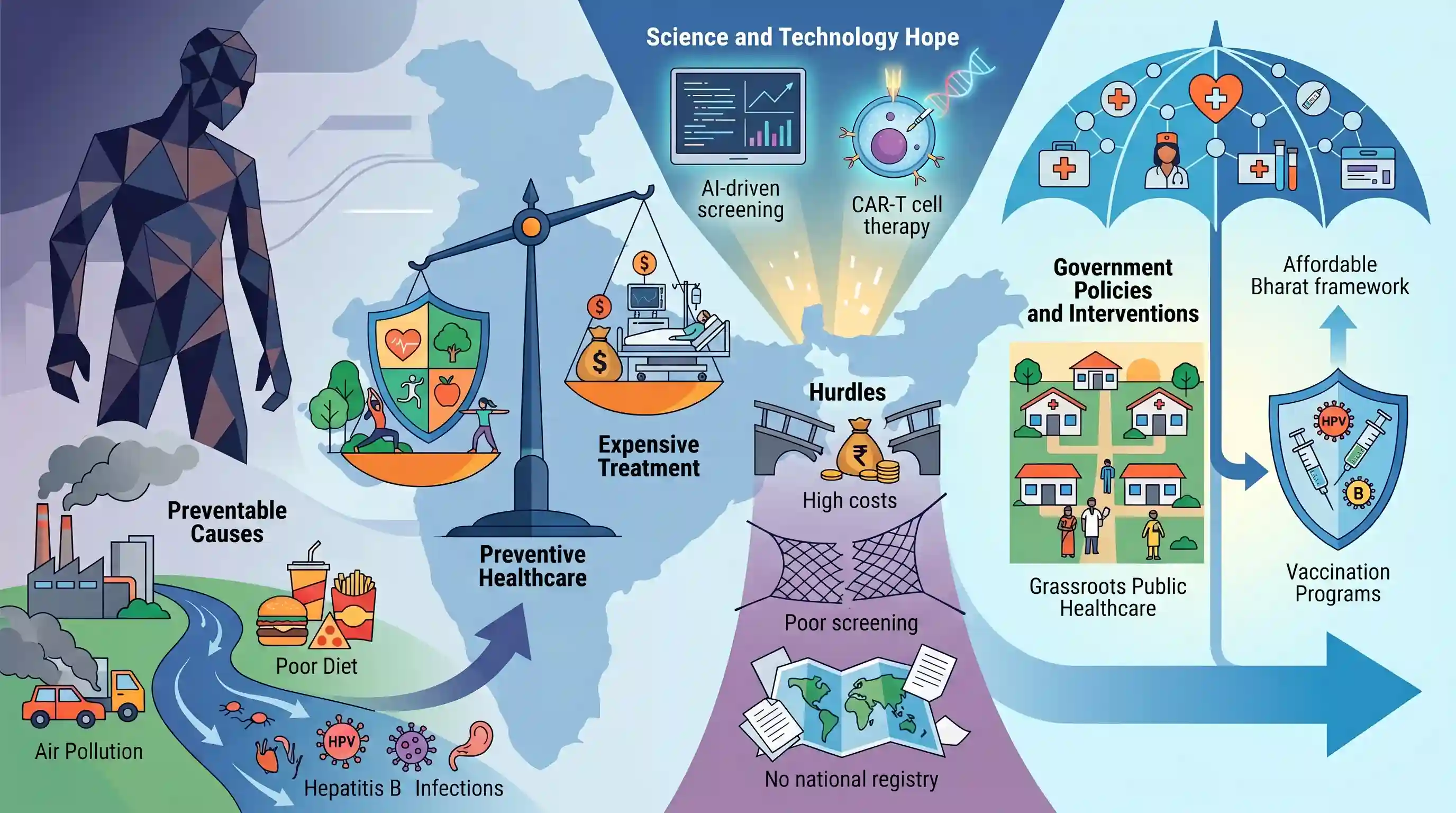
The article examines India's escalating cancer crisis, emphasizing the critical need to prioritize preventive healthcare over increasingly expensive treatments. Highlighting a recent Lancet report, it points out that the majority of cancer cases in India stem from preventable factors like air pollution, poor diet, and infections. While technological interventions such as AI-driven screening and the indigenous CAR-T cell therapy offer hope, significant hurdles remain, including exorbitant treatment costs, inadequate screening coverage, and the lack of a comprehensive national cancer registry. To curb this rising disease burden, India must strengthen grassroots public healthcare initiatives, expand vaccination programs (HPV and Hepatitis B), and scale up affordable diagnostics under frameworks like Ayushman Bharat.
Key Points
- A Lancet report reveals that over 70% of cancer cases in India are linked to preventable or modifiable risk factors such as tobacco, air pollution, and poor diet.
- India's cancer policy must pivot from a treatment-centric approach to making prevention and early detection the backbone of public health strategies.
- Technological innovations like AI-enabled screening, mobile vans, and tele-oncology are promising but require rapid scaling across the country.
- Despite the indigenous development of CAR-T cell therapy (NexCAR19), such advanced treatments remain prohibitively expensive for the masses.
- There is an urgent need to build a comprehensive national cancer registry and map to accurately track and manage the incidence of the disease.
Important Terms
Ayushman Bharat

India's flagship health initiative aiming for Universal Health Coverage through primary-level Ayushman Arogya Mandirs and secondary/tertiary insurance (PM-JAY) providing ₹5 lakh coverage per family annually.
UPSC context
GS Paper II: Social Justice/Health; tests understanding of Universal Health Coverage and government-led financial protection in healthcare.
CAR-T cell therapy
A breakthrough immunotherapy where a patient's T-cells are genetically engineered to express Chimeric Antigen Receptors (CARs), enabling them to recognize and destroy specific cancer cells.
UPSC context
GS Paper III: Science & Technology; tests knowledge of biotechnology, immunology, and personalized medicine for cancer treatment.
NexCAR19
India's first indigenously developed CAR-T cell therapy, designed to treat B-cell lymphomas and leukemia at a fraction of the cost of international alternatives.
UPSC context
GS Paper III: Science & Technology; highlights indigenous R&D achievements and affordability in high-end medical technology.
HPV Vaccine
A vaccine protecting against high-risk Human Papillomavirus strains (primarily 16 and 18) that cause the majority of cervical cancers; targeted for adolescent girls.
UPSC context
GS Paper II: Health/Social Sector; relevant for maternal health and the National Immunization Program's expansion.
Hepatitis B Vaccine
A preventive vaccine against the Hepatitis B virus, a major cause of liver cirrhosis and liver cancer; integrated into India's Universal Immunization Programme (UIP).
UPSC context
GS Paper II/III: Health Policy; tests knowledge of preventive healthcare strategies for reducing non-communicable disease burdens.
The Lancet
A premier global medical journal whose research and commission reports provide critical data for shaping international health policy and tracking developmental goals.
UPSC context
General Awareness: Used as an authoritative source for evidence-based policymaking in health and environmental sectors.
Prelims Trap
Cancer is strictly a non-communicable disease completely unaffected by infectious agents.
UPSC often tests NCD definitions. Certain major cancers (cervical, liver) are triggered by infectious viral agents (HPV, Hepatitis B/C), making them preventable via vaccines.
Static Concepts Connected
How does CAR-T cell therapy work compared to standard treatments?
- Mechanism: Instead of using chemical drugs to kill rapidly dividing cells (chemotherapy), it genetically modifies a patient's own T-cells to identify and attack cancer cells.
- Personalization: It is an autologous treatment, meaning it is highly customized to the individual's immune system, making it more targeted but complex and expensive.
- Target Scope: Currently, it is highly effective for specific blood cancers (like leukemia and lymphoma) but struggles against solid tumors.
What is the National Cancer Registry Programme (NCRP)?
- Nodal Agency: It is administered by the Indian Council of Medical Research (ICMR) and coordinates a network of population and hospital-based registries.
- Policy Utility: It generates epidemiological data that forms the backbone of the National Programme for Prevention and Control of Cancer, Diabetes, CVD and Stroke (NPCDCS).
Cross-Topic Patterns
Indigenous Biotech & Health Equity
Merging GS3 indigenisation (Cervavac, NexCAR19) with GS2 public health bridges the gap between advanced scientific breakthroughs and mass affordability under frameworks like Ayushman Bharat.
Environmental drivers of NCDs
The Lancet linking air pollution to India's cancer burden shifts the pollution debate from a purely GS3 ecological issue to a critical GS2 public health and demographic challenge.

Expect a multi-statement Prelims question comparing the mechanism of CAR-T cell therapy with mRNA vaccines and traditional chemotherapy.
Linked PYQs · 4
Linked PYQs · 4
- 2024MainsGS2
In a crucial domain like the public healthcare system the Indian State should play a vital role to contain the adverse impact of marketisation of the system. Suggest some measures through which the State can enhance the reach of public healthcare at the grassroots level.
- 2021MainsGS2
“Besides being a moral imperative of a Welfare State, primary health structure is a necessary precondition for sustainable development.” Analyze.
- 2023MainsGS3
Introduce the concept of Artificial Intelligence (AI). How does Al help clinical diagnosis? Do you perceive any threat to privacy of the individual in the use of Al in healthcare?
- 2017MainsGS3
Stem cell therapy is gaining popularity in India to treat a wide variety of medical conditions including Leukaemia, Thalassemia, damaged cornea and severe burns. Describe briefly what stem cell therapy is and what advantages it has over other treatments?
