Structural Reforms for Supreme Court and Regional Benches
Source:The Hindu ↗
Why It Matters
Provides critical insights into structural reforms of the judiciary, addressing systemic issues like case pendency, access to justice, and the dual role of the Supreme Court as a constitutional and ultimate appellate court.
Summary
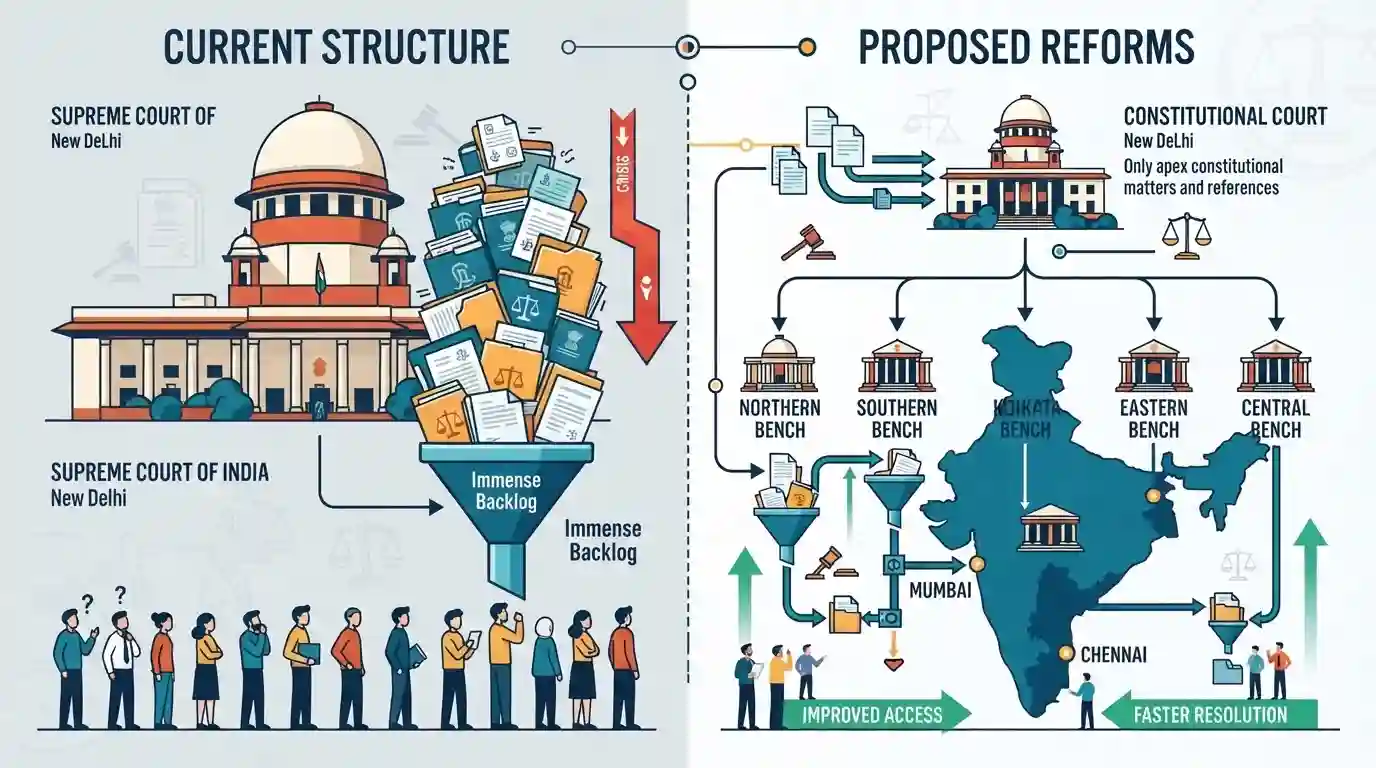
The article analyzes structural reforms for the Supreme Court of India, proposing its division into a constitutional court at New Delhi and regional appellate benches to handle the immense backlog of cases and improve judicial accessibility.
Key Points
- The Supreme Court of India faces a massive backlog of pending cases, exceeding tens of thousands, limiting access to justice for ordinary citizens.
- Proposals like creating a National Court of Appeal or dividing the Supreme Court into constitutional and regional/appellate divisions have long been discussed by the Law Commission.
- A regional bench model (cassation court style) would allow the Supreme Court at New Delhi to focus exclusively on constitutional and federal disputes, while regional courts handle regular civil and criminal appeals.
- Critics argue that division might fragment jurisprudence or compromise the unitary structure of the apex court, but structural reform remains imperative to tackle institutional overload.
Important Terms
Article 130 of the Constitution of India

Empowers the Chief Justice of India, with the approval of the President, to appoint other places besides Delhi as the seat of the Supreme Court, facilitating debates on establishing regional appellate benches.
UPSC context
GS Paper 2 (Polity and Governance - Judiciary). Tests knowledge of constitutional provisions concerning court structure, judicial federalism, and institutional reforms.
Law Commission of India
An independent statutory body established to recommend legal reforms, which notably proposed splitting the Supreme Court into a constitutional court in Delhi and regional cassation benches.
UPSC context
GS Paper 2 (Statutory, Regulatory and Quasi-Judicial Bodies). Tests understanding of institutional mechanisms for law reform and judicial restructuring.
Supreme Court of India
The apex judicial body of India, whose structural organization, backlog crises, and role as both a constitutional court and final court of appeal are subject to reform debates.
UPSC context
GS Paper 2 (Structure, Organization and Functioning of the Judiciary). Tests grasp of court jurisdiction, judicial backlog, and accessibility.
Prelims Trap
Splitting the Supreme Court into regional benches requires a direct constitutional amendment under Article 368.
Article 130 does NOT require a constitutional amendment to shift or establish benches outside Delhi; it only requires the CJI's approval with the President's concurrence.
Static Concepts Connected
What are the constitutional provisions governing the seat and jurisdiction of the Supreme Court of India?
- Seat of Court: Article 130 states that the Supreme Court shall sit in Delhi or in such other place or places as the CJI may, with the President's approval, appoint.
- Original Jurisdiction: Article 131 covers the original jurisdiction of the Supreme Court in federal disputes between the Centre and States or between States.
- Appellate / SLP: Article 136 empowers the Supreme Court to grant special leave to appeal from any judgment, decree, determination, sentence or order in any cause or matter passed or made by any court or tribunal in India.
Cross-Topic Patterns
Judicial Reforms and Federal Balance
Judicial federalism debates frequently pit the unitary apex court model against decentralized appellate structures, touching upon both federal balance and administrative decentralization in governance.

Article 130 + Law Commission regional bench proposals are prime material for a Mains GS2 analytical question on judicial restructuring.
Linked PYQs · 1
Linked PYQs · 1
- 2024MainsGS2
Explain the reasons for the growth of public interest litigation in India. As a result of it, has the Indian Supreme Court emerged as the world's most powerful judiciary ?
