ISRO NVS-03 Satellite Mission and Technical Innovations
Source:The Hindu ↗
Why It Matters
The article illustrates practical engineering workarounds and adaptive troubleshooting used by ISRO in complex satellite missions, which is vital for understanding space technology applications and challenges in the GS3 syllabus.
Summary
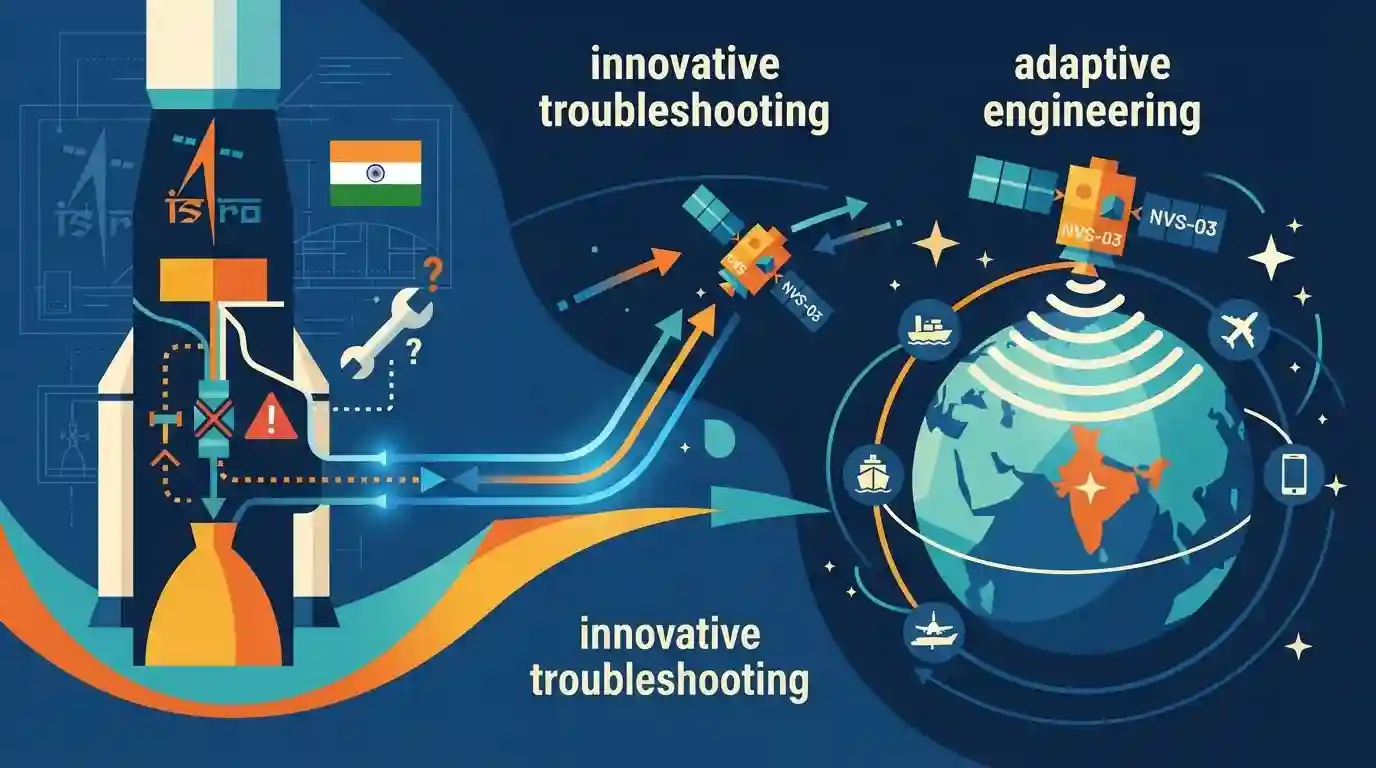
To overcome technical hurdles, ISRO flew the NVS-03 navigation satellite with its pyro valves open, demonstrating innovative troubleshooting and adaptive engineering in space missions.
Key Points
- ISRO flew the NVS-03 navigation satellite with pyro valves open to overcome technical hurdles during propulsion system operations.
- Pyro valves are normally closed devices used to control propellant flow in spacecraft propulsion systems, but opening them beforehand presented a unique engineering workaround.
- This approach highlights adaptive problem-solving and troubleshooting in complex space missions by Indian scientists.
Important Terms
ISRO

India's national space agency responsible for developing and launching space-borne platforms, deep-space probes, and satellite constellations for communication, remote sensing, and navigation.
UPSC context
UPSC Paper III (Science & Technology - Space). Tests institutional achievements, space missions, and indigenous technological capabilities.
NVS-03 satellite
The third second-generation navigation satellite under India's NavIC program, launched to bolster regional positioning services, featuring indigenous atomic clocks and L1-band civilian signals.
UPSC context
UPSC Paper III (Science & Technology - Space). Tests applications of satellite navigation, space indigenization, and recent mission milestones.
Pyro Valves
Explosively actuated valves used in spacecraft propulsion systems to isolate or release propellant lines; flying with them open bypasses potential electrical actuation failures.
UPSC context
UPSC Paper III (Science & Technology - Space Technology). Tests engineering troubleshooting and space mission hardware components.
NavIC
India's independent regional satellite navigation system (formerly IRNSS), providing accurate position information service in India and the region extending up to 1,500 km.
UPSC context
UPSC Paper III (Science & Technology - Space). Tests critical national infrastructure, strategic autonomy, and civilian navigation systems.
Prelims Trap
pyro valves are normally closed devices used to control propellant flow that can be opened and closed repeatedly during a mission.
Aspirants often confuse pyrotechnic (pyro) valves with regular solenoid valves; pyro valves are one-time actuated explosive devices, whereas solenoid valves are electrically operated and reversible.
Static Concepts Connected
What is the role of pyro valves and propulsion systems in satellite missions?
- One-time Actuation: Pyrotechnic valves use explosive charges to permanently open or close fluid lines in spacecraft propulsion systems.
- Propellant Control: They control high-pressure propellant flow to thrusters for orbital maneuvers and station-keeping.
- Irreversible Design: Once triggered, they cannot be reset, making pre-flight modifications high-risk engineering workarounds.
Cross-Topic Patterns
NavIC Resilience + Indigenous Technology Sourcing
ISRO's adaptive engineering in navigation systems parallels the use of indigenous atomic clocks in NavIC, testing reliance on domestic R&D over foreign component imports.

ISRO mission troubleshooting mechanisms like pyro-valve bypasses tested in multi-statement statements on space tech advancements.
Linked PYQs · 2
Linked PYQs · 2
- 2023MainsGS3
What is the main task of India's third moon mission which could not be achieved in its earlier mission? List the countries that have achieved this task. Introduce the subsystems in the spacecraft launched and explain the role of the Virtual Launch Control Centre' at the Vikram Sarabhai Space Centre which contributed to the successful launch from Sriharikota.
- 2017MainsGS3
India has achieved remarkable successes in unmanned space missions including the Chandrayaan and Mars Orbitter Mission, but has not ventured into manned space missions. What are the main obstacles to launching a manned space mission, both in terms of technology and logistics? Examine critically.
