Trade Liberalisation and Tariff Reduction in India Foreign Policy
Source:Indian Express ↗
Why It Matters
Highlights the negative impact of non-tariff barriers, specifically Quality Control Orders (QCOs), on India's global trade competitiveness and MSMEs, providing a critical perspective on India's current protectionist trade policies in the context of global supply chain integration.
Summary
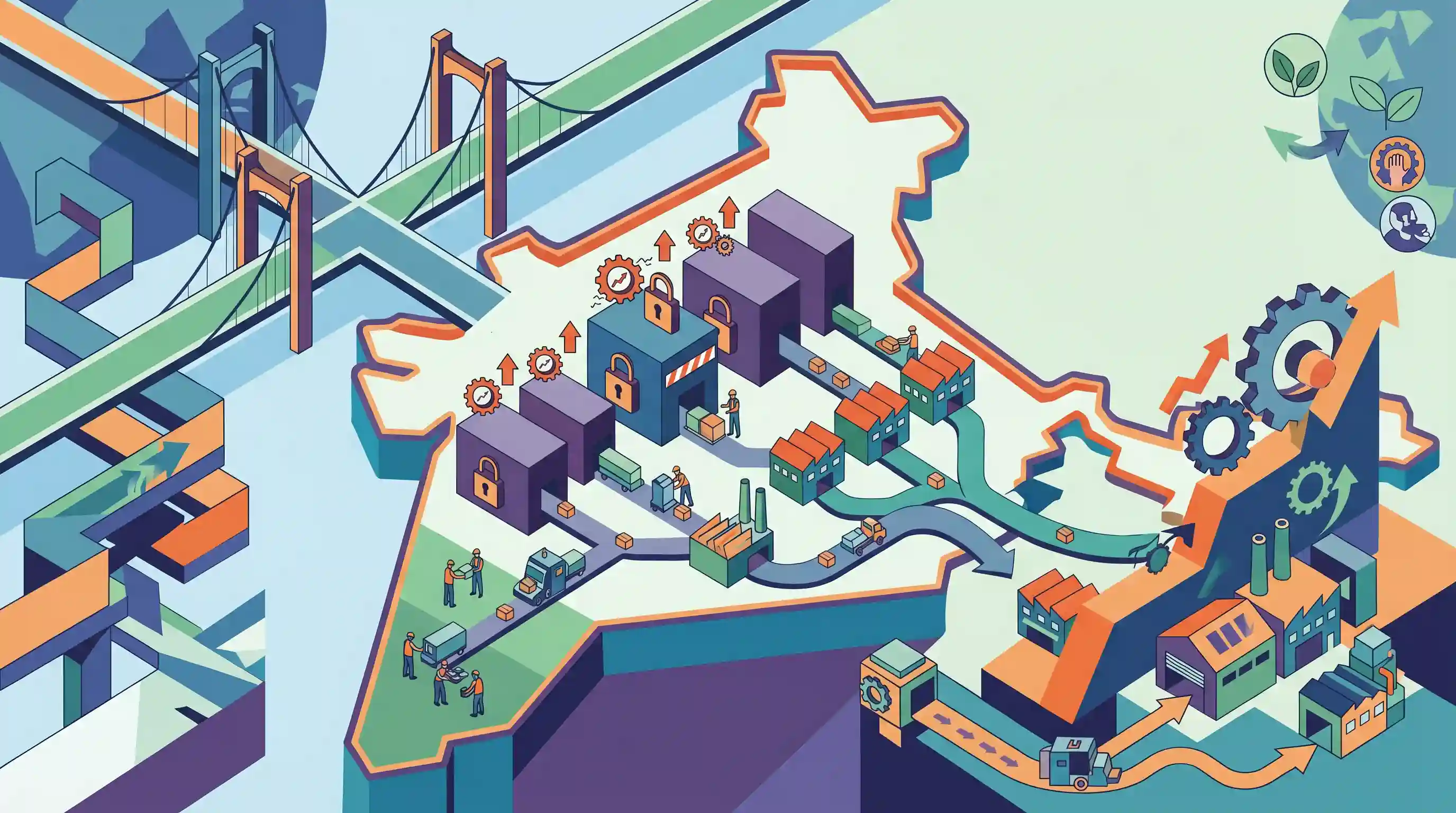
The article argues that India must complement its pursuit of Free Trade Agreements (FTAs) by liberalising its overarching trade regime, primarily by lowering tariffs and relaxing non-tariff barriers like Quality Control Orders (QCOs). While QCOs ostensibly ensure product safety, they effectively function as protectionist measures that raise input costs, harm MSME competitiveness, and create opportunities for lobbying. For India to deeply integrate into global supply chains and legitimately counter external non-tariff barriers (like Western labour or environmental standards), it needs an open, transparent trade regime. Over-reliance on protectionist tools threatens to hinder the growth of key labour-intensive export sectors.
Key Points
- India needs to liberalise its trade regime by lowering both tariffs and non-tariff barriers to fully benefit from its Free Trade Agreements (FTAs) and integrate into global supply chains.
- Quality Control Orders (QCOs), while ostensibly meant for consumer safety, function as protectionist non-tariff barriers that increase input costs and primarily hurt Micro, Small, and Medium Enterprises (MSMEs).
- High import tariffs, such as the 50% tariff faced by Indian exports to the US, heavily impact domestic industries like Andhra Pradesh's shrimp exporters.
- To successfully resist developed nations imposing non-tariff barriers related to labour and environmental standards, India must avoid using QCOs as a protectionist tool and let the market adjudicate quality.
Important Terms
Quality Control Orders (QCOs)

Mandatory technical regulations issued by the government under the BIS Act, 2016, requiring specific products to meet Indian quality standards to curb sub-standard imports and ensure safety.
UPSC context
GS-III/Economy; tests understanding of non-tariff barriers, protectionism, and their impact on MSME competitiveness and global trade integration.
Free Trade Agreements (FTAs)
Pacts between countries to reduce or eliminate customs duties and non-tariff hurdles on goods and services, facilitating deeper economic integration and market access.
UPSC context
GS-II/International Relations & GS-III/Economy; critical for questions on trade deficits, 'Atmanirbhar Bharat', and regional blocs like RCEP or India-EU FTA.
Non-Tariff Barriers (NTBs)
Trade restrictions beyond customs duties, such as technical standards (TBT), sanitary rules (SPS), or licensing, often used to protect domestic industries under the guise of safety.
UPSC context
GS-III/Trade Policy; tests ability to analyze modern protectionist tools that circumvent WTO tariff rules and affect export growth.
MSMEs (Micro, Small and Medium Enterprises)
Small-scale businesses defined by specific investment and turnover limits (e.g., Micro: <₹1cr investment, <₹5cr turnover), serving as the 'backbone' of Indian employment and exports.
UPSC context
GS-III/Economy; central to topics on inclusive growth, manufacturing (Make in India), and the challenges of complying with global quality standards.
Trade Liberalization
The reduction of government restrictions, particularly tariffs and non-tariff barriers, to allow for the free flow of goods and services between nations.
UPSC context
GS-III/Economic Development; evaluates the shift from import substitution to export-led growth and its impact on domestic industrial maturity.
Prelims Trap
"Quality Control Orders (QCOs) are tariff barriers imposed by India to protect domestic manufacturing."
QCOs are Non-Tariff Barriers (NTBs) falling under the WTO's Technical Barriers to Trade (TBT) agreement. They regulate standards, not customs duties or tariffs.
Static Concepts Connected
How does the WTO regulate Non-Tariff Barriers like QCOs?
- TBT Agreement: Ensures technical regulations, standards, and conformity assessment procedures (like QCOs) are non-discriminatory and do not create unnecessary obstacles to trade.
- SPS Agreement: Covers food safety and animal/plant health standards. Relevant for agricultural and marine exports like shrimp, ensuring health rules aren't disguised protectionism.
- National Treatment: Under both agreements, imported goods must be treated no less favorably than domestic goods regarding technical and safety regulations.
What is the difference between Trade Remedial Measures and Non-Tariff Barriers?
- Trade Remedies: Include Anti-Dumping Duties (ADD), Countervailing Duties (CVD), and Safeguards. These are WTO-sanctioned, tariff-based measures to correct unfair trade practices.
- Non-Tariff Barriers: Include quotas, licensing, embargoes, and QCOs. Developed nations also increasingly use stringent environmental and labor standards as disguised NTBs.
Cross-Topic Patterns
Aquaculture vulnerability to global trade wars
India's Blue Economy goals depend heavily on shrimp (66% of marine exports). Extreme reliance on the US market exposes Andhra Pradesh's aquaculture farmers to sudden, arbitrary anti-dumping and countervailing duties.
Import substitution hurting MSME integration
Protectionist QCOs aimed at curbing cheap imports inflate domestic raw material prices by 15-30%. This squeezes MSME margins, directly contradicting the push to integrate India into Global Value Chains (GVCs).
Environmental standards as modern NTBs
Western nations increasingly bypass traditional tariffs by deploying climate rules (like the EU's CBAM) or labor standards as de facto Non-Tariff Barriers, complicating India's FTA negotiations.

Expect a 2026 Prelims statement distinguishing Technical Barriers to Trade (like QCOs) from tariff-based Trade Remedies.
Linked PYQs · 4
Linked PYQs · 4
- 2025MainsGS3
What are the challenges before the Indian economy when the world is moving away from free trade and multilateralism to protectionism and bilateralism? How can these challenges be met?
- 2023MainsGS3
Faster economic growth requires increased share of the manufacturing sector in GDP, particularly of MSMEs. Comment on the present policies of the Government in this regard.
- 2017MainsGS3
Account for the failure of manufacturing sector in achieving the goal of labour-intensive exports. Suggest measures for more labour-intensive rather than capital-intensive exports.
- 2014MainsGS2
The aim of Information Technology Agreements (ITAs) is to lower all taxes and tariffs on information technology products by signatories to zero. What impact would such agreements have on India's interests?
