Road Infrastructure as a Strategic Tool for Internal Peace
Source:The Hindu ↗
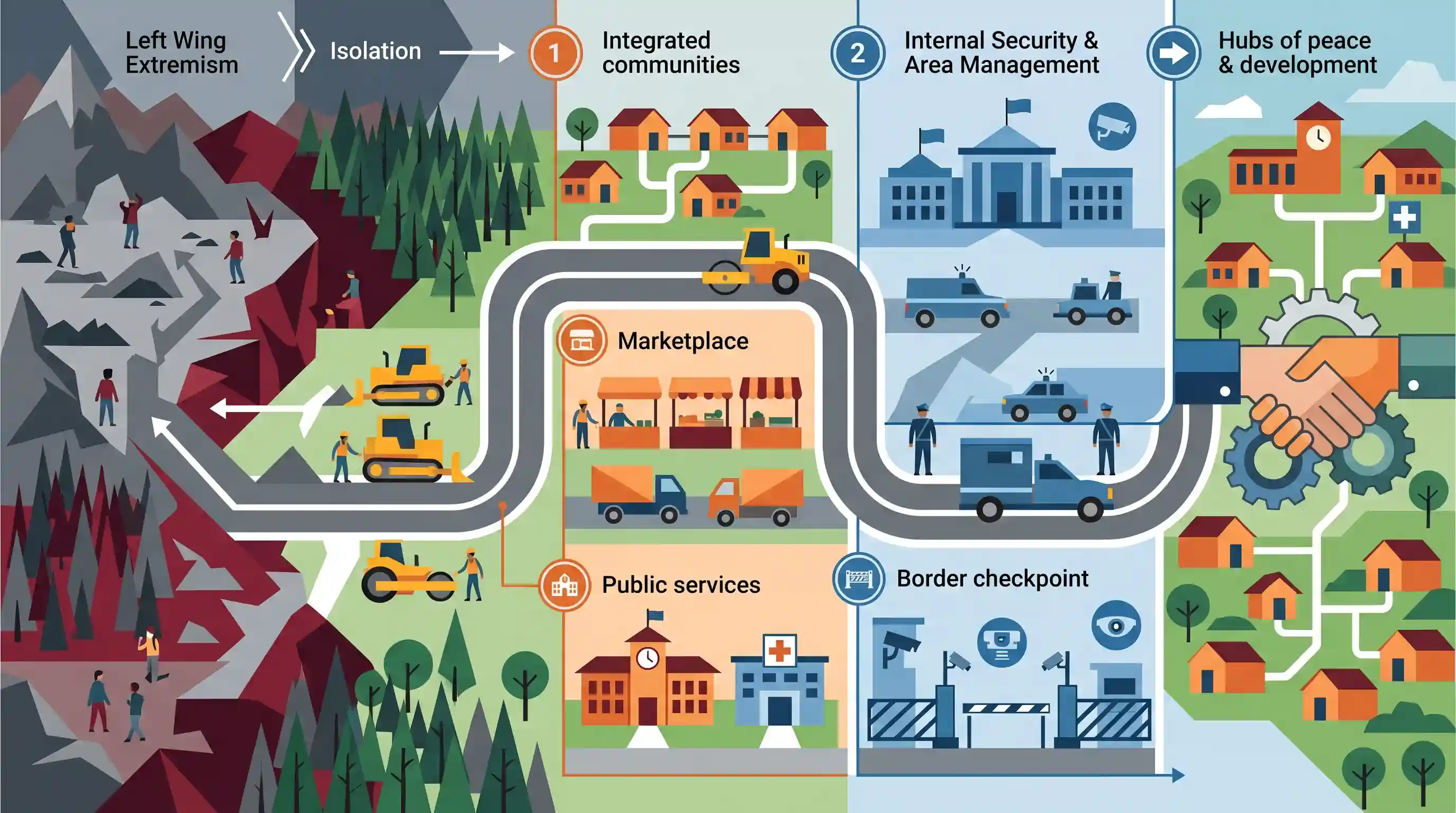
Why It Matters
This op-ed highlights the developmental approach to internal security, demonstrating how physical infrastructure can act as an active tool for peace-building, regional integration, and countering extremism—core themes for GS-3 answers.
Summary
The article emphasizes the profound intersection between infrastructure development and conflict resolution, asserting that building roads in marginalized or border regions is foundational to establishing lasting peace. By improving connectivity, roads integrate isolated communities into the broader economy, provide access to essential public services, and mitigate the socio-economic grievances that often fuel insurgency and extremism. Concurrently, enhanced infrastructure strengthens internal security by facilitating better administrative outreach and mobility for law enforcement. Ultimately, the piece argues that physical connectivity must be accompanied by community trust-building to successfully transform conflict zones into hubs of peace and development.
Key Points
- Strategic Role of Connectivity: Road infrastructure acts as a vital catalyst for peace by bridging physical and socio-economic divides in border and conflict-affected regions.
- Economic and Social Integration: Better roads provide marginalized populations with access to markets, education, and healthcare, addressing the developmental deficits that often fuel alienation and unrest.
- Enhancing Internal Security: Improved road networks allow for faster mobility of security forces, reinforcing state capacity and helping counter insurgencies and Left Wing Extremism (LWE).
- Trust and Perception Management: Infrastructure projects must be inclusive and coupled with community engagement to ensure that development fosters genuine peace rather than being perceived merely as militarization.
Important Terms
Border Roads Organisation (BRO)

A specialized executive arm of the Ministry of Defence that develops and maintains road networks in India’s border areas and friendly neighboring countries.
UPSC context
GS III: Internal Security/Infrastructure. Crucial for strategic mobility, troop deployment, and socio-economic integration of remote frontier regions.
Vibrant Villages Programme (VVP)
A centrally sponsored scheme (Budget 2022-23) aimed at the comprehensive development of villages along India’s international land borders to prevent out-migration and improve quality of life.
UPSC context
GS III: Security Challenges in Border Areas. Addresses the 'first line of defense' by strengthening border community resilience.
Border Area Development Programme (BADP)
A centrally sponsored program initiated in 1986-87 to meet special developmental needs and ensure a sense of security among people living in remote border blocks.
UPSC context
GS II: Governance/Welfare Schemes. Focuses on bridging gaps in socio-economic infrastructure to mitigate local grievances.
Border Infrastructure and Management (BIM) Scheme
A Central Sector Scheme under the Ministry of Home Affairs that funds physical infrastructure including border fences, roads, floodlights, and Border Out Posts (BOPs).
UPSC context
GS III: Internal Security. The primary umbrella funding mechanism for physical and technological fortification of India's international borders.
Left Wing Extremism (LWE)
An armed insurgency (Maoism/Naxalism) aiming to overthrow the government, often exploiting socio-economic grievances and lack of infrastructure in underdeveloped tribal regions.
UPSC context
GS III: Internal Security. Tests the development-security nexus and the effectiveness of integrated counter-insurgency strategies like SAMADHAN.
Prelims Trap
The Road Connectivity Project for LWE Areas (RCPLWEA) is administered directly by the Ministry of Home Affairs.
While RCPLWEA is aimed at internal security, it is a vertical under the Pradhan Mantri Gram Sadak Yojana (PMGSY), implemented by the Ministry of Rural Development.
Static Concepts Connected
What is the SAMADHAN doctrine for Left Wing Extremism?
- S-A-M-A: Smart Leadership, Aggressive Strategy, Motivation & Training, and Actionable Intelligence form the doctrine's kinetic operations base.
- D-H-A-N: Dashboard-based KPIs, Harnessing Technology, Action plan per theatre, and No access to financing focus on developmental tracking and choking insurgent funds.
What entails the 'Clear, Hold, and Build' counter-insurgency doctrine?
- Clear & Hold: Security forces physically flush out insurgents from a contested area and establish Forward Operating Bases (FOBs) to prevent their return.
- Build: The state rapidly deploys infrastructure (roads, schools, healthcare) to consolidate authority, deliver public services, and win local community trust.
- Hearts & Minds: Civic Action Programmes (CAP) are executed alongside building activities to counter insurgent propaganda and ensure development isn't perceived as mere militarization.
Cross-Topic Patterns
Rural schemes as Counter-Insurgency
Road-building in LWE areas bridges GS3 internal security with GS2 governance, showing how rural development schemes (PMGSY) double as strategic counter-insurgency and state-building tools.
Vibrant Villages & Border Demographics
Infrastructure addresses border out-migration. By retaining civilians with amenities, the state turns local populations into strategic intelligence assets ('eyes and ears') against trans-border threats.

Expect a GS3 Mains question evaluating 'infrastructure as a weapon of peace', comparing its application in LWE belts vs. Northern borders.
Linked PYQs · 4
Linked PYQs · 4
- 2024MainsGS3
India has a long and troubled border with China and Pakistan fraught with contentious issues. Examine the conflicting issues and security challenges along the border. Also give out the development being undertaken in these areas under the Border Area Development Programme (BADP) and Border Infrastructure and Management (BIM) Scheme.
- 2020MainsGS3
For effective border area management, discuss the steps required to be taken to deny local support to militants and also suggest ways to manage favourable perception among locals.
- 2025MainsGS3
The Government of India recently stated that Left Wing Extremism (LWE) will be eliminated by 2026. What do you understand by LWE and how are the people affected by it? What measures have been taken by the government to eliminate LWE?
- 2025MainsGS3
What are the major challenges to internal security and peace process in the North-Eastern States? Map the various peace accords and agreements initiated by the government in the past decade.
