Healthcare System Quality and Public Health Infrastructure
Source:Indian Express ↗
Why It Matters
Healthcare quality and infrastructure are recurring themes in UPSC Mains GS2. The transition from merely expanding access to ensuring quality and future-readiness is critical for essays and policy-based questions on public health administration and sustainable development.
Summary
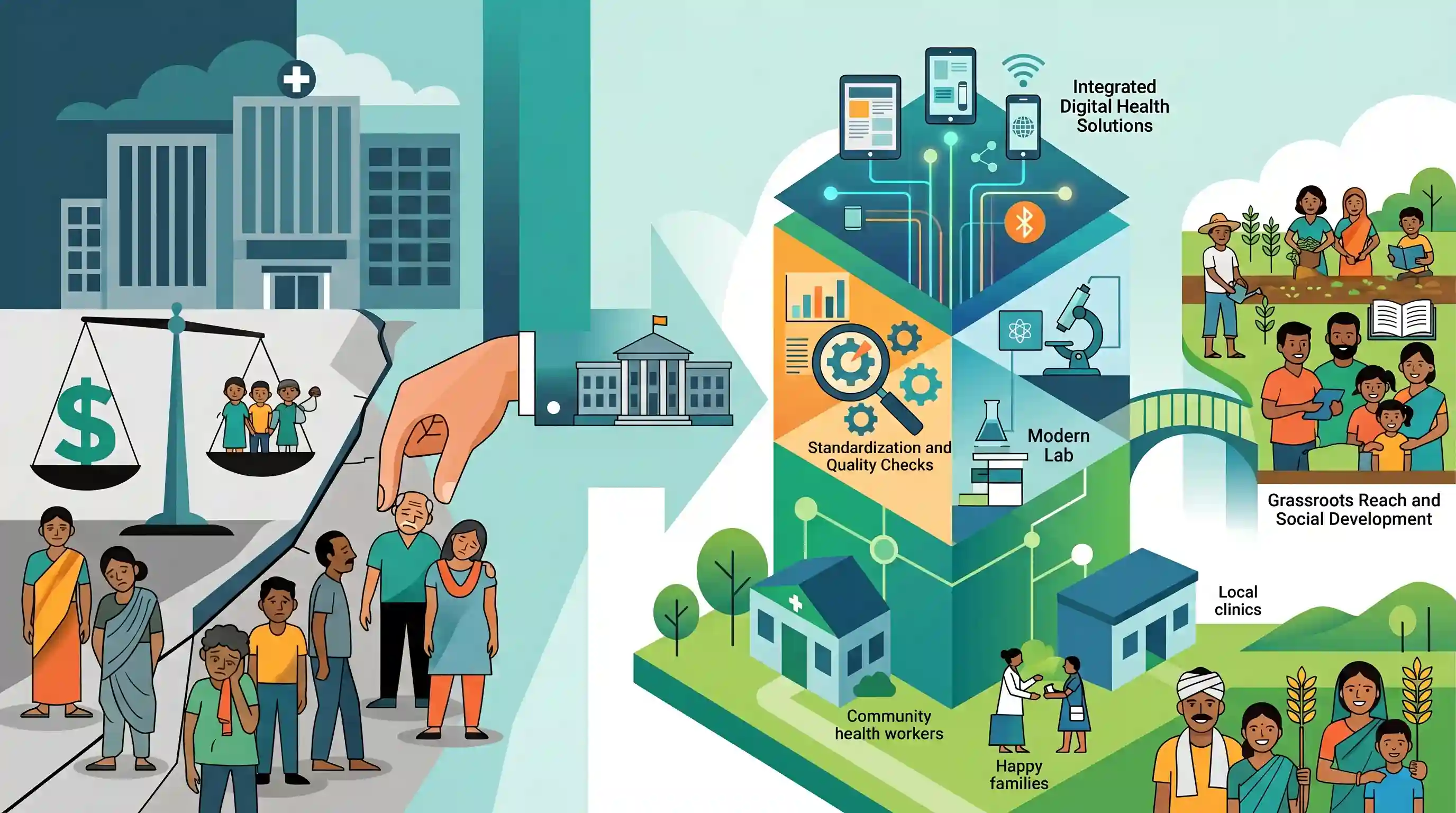
The article emphasizes that for India's healthcare system to be resilient and future-ready, the focus must shift from merely expanding physical infrastructure to ensuring high-quality care. It highlights that building a sustainable health architecture requires standardizing care, implementing rigorous quality checks, and strengthening primary healthcare systems. Addressing the adverse impacts of healthcare marketization, the piece advocates for strong state intervention to guarantee equitable access, integrate digital health solutions, and ensure that quality healthcare reaches the grassroots level as a precondition for broader social development.
Key Points
- Expansion of healthcare infrastructure must be coupled with stringent quality control and accreditation standards to genuinely improve health outcomes.
- A future-ready healthcare system requires robust primary healthcare networks to act as the first line of defense during pandemics and health emergencies.
- The State must play a proactive role to counter the adverse impacts of marketization in healthcare, ensuring quality care remains affordable and accessible at the grassroots level.
- Integration of digital health technologies, telemedicine, and unified health records are critical components of an adaptable and quality-driven healthcare ecosystem.
Important Terms
Ayushman Bharat

India’s flagship health program aiming for Universal Health Coverage. It includes PM-JAY for secondary/tertiary insurance and Ayushman Arogya Mandirs for primary care, providing financial protection to over 50 crore vulnerable citizens.
UPSC context
GS II (Social Justice); tests understanding of Universal Health Coverage and reducing out-of-pocket expenditure.
National Health Mission
A centrally sponsored mission focused on providing equitable and quality healthcare. It subsumes rural (NRHM) and urban (NUHM) components to strengthen primary health infrastructure and decentralized service delivery.
UPSC context
GS II (Social Sector); relevant for decentralized governance and improving public health indicators like MMR and IMR.
Clinical Establishments Act (2010)
A central legislation (2010) mandating registration and regulation of all clinical establishments to ensure minimum quality standards. It seeks to standardize services and increase transparency in both public and private healthcare.
UPSC context
GS II (Regulatory Bodies); critical for health standardization, patient safety, and private sector accountability.
National Health Authority (NHA)
The apex autonomous body responsible for implementing Ayushman Bharat PM-JAY and the Digital Mission. It manages the technological infrastructure, operational guidelines, and quality standards for these flagship health schemes.
UPSC context
GS II (Health Governance); focuses on institutional implementation of flagship schemes and digital health ecosystems.
Ministry of Health and Family Welfare (MoHFW)
The central ministry responsible for national health policy, public health programs, and medical education. It coordinates with states to ensure accessible and affordable healthcare through various national missions.
UPSC context
GS II (Governance); essential for understanding the executive's role in social sector management and policy formulation.
Prelims Trap
"India's Out-of-Pocket Expenditure (OOPE) on health has consistently increased over the last decade."
While OOPE remains high globally at ~47%, it has actually declined as a percentage of Total Health Expenditure (THE) in recent years due to state interventions like Ayushman Bharat.
Static Concepts Connected
What are the core building blocks of the Ayushman Bharat Digital Mission (ABDM)?
- ABHA Number: A 14-digit unique identifier for citizens to access and safely share their health records digitally across participating healthcare providers.
- Healthcare Professionals Registry: A comprehensive repository of all healthcare professionals involved in delivering services across both modern and traditional systems of medicine.
- Health Facility Registry: A database of health facilities (clinics, hospitals, labs) across public and private sectors, ensuring transparency and accountability.
How does the Clinical Establishments Act, 2010 regulate healthcare quality?
- Standardization: Mandates registration and prescribes minimum standards for clinical establishments across all recognized systems of medicine (allopathy, AYUSH).
- State Implementation: Since public health is a State subject, this Central Act applies only when state legislatures pass a resolution to adopt it.
- Mandatory Emergency Care: Legally requires establishments to provide necessary medical treatment to stabilize anyone presenting in an emergency condition, irrespective of payment capability.
Cross-Topic Patterns
Health quality and Demographic Dividend
Standardized healthcare directly influences India's demographic dividend by shifting human capital development from mere survival metrics (IMR/MMR) to productive longevity and reducing poverty caused by catastrophic health expenses.
ABDM as a Digital Public Good (DPI)
Similar to UPI for finance, the Ayushman Bharat Digital Mission utilizes open APIs to reduce information asymmetry and scale telemedicine, making it a classic Digital Public Infrastructure (DPI) case study.

Expect a 2026 multi-statement prelims question integrating ABHA's digital architecture with recent trends in out-of-pocket health spending.
Linked PYQs · 3
Linked PYQs · 3
- 2024MainsGS2
In a crucial domain like the public healthcare system the Indian State should play a vital role to contain the adverse impact of marketisation of the system. Suggest some measures through which the State can enhance the reach of public healthcare at the grassroots level.
- 2021MainsGS2
“Besides being a moral imperative of a Welfare State, primary health structure is a necessary precondition for sustainable development.” Analyze.
- 2020MainsGS2
In order to enhance the prospects of social development, sound and adequate health care policies are needed particularly in the fields of geriatric and maternal health care. Discuss.
