Mercury Contamination in Water Sources Near Neyveli Lignite
Source:The Hindu ↗
Why It Matters
Heavy metal pollution (especially mercury) from the coal and thermal power sectors is a critical and recurring UPSC theme across Prelims and Mains. This issue perfectly illustrates the intersection of industrial growth, severe environmental degradation, public health risks (e.g., neurotoxic effects of mercury), and regulatory challenges involving State Pollution Control Boards and the NGT.
Summary
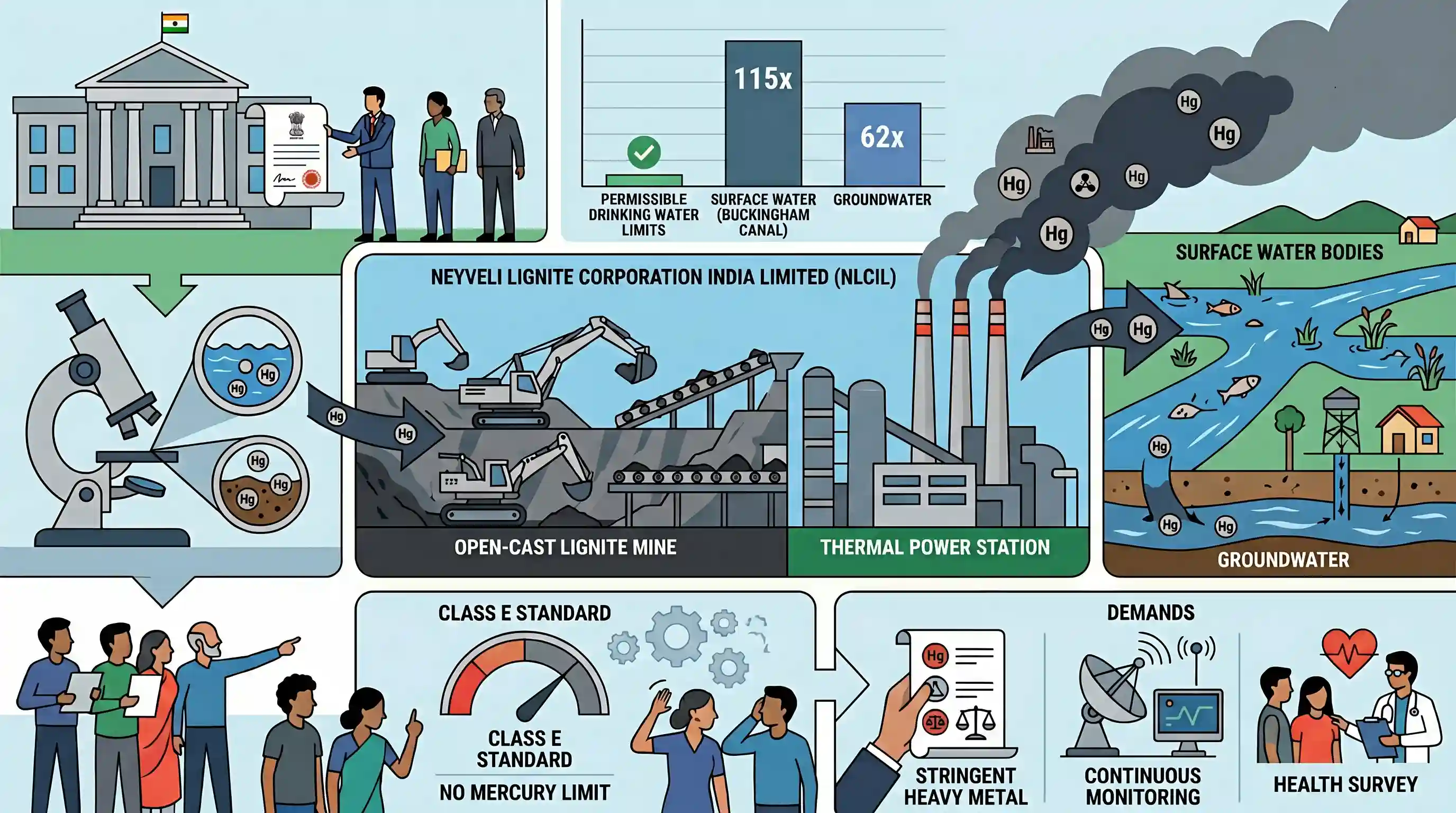
A report submitted by the Tamil Nadu Pollution Control Board (TNPCB) to the National Green Tribunal (NGT) has revealed alarming levels of mercury contamination in water and soil around the Neyveli Lignite Corporation India Limited (NLCIL). Initiated following a study by environmental groups Poovulagin Nanbargal and Manthan Adhyayan Kendra, the TNPCB investigation found mercury levels in surface water bodies like the Buckingham canal at 115 times the permissible drinking water limits, and 62 times higher in local groundwater. The contamination is largely linked to the operations of NLCIL's thermal power stations and lignite mines. Activists have criticized the TNPCB for assessing the water quality against the lenient 'Class E' standard, which lacks a specific mercury limit, ignoring the fact that local communities rely on this water for drinking and agriculture. There are mounting demands for the Union Environment Ministry to set stringent heavy metal discharge standards, ensure continuous environmental monitoring, and conduct an immediate health survey for the affected population.
Key Points
- The TNPCB submitted a report to the NGT revealing severe mercury contamination in water and soil around the NLCIL facility in Cuddalore district.
- Surface water bodies like the Buckingham canal showed mercury levels up to 115 times the permissible limits for drinking water, while groundwater near NLCIL mines had levels 62 times higher.
- The TNPCB controversially applied the 'Class E' standard (intended for industrial cooling/waste disposal, lacking a mercury limit) to these water sources, despite local dependence on them for drinking and agriculture.
- The contamination is primarily attributed to emissions and effluents from NLCIL's lignite mines and thermal power stations.
- Environmental groups are urging the MoEFCC to establish stricter effluent discharge limits for heavy metals and demanding a comprehensive health survey for affected residents.
Important Terms
National Green Tribunal (NGT)

A statutory body established under the NGT Act 2010 for the expeditious disposal of cases relating to environmental protection and the conservation of forests and other natural resources.
UPSC context
GS Paper 2 & 3: Statutory bodies and environmental governance. Essential for judicial mechanisms in environmental disputes.
NLC India Limited (NLCIL)
A Navratna Central Public Sector Undertaking (CPSU) under the Ministry of Coal, primarily engaged in lignite and coal mining and thermal power generation in India.
UPSC context
GS Paper 3: Infrastructure and energy. Relevant for PSU categorization and industrial environmental impact.
IS 2296:1992 (Class E)
The Bureau of Indian Standards (BIS) classification for inland surface water. 'Class E' denotes water suitable only for irrigation, industrial cooling, and controlled waste disposal, typically lacking stringent toxic metal limits.
UPSC context
GS Paper 3: Environmental pollution. Tests knowledge of water quality standards and industrial discharge monitoring.
Tamil Nadu Pollution Control Board (TNPCB)
A statutory state-level regulator established under the Water (Prevention and Control of Pollution) Act, 1974, responsible for monitoring pollution and enforcing environmental laws in Tamil Nadu.
UPSC context
GS Paper 2: Statutory and regulatory bodies. Important for state-level environmental administration and oversight.
Environment (Protection) Act, 1986
An 'Umbrella Legislation' enacted following the Bhopal Gas Tragedy to provide a framework for environmental protection and give the Central Government powers to set national standards.
UPSC context
GS Paper 3: Environmental legislation. The primary legal framework for pollution control and environmental conservation.
Prelims Trap
Class E surface water classification by CPCB designates sources that are safe for drinking after conventional treatment.
Class A to C are designated for drinking. Class E is strictly for irrigation, industrial cooling, and controlled waste disposal, famously lacking strict heavy metal limits.
Static Concepts Connected
How does the CPCB classify surface water quality in India?
- Classes A to C: Designates water fit for drinking, with varying degrees of conventional treatment and disinfection required.
- Class D: Designated for propagation of wildlife and fisheries.
- Class E: Designated strictly for irrigation, industrial cooling, and controlled waste disposal.
What are the key anthropogenic sources and impacts of mercury pollution?
- Major Sources: Coal-fired thermal power plants, artisanal gold mining, and waste incineration.
- Bioaccumulation: Converts to highly toxic methylmercury in aquatic ecosystems, biomagnifying up the food chain (e.g., in fish).
- Health Impacts: Causes severe neurological damage and developmental defects, famously identified as Minamata disease in Japan.
- Minamata Convention: A global treaty designed to protect human health and the environment from anthropogenic emissions of mercury.
Cross-Topic Patterns
Buckingham Canal & NW-4 Development
Buckingham Canal's severe pollution complicates its slated development as part of National Waterway 4, linking historical geography, infrastructure planning, and urban environmental degradation.
Navratna CPSEs vs. Environmental Governance
The NGT's scrutiny of NLCIL (a Navratna CPSE) highlights the regulatory friction between state-backed coal/lignite energy security and stringent environmental compliance demanded by civil society.

Expect a multi-statement prelims question integrating CPCB’s Class A-E water criteria, mercury emissions from coal, and Minamata Convention.
Linked PYQs · 5
Linked PYQs · 5
- 2023PrelimsGS1
Consider the following statements regarding mercury pollution: 1. Gold mining activity is a source of mercury pollution in the world. 2. Coal-based thermal power plants cause mercury pollution. 3. There is no known safe level of exposure to mercury. How many of the above statements are correct?
- 2014MainsGS3
Environmental Impact Assessment studies are increasingly undertaken before a project is cleared by the Government. Discuss the environmental impacts of coal-fired thermal plants located at coal pitheads.
- 2025MainsGS3
Mineral resources are fundamental to the country's economy and these are exploited by mining. Why is mining considered an environmental hazard? Explain the remedial measures required to reduce the environmental hazard due to mining.
- 2024MainsGS3
Industrial pollution of river water is a significant environmental issue in India. Discuss the various mitigation measures to deal with this problem and also the government's initiatives in this regard.
- 2013MainsGS3
Enumerate the National Water Policy of India. Taking river Ganges as an example, discuss the strategies which may be adopted for river water pollution control and management. What are the legal provisions of management and handling of hazardous wastes in India?
