Tamil Nadu Assembly Speaker Resignation Ruling and Anti Defection Law
Source:The Hindu ↗
Why It Matters
The case exposes a critical loophole in the anti-defection law, wherein legislators facing disqualification resign to evade penal consequences. This underscores the need for clarity on the Speaker's powers in handling resignations alongside pending defection cases, a persistent issue in Indian parliamentary democracy.
Summary
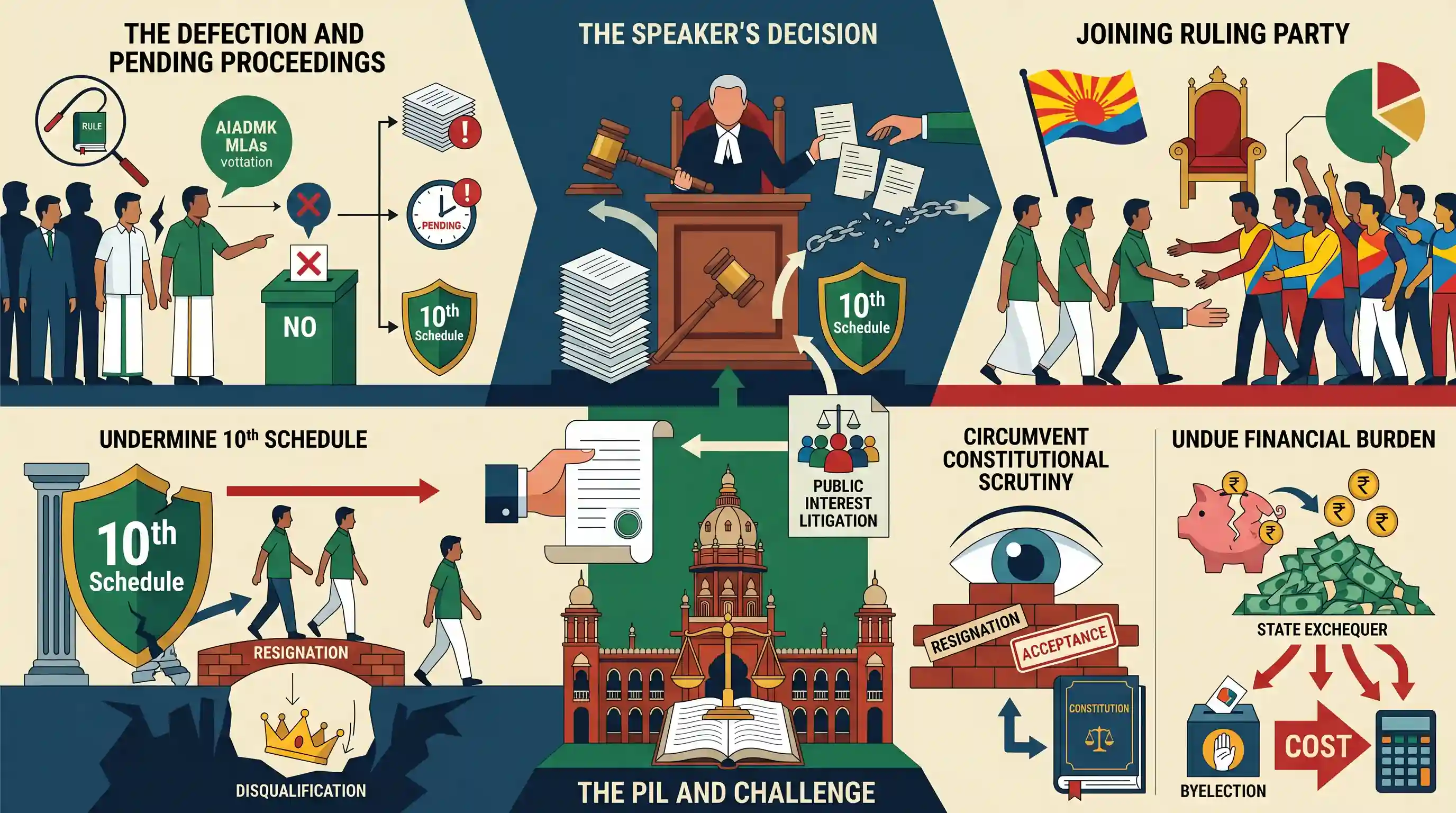
A public interest litigation in the Madras High Court challenges the Tamil Nadu Legislative Assembly Speaker's decision to accept the resignations of three AIADMK MLAs while disqualification proceedings against them under the anti-defection law were pending. The MLAs had voted against the party whip during a confidence motion and subsequently resigned to join the ruling TVK. The petitioner argues that allowing resignations to bypass disqualification undermines the Tenth Schedule, circumvents constitutional scrutiny, and imposes an undue financial burden on the exchequer through unnecessary byelections.
Key Points
- The AIADMK sought the disqualification of 25 MLAs for voting against the party whip during a trust vote in favour of the ruling TVK government.
- Three of the 25 MLAs subsequently resigned and joined TVK, and the Tamil Nadu Assembly Speaker immediately accepted their resignations.
- A PIL filed in the Madras High Court argues that accepting these resignations allows the legislators to bypass the pending disqualification proceedings under the Tenth Schedule.
- The petitioner asserts that this practice circumvents constitutional scrutiny, undermines the anti-defection law, and imposes an unnecessary financial burden on the state by triggering byelections.
- The dispute highlights the tension between an MLA's right to resign and the Speaker's constitutional responsibility to adjudicate anti-defection petitions impartially.
Important Terms
Tenth Schedule

A constitutional provision added by the 52nd Amendment Act (1985) to prevent political instability by disqualifying legislators who switch parties or defy party directives.
UPSC context
GS Paper II (Polity); fundamental for questions on parliamentary democracy, legislative discipline, and constitutional amendments.
Anti-Defection Law
The legal framework governing the disqualification of MPs and MLAs on grounds of defection, aimed at curbing unprincipled party-hopping and horse-trading.
UPSC context
GS Paper II; tests knowledge of the 52nd and 91st Amendments and the balance between stability and dissent.
Office of the Speaker
The constitutional authority presiding over the lower house of a legislature, serving as a quasi-judicial arbiter in disqualification cases under the Tenth Schedule.
UPSC context
GS Paper II (Legislature); crucial for understanding the impartiality, neutrality, and adjudicatory powers of presiding officers.
Whip
A directive issued by a political party to ensure its members attend and vote in alignment with the party leadership's instructions in the legislature.
UPSC context
GS Paper II; relates to parliamentary floor management, party discipline, and the rights of individual legislators.
Judicial Review
The judiciary's power to scrutinize legislative or executive actions, including the Speaker's decisions, to ensure they adhere to constitutional principles and natural justice.
UPSC context
GS Paper II (Judiciary); tests understanding of the 'basic structure' and landmark cases like Kihoto Hollohan (1992).
Byelection
An interim election held to fill a legislative vacancy arising from the death, resignation, or disqualification of an elected member before their term ends.
UPSC context
GS Paper II (Elections); pertains to the Representation of the People Act and the administrative costs of mid-term vacancies.
Prelims Trap
Pending disqualification proceedings under the Tenth Schedule automatically lapse if an MLA voluntarily resigns.
The SC ruled in the Balasaheb Patil case (2019) that resignation does not render pending disqualification proceedings infructuous. Legislators cannot simply resign to escape the penal consequences of defection.
Static Concepts Connected
How is an MLA's resignation regulated under the Constitution?
- Article 190(3)(b): Under Article 190(3)(b), an MLA's seat falls vacant upon resignation, but the Speaker must reject it if satisfied the resignation is not "voluntary or genuine."
- 33rd Amendment Act: Added via the 33rd Amendment Act (1974) to prevent coerced resignations, it empowers the Speaker to conduct an inquiry before accepting any resignation letter.
What are the limitations on the Speaker's power under the 10th Schedule?
- Judicial Review: Under the Kihoto Hollohan (1992) ruling, the Speaker acts as a tribunal; their final decisions are subject to judicial review on grounds of mala fides or constitutional violation.
- Three-Month Limit: The Supreme Court in Keisham Meghachandra (2020) ruled that Speakers must decide disqualification petitions within an outer limit of three months in ordinary circumstances.
- No Ban on Bypolls: The Speaker cannot dictate the duration of disqualification (e.g., until the Assembly term ends) or bar a disqualified member from contesting subsequent by-elections.
Cross-Topic Patterns
RPA 1951 and by-election mandates
Resignations trigger mandatory by-elections under Section 151A of the RPA, 1951. Combining these topics highlights how exploiting constitutional loopholes imposes heavy electoral and financial burdens on the state exchequer.
91st Amendment and ministerial bans
Disqualified members are barred from holding ministerial or remunerative posts until re-elected (Article 164(1B)). Resigning specifically to bypass disqualification circumvents the core intent of the 91st Amendment Act.

Expect a 2026 Prelims statement testing whether pending anti-defection proceedings automatically lapse upon an MLA's voluntary resignation.
Linked PYQs · 3
Linked PYQs · 3
- 2023MainsGS2
Discuss the role of Presiding Officers of state legislatures in maintaining order and impartiality in conducting legislative work and in facilitating best democratic practices.
- 2020MainsGS2
Once a Speaker, Always a Speaker' ! Do you think this practice should be adopted to impart objectivity to the office of the Speaker of Lok Sabha ? What could be its implications for the robust functioning of parliamentary business in India?
- 2025PrelimsGS1
Consider the following statements : I. If any question arises as to whether a Member of the House of the People has become subject to disqualification under the 10th Schedule, the President's decision in accordance with the opinion of the Council of Union Ministers shall be final. II. There is no mention of the word 'political party' in the Constitution of India. Which of the statements given above is/are correct?
