Tamil Nadu IAS Officer Promotions and Centre State Jurisprudence
Source:The Hindu ↗
Why It Matters
This issue bridges two core GS2 themes: the federal friction surrounding the administration of All India Services (AIS) and the judicial limitations of Public Interest Litigation (PIL). It serves as a practical example for Mains answers on the cadre-controlling authority of the Centre versus State administrative needs, as well as the Supreme Court/High Court guidelines restricting PILs in service matters to prevent frivolous litigation.
Summary
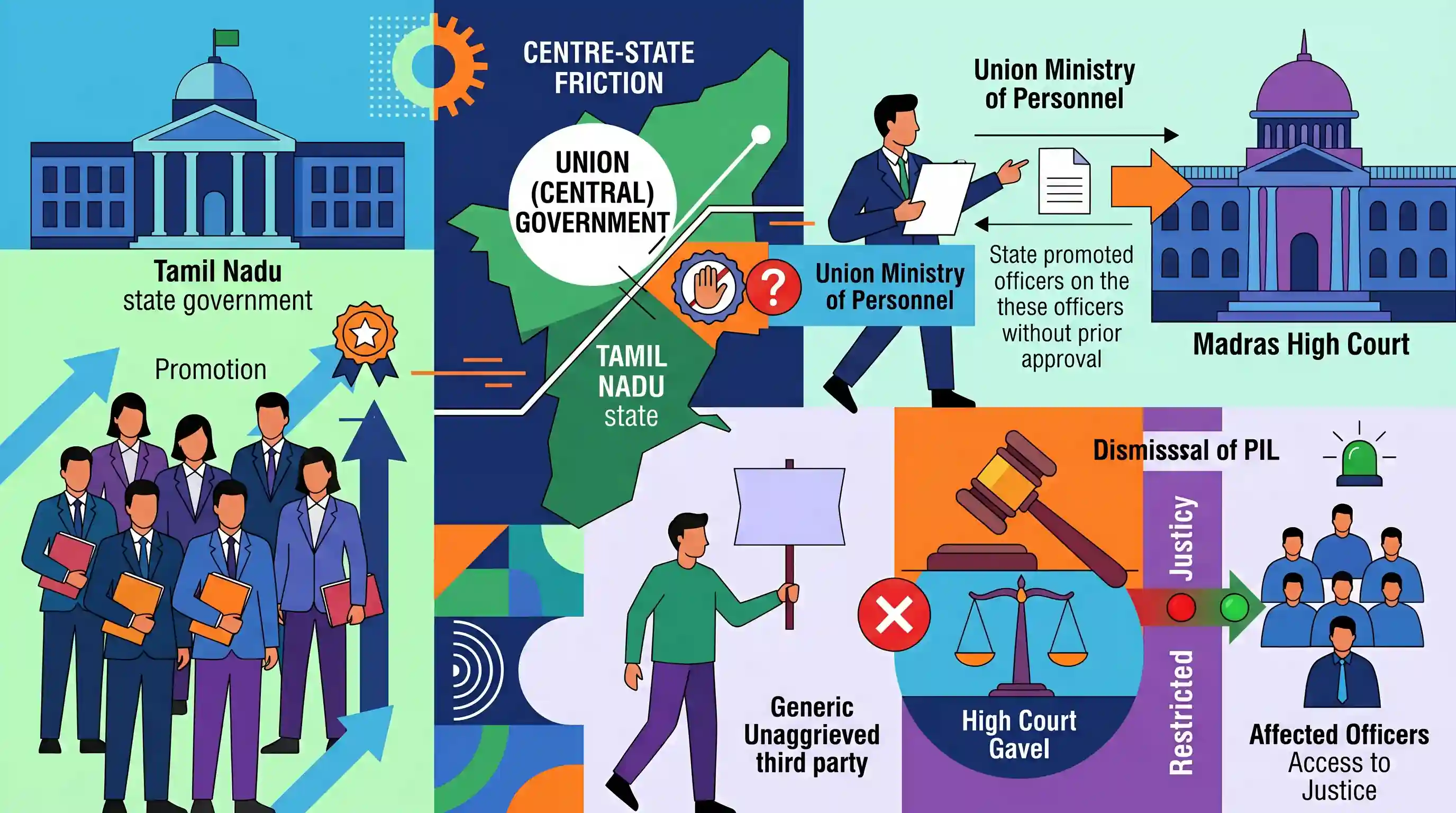
The Tamil Nadu government promoted seven IAS officers to the Chief Secretary grade without prior approval from the Centre, a fact brought to light by the Union Ministry of Personnel, Public Grievances and Pensions before the Madras High Court. The disclosure occurred during the hearing of a Public Interest Litigation (PIL) challenging the State's Government Order. The High Court dismissed the PIL, ruling that public interest litigations cannot be entertained in government service matters at the behest of an unaggrieved third party. The court reiterated that only the officers directly affected have the locus standi to challenge such administrative actions, underscoring both the limits of PILs and the ongoing friction in Centre-State relations concerning All India Services.
Key Points
- The Tamil Nadu government promoted seven IAS officers to the rank of Chief Secretary without obtaining prior approval from the Central Government.
- The Union Ministry of Personnel informed the Madras High Court that the State proceeded with the promotions despite the Centre not having granted the requested approval.
- Activist A. Shankar filed a Public Interest Litigation (PIL) challenging the State's Government Order regarding these promotions.
- The Madras High Court dismissed the PIL, stating that third-party PILs are not maintainable in government service matters and only the aggrieved officers possess the locus standi to file a challenge.
- The incident highlights the ongoing administrative friction between states and the Centre over the control and management of All India Services officers.
Important Terms
All India Services (AIS)

Civil services (IAS, IPS, IFoS) common to both Union and States, established under Article 312 to ensure administrative unity across the country.
UPSC context
GS-II/Federalism; tests the dual-control mechanism where the Centre recruits while States exercise immediate administrative supervision.
Chief Secretary
The highest-ranking civil servant and administrative head of a State government, serving as the principal advisor to the Chief Minister.
UPSC context
GS-II/State Executive; tests understanding of the state-level bureaucratic hierarchy and the role of the senior-most officer.
Public Interest Litigation (PIL)
A legal mechanism allowing any person to approach the court for the enforcement of public interest or rights of marginalized sections.
UPSC context
GS-II/Judiciary; explores judicial activism and the legal precedent that PILs are generally not maintainable in government service matters.
Locus Standi
The legal capacity of a party to approach a court, based on having a sufficient connection to or harm from the matter.
UPSC context
GS-II/Judiciary; relevant for distinguishing between an 'aggrieved person' and a 'stranger' in legal challenges to executive actions.
Ministry of Personnel, Public Grievances and Pensions
The nodal Union ministry for personnel management, serving as the cadre-controlling authority for the Indian Administrative Service (IAS).
UPSC context
GS-II/Governance; tests the role of central oversight in the training, career progression, and discipline of All India Services.
Indian Administrative Service (Cadre) Rules
Statutory rules formulated under the AIS Act, 1951, regulating the recruitment, cadre strength, and service conditions of IAS officers.
UPSC context
GS-II/Governance; tests the legal framework of Centre-State relations regarding the administration of the civil services 'steel frame'.
Prelims Trap
A PIL can be filed by any citizen to challenge irregularities in the promotion of civil servants.
The Supreme Court has explicitly barred PILs in government service matters like promotions. Only a directly aggrieved officer has locus standi, except when seeking a writ of Quo Warranto.
Static Concepts Connected
What is the framework of dual control over All India Services (AIS)?
- Dual Control: States exercise immediate administrative control, while ultimate disciplinary and cadre management control vests with the Union government.
- Controlling Authorities: DoPT manages IAS, Ministry of Home Affairs manages IPS, and MoEFCC manages the Indian Forest Service.
- Apex Promotions: State governments cannot unilaterally promote officers to the Apex Scale (Chief Secretary grade) without obtaining prior approval from the Central Government.
What are the limitations on filing PILs in government service matters?
- General Bar: The Supreme Court has established that PILs are not maintainable in government service matters such as appointments, promotions, or disciplinary actions.
- Locus Standi: Strict standing applies; only legally aggrieved officers whose individual rights are directly infringed can challenge administrative orders.
- Sole Exception: A public interest litigation can only be entertained in service matters if it specifically seeks a writ of Quo Warranto (challenging authority to hold a public office).
Cross-Topic Patterns
Federal friction over IAS Cadre Rules
Unilateral State promotions echo the inverse friction seen when the Centre proposed mandatory deputation of IAS officers, highlighting persistent dual-control tensions.
Locus Standi vs PIL expansion
While locus standi is vastly relaxed for environmental issues, the judiciary strictly maintains traditional standing in service jurisprudence to prevent administrative paralysis by third parties.

Expect a multi-statement Prelims question testing the Cadre Controlling Authorities of AIS and the non-maintainability of PILs in service matters.
Linked PYQs · 2
Linked PYQs · 2
- 2024MainsGS2
What changes has the Union Government recently introduced in the domain of Centre-State relations ? Suggest measures to be adopted to build the trust between the Centre and the States and for strengthening federalism.
- 2024MainsGS2
Explain the reasons for the growth of public interest litigation in India. As a result of it, has the Indian Supreme Court emerged as the world's most powerful judiciary ?
