TN disbands High-Level Committee on Union-State Relations
Source:The Hindu ↗
Why It Matters
Centre-state relations and cooperative federalism are core pillars of the Indian constitutional framework. The disbandment of a state-level committee addressing federal autonomy highlights regional frictions, legislative debates, and the practical challenges of sustaining federal balance in India.
Summary
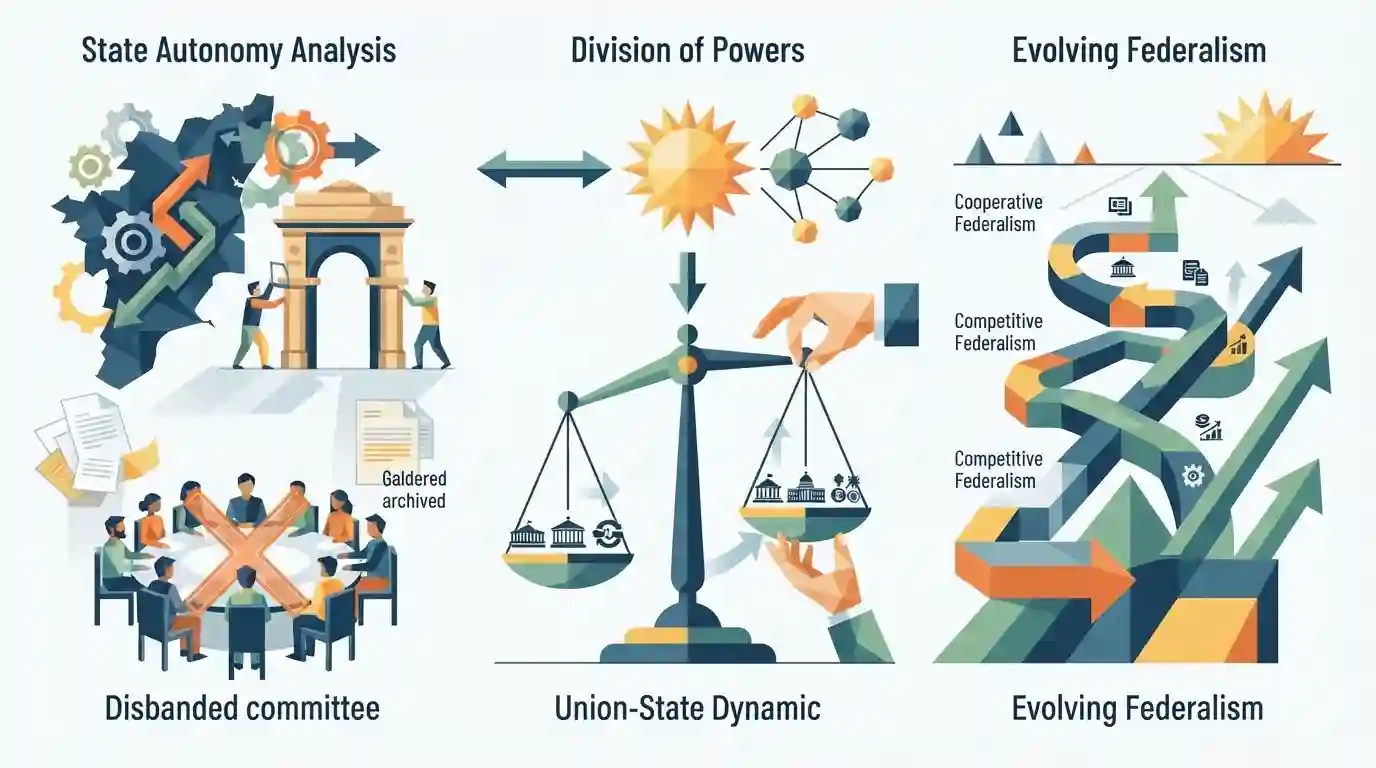
The Tamil Nadu government has formally disbanded the High-Level Committee on Union-State Relations, which was set up to analyze federal structures, safeguard state autonomy, and evaluate the division of powers between the Union and the State. This development highlights the evolving and sensitive nature of cooperative and competitive federalism in India, impacting discussions on state rights and legislative jurisdiction.
Key Points
- The Tamil Nadu government has disbanded the High-Level Committee on Union-State Relations, which was earlier established to examine federal dynamics and state autonomy.
- The committee was initially formed under the chairmanship of retired Justice A.K. Rajan to review state-centre relations and recommend measures to strengthen federalism and state autonomy.
- The decision reflects shifts in governance priorities and regional political strategies regarding centre-state legislative and financial engagements.
- Centre-state relations remain a crucial aspect of Indian federalism, marked by ongoing debates over fiscal federalism, gubernatorial roles, and legislative encroachments.
Important Terms
High-Level Committee on Union-State Relations

A committee set up by the Tamil Nadu government to review federal structures, fiscal federalism, and state autonomy, later disbanded and its functions transferred to the State Law Commission.
UPSC context
UPSC Mains GS Paper II (Polity & Governance — Centre-State Relations, federalism, state autonomy, and devolution of powers).
Constitution of India
The foundational law of India providing the overarching framework for legislative, executive, and financial powers between the Union and the States.
UPSC context
UPSC Mains GS Paper II (Indian Constitution — historical underpinnings, evolution, features, amendments, structure, and basic structure doctrine).
Justice A.K. Rajan Committee
A committee established by the Tamil Nadu government to study the impact of NEET on medical admissions and examine issues of federal jurisdiction and state-level social justice.
UPSC context
UPSC Mains GS Paper II (Centre-State Relations, federalism, concurrent list subjects like education, and state legislative powers).
Static Concepts Connected
What are the major historical commissions appointed by the Government of India to review Centre-State relations?
- Rajamannar Committee: Appointed in 1969 by the Tamil Nadu government; first state-level committee to examine state autonomy and suggest constitutional amendments.
- Sarkaria Commission: Set up in 1983 under Justice R.S. Sarkaria; examined power balance and recommended strengthening cooperative federalism without altering basic structure.
- Punchhi Commission: Constituted in 2007 under Justice Madan Mohan Punchhi; focused on contemporary challenges like devolution of financial powers and role of Governors.
Cross-Topic Patterns
Article 3 Reorganization + Cooperative Federalism
The debate on Article 3 amendments and state concurrence echoes long-standing federal friction seen during the formation of new states and Union Territories under Article 3.
State Law Commissions + Legislative Autonomy
Disbanding the panel in favor of the State Law Commission mirrors how states utilize statutory bodies to institutionalize administrative and legal pushback against central legislation.

Centre-state committees (Sarkaria, Punchhi, Rajamannar) + Article 3 amendment proposals frequently appear in matching-list prelims questions.
Linked PYQs · 3
Linked PYQs · 3
- 2024MainsGS2
What changes has the Union Government recently introduced in the domain of Centre-State relations ? Suggest measures to be adopted to build the trust between the Centre and the States and for strengthening federalism.
- 2025MainsGS2
Examine the evolving pattern of Centre-State financial relations in the context of planned development in India. How far have the recent reforms impacted the fiscal federalism in India?
- 2020MainsGS2
How far do you think cooperation, competition and confrontation have shaped the nature of federation in India? Cite some recent examples to validate your answer.
