Tamil Nadu Maternity Leave Rules and Supreme Court Rulings
Source:The Hindu ↗
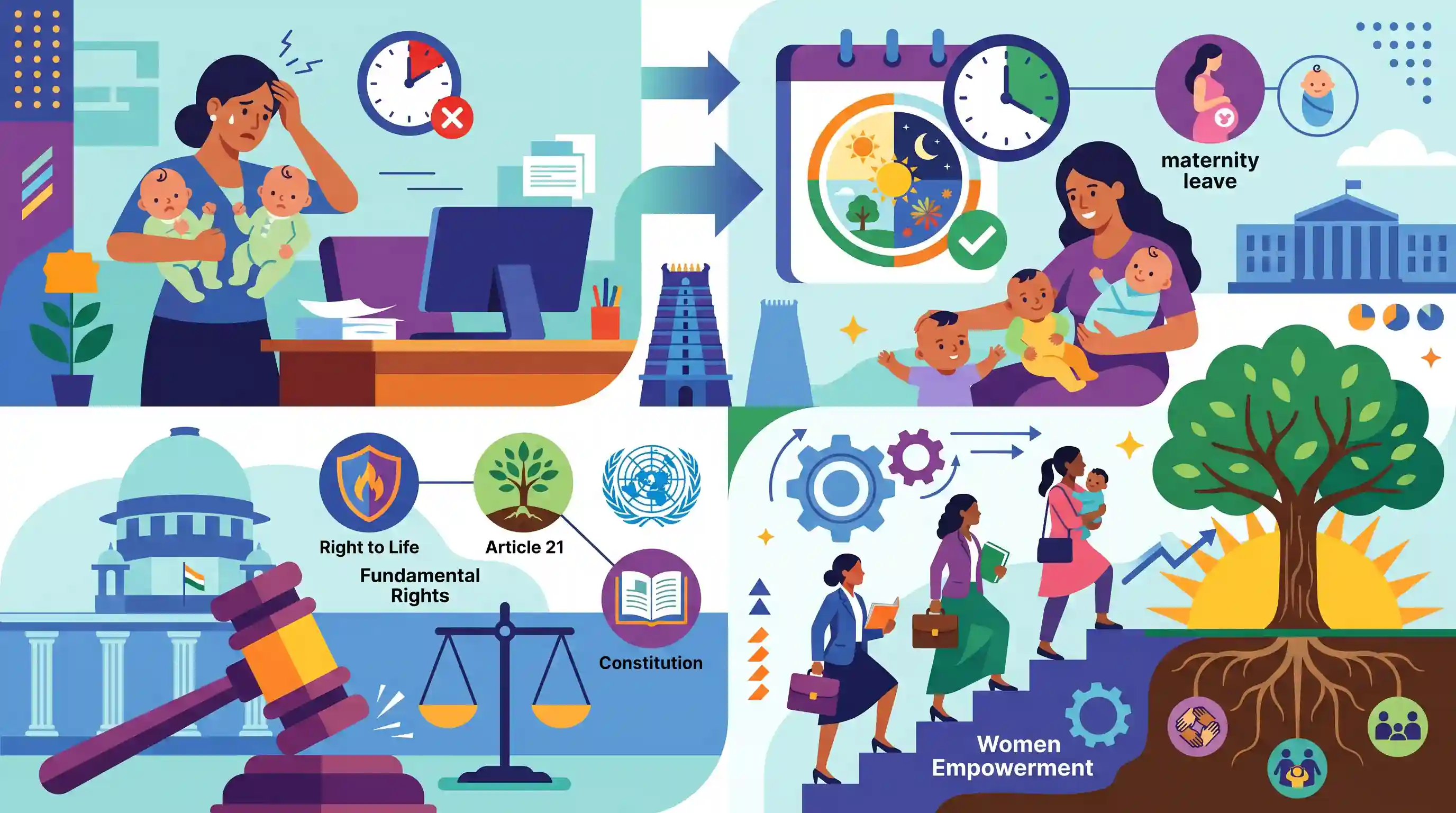
Why It Matters
Maternity benefits are crucial for female labor force participation, early childhood care, and gender justice. The intersection of statutory law (Maternity Benefit Act) and constitutional rights (Article 21) frequently features in both Prelims (as policy/legal provisions) and Mains (as governance/social justice issues).
Summary
The Tamil Nadu government has amended its maternity leave rules, enabling women government employees to avail 365 days of maternity leave for a second delivery even if they had twins during their first pregnancy. This replaces an earlier rule that restricted the leave to just two weeks in such scenarios. The decision aligns with recent directives from the Supreme Court and Madras High Court. The Supreme Court emphasized that restricting maternity leave violates the fundamental right to life and personal liberty under Article 21, adding that international treaties do not limit maternity benefits based on the number of children. Furthermore, women with two or more surviving children will be entitled to a maximum of 12 weeks of paid maternity leave, in accordance with the Maternity Benefit Act, 1961.
Key Points
- The Tamil Nadu government amended rules to grant 365 days of maternity leave for a second delivery, even if the woman government employee had twins in her first delivery.
- Previously, the state's rules restricted maternity leave to only two weeks in such cases.
- The amendment follows a Supreme Court ruling which held that restricting maternity benefits violates Article 21 of the Constitution.
- The Supreme Court also noted that international treaties recognise maternity entitlements without limiting them based on the number of children.
- In alignment with the Maternity Benefit Act, women employees with two or more surviving children are now eligible for up to 12 weeks of maternity leave on full pay.
Important Terms
Maternity Benefit Act, 1961

A landmark central law ensuring paid leave and job security for pregnant employees. It was amended in 2017 to increase paid leave from 12 to 26 weeks for the first two children.
UPSC context
GS Paper II (Social Justice/Laws for Vulnerable Sections) and GS Paper I (Women Empowerment). Tests knowledge of statutory labor rights.
Article 21 of the Constitution
Constitutional provision guaranteeing the Right to Life and Personal Liberty. The Supreme Court interprets this to include reproductive autonomy and the right to health, specifically covering maternity benefits.
UPSC context
GS Paper II (Polity/Fundamental Rights). Tests the expansive judicial interpretation of 'Right to Life' regarding gender and social welfare.
Supreme Court (Maternity Rulings)
India’s highest court, which in May 2025 ruled that restrictive maternity leave policies based on the number of children violate fundamental rights and international human rights standards.
UPSC context
GS Paper II (Governance/Judiciary). Tests the role of the judiciary in upholding social justice and correcting executive policy.
Madras High Court (January 2026 Ruling)
The High Court for Tamil Nadu and Puducherry, which in January 2026 declared that denying full maternity leave after a twin birth is discriminatory and unconstitutional.
UPSC context
GS Paper II (Governance). Highlights state-level judicial intervention in labor welfare and civil service rules.
Two-Child Norm Policy
A state policy often embedded in service rules to limit benefits to those with only two children; recently challenged for being 'mechanical' and violating reproductive rights.
UPSC context
GS Paper II (Social Justice) and Paper I (Population). Tests the balance between population control and individual fundamental rights.
Prelims Trap
"The Maternity Benefit Act mandates a uniform 26 weeks of paid maternity leave for all pregnancies."
The Act provides 26 weeks only for the first two children. For women with two or more surviving children, the entitlement drops to 12 weeks.
Static Concepts Connected
What are the key provisions of the Maternity Benefit (Amendment) Act, 2017?
- Duration: 26 weeks for the first two children, reduced to 12 weeks for mothers with two or more surviving children.
- Institutional Support: Mandatory crèche facilities for establishments with 50 or more employees, allowing the mother four visits daily.
- Adoptive/Surrogate Mothers: 12 weeks of paid leave for adopting mothers (if infant is <3 months) and commissioning (surrogate) mothers.
How does the Indian Constitution protect maternity and reproductive rights?
- Article 42 (DPSP): Explicitly directs the State to make provisions for securing just and humane conditions of work and for maternity relief.
- Article 21 (FR): The Supreme Court interprets reproductive autonomy and the right to dignity during motherhood as intrinsic to the right to life and personal liberty.
Cross-Topic Patterns
Reproductive Autonomy vs Two-Child Norms
The Supreme Court's use of Article 21 to override restrictive state service rules highlights the growing jurisprudence around reproductive autonomy versus administrative population control measures.
Global Treaties in Domestic Labor Law
The judiciary's reliance on CEDAW and ILO conventions to expansively interpret fundamental rights is a recurring GS-II theme, connecting global human rights frameworks to local labor governance.

Expect a 2026 Prelims question mixing the Maternity Benefit Act's 26-week/12-week tiers with Article 42 (DPSP) and Article 21 rights.
Linked PYQs · 3
Linked PYQs · 3
- 2023MainsGS2
Explain the constitutional perspectives of Gender Justice with the help of relevant Constitutional Provisions and case laws.
- 2019PrelimsGS1
Which of the following statements is/are correct regarding the Maternity Benefit (Amendment) Act, 2017? 1. Pregnant women are entitled for three months pre-delivery and three months post-delivery paid leave. 2. Enterprises with crèches must allow the mother minimum six crèche visits daily. 3. Women with two children get reduced entitlements. Select the correct answer using the code given below.
- 2024MainsGS2
Right to privacy is intrinsic to life and personal liberty and is inherently protected under Article 21 of the constitution. Explain. In this reference discuss the law relating to D.N.A. testing of child in the womb to establish its paternity.
