Samagra Shiksha Fund Disputed Withholding and State Protests
Source:The Hindu ↗
Why It Matters
This issue serves as a live case study for GS2 questions on Centre-State relations and fiscal federalism. It demonstrates how political and ideological differences over national policies (such as the NEP) can lead to the withholding of critical funds (like SSA) by the Union government, challenging the cooperative federal structure and impacting state-level governance and public service delivery.
Summary
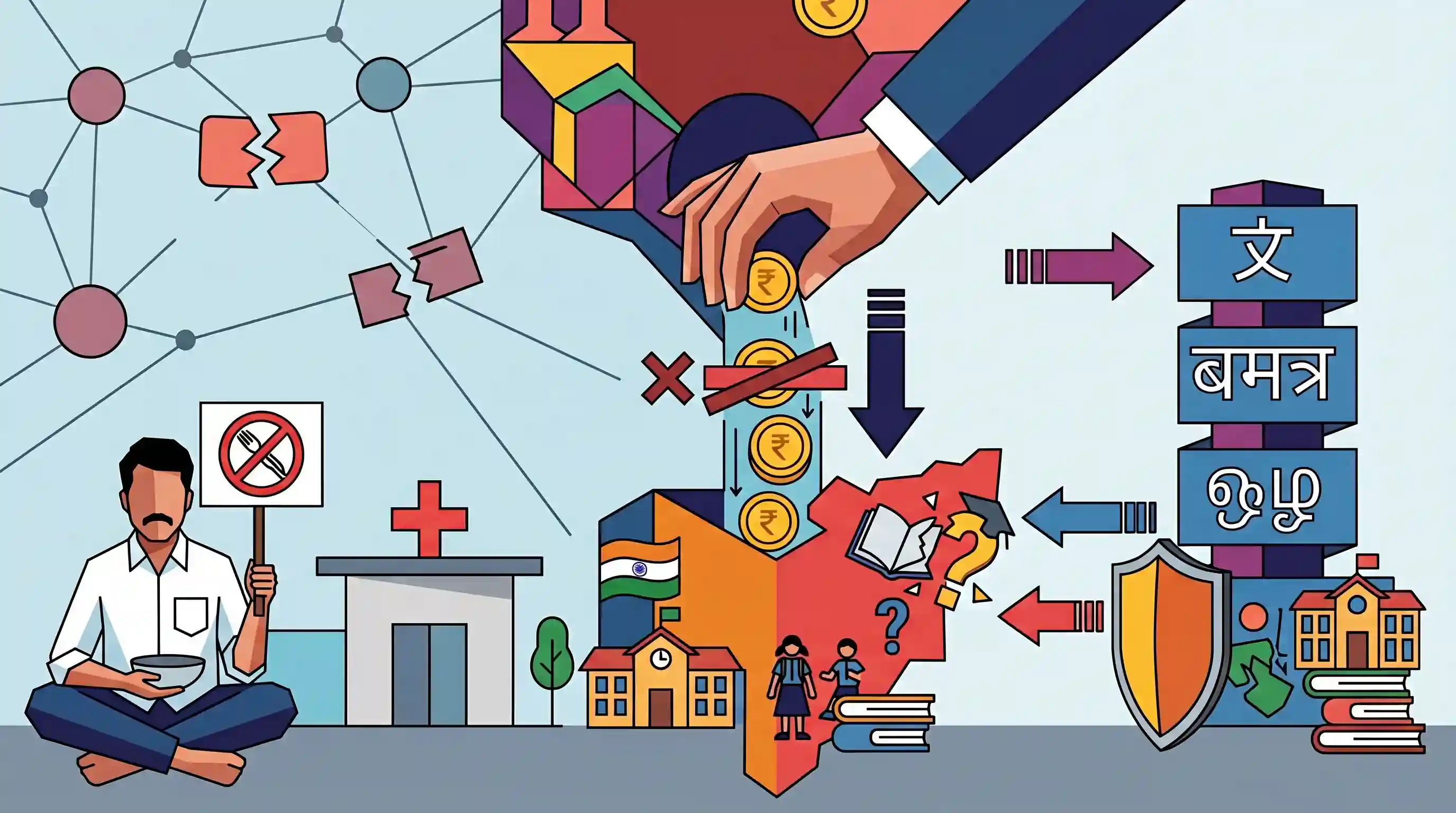
Tamil Nadu Congress MP Sasikanth Senthil was admitted to a Chennai government hospital following a deterioration in his health during an indefinite hunger strike. His protest is directed against the Union government for withholding over ₹2,000 crore in funds meant for Tamil Nadu under the Samagra Shiksha Abhiyan (SSA). Senthil, along with other state leaders, alleges that the BJP-led Centre is penalizing the state over ideological disagreements, particularly Tamil Nadu's resistance to the National Education Policy (NEP) and the imposition of a three-language formula. This development underscores significant challenges in India's fiscal federalism, illustrating how Centrally Sponsored Schemes can become friction points between the Union and states, directly impacting crucial social sector investments like education.
Key Points
- Tiruvallur MP Sasikanth Senthil was shifted to a Chennai hospital after his health deteriorated during a hunger strike protesting the non-release of Samagra Shiksha Abhiyan (SSA) funds to Tamil Nadu.
- The Union government has withheld over ₹2,000 crore meant for the state under the SSA scheme, leading to severe financial constraints for educational programs.
- Senthil accused the BJP-led central government of withholding funds due to ideological differences, particularly Tamil Nadu's opposition to certain provisions of the National Education Policy (NEP), such as the three-language formula.
- The incident highlights the growing friction in Centre-State financial relations and the contentious use of Centrally Sponsored Schemes (CSS) to pressure states into adopting Union government policies.
Important Terms
Samagra Shiksha Abhiyan (SSA)

An integrated school education scheme (pre-school to Class 12) launched in 2018. It subsumes Sarva Shiksha Abhiyan, Rashtriya Madhyamik Shiksha Abhiyan, and Teacher Education to provide inclusive, equitable quality education.
UPSC context
GS Paper 2 (Social Justice/Education). Tests knowledge of flagship schemes and financial friction in central-state funding.
National Education Policy (NEP) 2020
A 2020 framework aiming to transform India's education system through a 5+3+3+4 structure, vocational training, and holistic learning, replacing the 1986 policy to meet 21st-century needs.
UPSC context
GS Paper 2 (Governance). Crucial for mains questions on educational reforms, socio-economic development, and constitutional federalism.
Centrally Sponsored Schemes (CSS)
Welfare programs designed by the Union government but implemented by States, with shared funding (typically 60:40). They allow the Centre to direct social sector investments in State-list subjects.
UPSC context
GS Paper 2 (Polity/Federalism). Essential for understanding fiscal transfers and implementation challenges in a federal structure.
Fiscal Federalism
The division of financial powers and responsibilities between the Union and States, encompassing taxation, revenue sharing, and grants-in-aid to balance state autonomy with national coherence.
UPSC context
GS Paper 2 & 3. Tests concepts of cooperative federalism, tax devolution, and institutional roles like the Finance Commission.
Three-Language Formula
A 1968 policy framework requiring students to learn Hindi, English, and a regional language. Reaffirmed in NEP 2020, it aims to promote multilingualism and national integration.
UPSC context
GS Paper 2 (Social Justice/Polity). Relevant for understanding linguistic politics and regional resistance to central policies.
Two-Language Policy
A policy adopted by Tamil Nadu since 1968, mandateing the study of only Tamil and English, representing the state's rejection of the Three-Language Formula's Hindi requirement.
UPSC context
GS Paper 2 (Federalism). Illustrates the impact of regional linguistic identity on national policy implementation.
Prelims Trap
"Samagra Shiksha Abhiyan is a Central Sector Scheme fully funded by the Union Government."
Samagra Shiksha Abhiyan is a Centrally Sponsored Scheme (CSS) with a 60:40 or 90:10 funding split, not a 100% Union-funded Central Sector Scheme.
Static Concepts Connected
How do Centrally Sponsored Schemes (CSS) differ from Central Sector Schemes?
- Funding Pattern: CSS involves cost-sharing (e.g., 60:40 or 90:10), whereas Central Sector Schemes are 100% funded by the Union government.
- Implementation: CSS are generally implemented by State governments, while Central Sector Schemes are executed directly by Central ministries or agencies.
- Subject Jurisdiction: CSS are typically formulated for subjects in the State List to encourage state action, whereas Central Sector Schemes deal with Union List subjects.
What is the constitutional basis for Union grants on non-Union subjects?
- Article 282: It allows both the Union and States to make discretionary grants for any "public purpose," even if it falls outside their strict legislative competence.
- Discretionary Nature: Article 282 grants are discretionary, meaning the Centre is not legally bound to give them, unlike statutory grants under Article 275 recommended by the Finance Commission.
Cross-Topic Patterns
CSS conditionalities vs. State autonomy
Linking CSS fund release to the adoption of Union policies (like NEP or branding mandates) is a recurring friction point, mirroring recent disputes over Ayushman Bharat co-branding in opposition-ruled states.
The 42nd Amendment's federal legacy
Moving Education from the State to the Concurrent list in 1976 enables the Union to dictate terms via policies like the NEP, causing persistent jurisdictional friction with linguistic-nationalist states.

Expect a Mains GS2 question on how conditional CSS funding is used to bypass state autonomy on Concurrent List subjects like education.
Linked PYQs · 4
Linked PYQs · 4
- 2025MainsGS2
Examine the evolving pattern of Centre-State financial relations in the context of planned development in India. How far have the recent reforms impacted the fiscal federalism in India?
- 2024MainsGS2
What changes has the Union Government recently introduced in the domain of Centre-State relations ? Suggest measures to be adopted to build the trust between the Centre and the States and for strengthening federalism.
- 2018PrelimsGS1
Consider the following statements: 1. As per the Right to Education (RTE) Act, to be eligible for appointment as a teacher in a State, a person would be required to possess the minimum qualification laid down by the concerned State Council of Teacher Education. 2. As per the RTE Act, for teaching primary classes, a candidate is required to pass a Teacher Eligibility Test conducted in accordance with the National Council of Teacher Education guidelines. 3. In India, more than 90% of teacher education institutions are directly under the State Governments. Which of the statements given above is/are correct?
- 2016MainsGS2
Professor Amartya Sen has advocated important reforms in the realms of primary education and primary health care. What are your suggestions to improve their status and performance?
