Tamil Nadu CM urges PM Modi to modify provisions of VB-G-RAM-G Act
Source:The Hindu ↗
Why It Matters
This development is highly relevant for GS-2 as it illustrates contemporary friction in fiscal federalism and cooperative federalism concerning centrally sponsored schemes. The shift from MGNREGS to VB-G-RAM-G highlights changing dynamics in rural employment guarantees, state financial autonomy, and the necessity of decentralized governance for climate-resilient policy implementation.
Summary
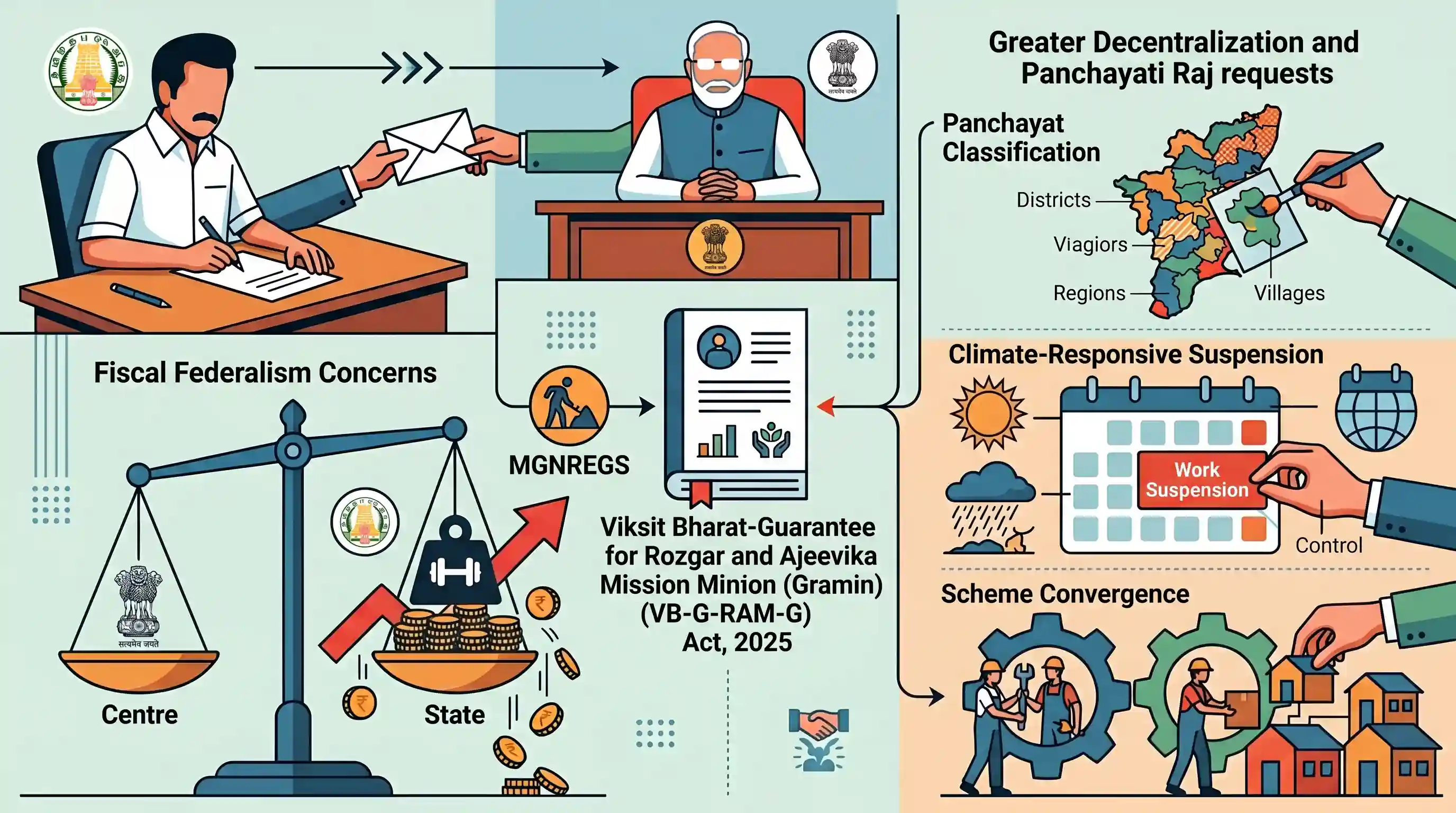
Tamil Nadu Chief Minister C. Joseph Vijay has written to Prime Minister Narendra Modi seeking relaxations and modifications to the newly enacted Viksit Bharat-Guarantee for Rozgar and Ajeevika Mission (Gramin) (VB-G-RAM-G) Act, 2025, which replaced MGNREGS on July 1. He flagged concerns over fiscal federalism, noting that the new 60:40 fund-sharing ratio for wages significantly increases the financial burden on the state by over ₹5,000 crore. Furthermore, the CM argued for greater decentralization, requesting that the State be allowed to formulate its own panchayat classification methodology, dynamically schedule the 60-day agricultural work suspension to account for climate anomalies like El Niño, and independently approve convergence with State-level housing schemes.
Key Points
- Tamil Nadu CM C. Joseph Vijay urged PM Modi to amend the new VB-G-RAM-G Act, 2025, which replaces the MGNREGS, and suggested including Mahatma Gandhi's name in the new Act's title.
- The transition introduces a 60:40 (Union:State) funding ratio for all components (Wage, Material, Administrative), shifting an additional burden of ₹5,000 crore onto the State compared to MGNREGA's 100% wage coverage by the Centre.
- The CM requested restoring 100% central funding for wage and administrative components while maintaining a 75:25 ratio for materials.
- Tamil Nadu opposes the centralized methodology for classifying village panchayats and demands an intra-State customized distribution formula.
- The CM advocated for decentralized authority (given to District Collectors) to dynamically notify the 60-day suspension period based on local climate vagaries (e.g., El Niño) rather than fixed central mandates.
- The state sought devolution of power to approve convergence with State housing schemes, eliminating the need for the Union government to individually notify every scheme.
Important Terms
VB-G-RAM-G Act, 2025

2025 legislation replacing MGNREGA, guaranteeing 125 days of rural manual work. It introduces normative fund allocations, a 60:40 cost-sharing ratio for wages, and a 60-day mandatory work suspension during peak agricultural seasons.
UPSC context
GS II (Governance/Social Justice) & GS III (Employment). Core topic for understanding the transition from demand-driven to mission-mode welfare architecture.
Mahatma Gandhi National Rural Employment Guarantee Act (MGNREGA)
The 2005 predecessor to VB-G-RAM-G that guaranteed 100 days of unskilled work. It featured 100% Central funding for unskilled wages and a demand-driven model based on local labor budgets.
UPSC context
GS II (Social Justice). Provides the baseline for comparing rights-based employment guarantees with the new normative allocation framework.
Fiscal Federalism
The division of financial powers and responsibilities between the Union and State governments. The VB-G-RAM-G Act's increased wage burden on states is a contemporary challenge to this balance.
UPSC context
GS II (Federalism). Tests the ability to analyze Centre-State relations through the lens of vertical fiscal imbalance and scheme funding.
60:40 Fund-Sharing Ratio
A funding model where the Union Government provides 60% of costs and the State provides 40%. In VB-G-RAM-G, this applies to wages, materials, and administration for general category states.
UPSC context
GS II (Governance). Specifically tests knowledge of financial devolution and the fiscal pressure on states within Centrally Sponsored Schemes.
Centrally Sponsored Scheme (CSS)
Welfare programs funded jointly by the Centre and States but implemented by State governments. These schemes often carry mandatory funding ratios and implementation guidelines set by the Union.
UPSC context
GS II (Governance). Fundamental concept for questions on the architecture of Indian social welfare and intergovernmental cooperation.
Normative Allocation
A top-down funding system where the Centre determines state fund allocations in advance based on objective parameters, replacing the demand-driven "labor budget" model used under MGNREGA.
UPSC context
GS II & III (Governance/Economy). Critical for discussing the shift from rights-based local demand to centralized fiscal planning.
Agricultural Work Suspension
The statutory suspension of rural work for up to 60 days annually during peak sowing/harvesting to ensure agricultural labor availability, a new feature introduced by the VB-G-RAM-G Act.
UPSC context
GS III (Agriculture/Employment). Tests understanding of policy attempts to balance rural employment guarantees with the seasonal labor needs of farming.
Prelims Trap
Under the VB-G-RAM-G Act, the Union government bears 100% of the wage cost for unskilled manual workers.
Aspirants will wrongly assume the new Act retains the old MGNREGA funding pattern (100% wage coverage by the Union). The new Act introduces a uniform 60:40 ratio.
Static Concepts Connected
How do Centrally Sponsored Schemes differ from Central Sector Schemes?
- Centrally Sponsored Schemes: Jointly funded by Union and States (typically 60:40 or 90:10), but implemented by State governments. VB-G-RAM-G acts as a CSS.
- Central Sector Schemes: 100% funded and implemented directly by the Union government (e.g., PM-KISAN, BharatNet).
- Federal Friction: Finance Commissions often suggest rationalizing CSS to provide States with more untied funds rather than rigid conditional grants.
What is the Constitutional mandate for decentralized planning under PRIs?
- Article 243G: Article 243G requires State legislatures to endow Panchayats with powers to prepare plans for economic development and social justice.
- 11th Schedule: Lists 29 functional items (including poverty alleviation and rural housing) meant for devolution to Panchayati Raj Institutions.
- District Planning Committee: Article 243ZD mandates a committee at the district level to consolidate plans prepared by Panchayats and Municipalities.
Cross-Topic Patterns
Climate Anomalies + Welfare Suspension
Tying the 60-day work suspension to local El Niño or drought conditions highlights the growing intersection of disaster management, climate change adaptation, and rural safety nets.
Fiscal Federalism + CSS Rigidities
The 60:40 wage shift and centralized panchayat classification mirror classic State grievances over 'one-size-fits-all' rigidities in Centrally Sponsored Schemes (CSS) undermining cooperative federalism.

Expect a 2026 mains question on 'one-size-fits-all' CSS mandates vs. fiscal federalism, using VB-G-RAM-G's funding/climate rigidities.
Linked PYQs · 4
Linked PYQs · 4
- 2011PrelimsGS1
Among the following who are eligible to benefit from the “Mahatma Gandhi National Rural Employment Guarantee Act”?
- 2025MainsGS2
Examine the evolving pattern of Centre-State financial relations in the context of planned development in India. How far have the recent reforms impacted the fiscal federalism in India?
- 2024MainsGS2
What changes has the Union Government recently introduced in the domain of Centre-State relations ? Suggest measures to be adopted to build the trust between the Centre and the States and for strengthening federalism.
- 2022MainsGS2
To what extent, in your opinion, has the decentralisation of power in India changed the governance landscape at the grassroots?
