Tamil Nadu Urban Greening Policy and Climate Resilience
Source:The Hindu ↗
Why It Matters
Provides a robust, state-level case study on sustainable urban planning. Concepts like the '3-30-300' rule, micro-forests (Miyawaki method), and 'blue-green infrastructure' are highly relevant keywords for GS1 (Urbanization), GS3 (Environment/Disaster Management), and Essay papers addressing climate change and city development.
Summary
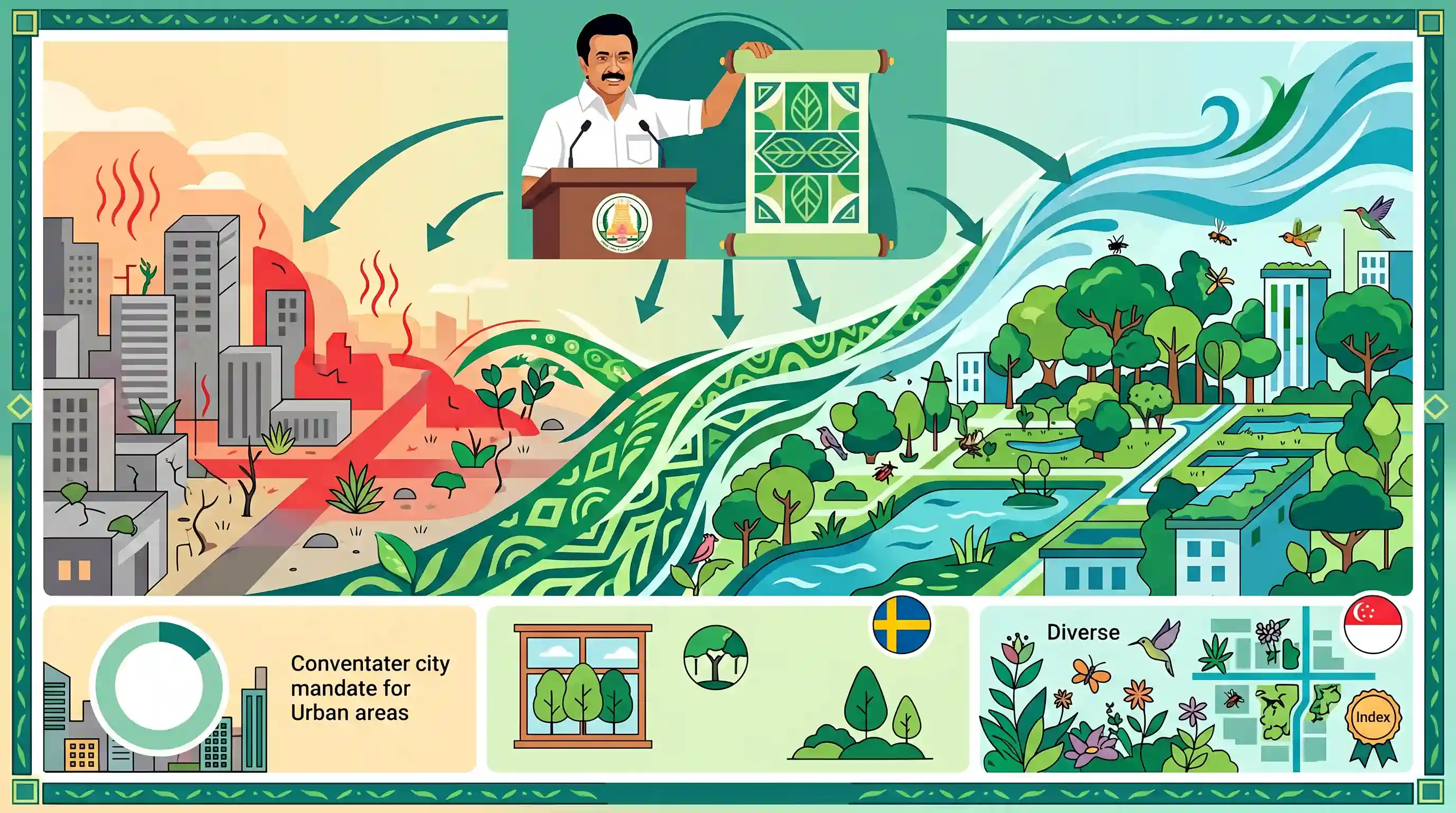
Tamil Nadu Chief Minister M.K. Stalin has unveiled the Tamil Nadu Urban Greening Policy 2026 to foster sustainable, climate-resilient cities. Driven by the Green Tamil Nadu Mission’s goal of achieving 33% forest and tree cover, the policy mandates Urban Local Bodies to sustain a minimum of 15% green cover. It seeks to mitigate urban heat islands and biodiversity loss by integrating trees, micro-forests, wetlands, and blue-green infrastructure into urban planning. The initiative also adopts global benchmarks like the Swedish '3-30-300' livability guideline and the Singapore City Biodiversity Index.
Key Points
- The Tamil Nadu Urban Greening Policy 2026 was released to build climate-resilient and sustainable cities by integrating blue-green infrastructure into urban planning.
- It mandates Urban Local Bodies (ULBs) to maintain a minimum 15% green cover within urban areas and authorizes them to levy a 'green fee' to fund these initiatives.
- The policy incorporates the Swedish '3-30-300' guideline, ensuring citizens can see at least 3 trees from their home, have 30% neighbourhood canopy cover, and live within 300 meters of a park.
- The initiative combats the urban heat island effect, declining air quality, and biodiversity loss through the creation of micro-forests (Kurunkadugal), village woodlots, and wetland conservation.
Important Terms
Tamil Nadu Urban Greening Policy 2026

A state policy mandating Urban Local Bodies to maintain 15% green cover. It integrates blue-green infrastructure and nature-based solutions to enhance climate resilience and urban biodiversity.
UPSC context
GS-III: Environment & Disaster Management; tests knowledge of state-level climate adaptation and urban heat mitigation strategies.
3-30-300 Urban Green Livability Guideline
An urban forestry benchmark requiring 3 trees visible from every home, 30% neighborhood canopy cover, and residence within 300 meters of a park.
UPSC context
GS-III: Sustainable Development; relevant for urban livability standards and international best practices for SDG 11.
City Biodiversity Index
A self-assessment tool (Singapore Index) using 23-28 indicators to evaluate city-level biodiversity conservation, ecosystem services, and environmental governance.
UPSC context
GS-III: Biodiversity; provides a framework for measuring urban ecological health and evidence-based environmental governance.
Green Tamil Nadu Mission
A large-scale afforestation program aiming to increase Tamil Nadu's green cover from ~23.7% to 33% by 2031 through planting 265 crore native seedlings.
UPSC context
GS-III: Environment; example of mass afforestation, carbon sequestration, and state-led ecological restoration projects.
Municipal Administration and Water Supply (MAWS) department
The state department tasked with implementing urban greening through a dedicated Urban Forest Wing and ensuring convergence between municipal bodies and environmental goals.
UPSC context
GS-II: Governance; highlights institutional mechanisms and the role of Urban Local Bodies in implementing environmental policies.
Nature-based Solutions Institute
A Sweden-based organization that developed the 3-30-300 rule, focusing on nature-based solutions to improve urban resilience, public health, and climate adaptation.
UPSC context
GS-III: Environment; illustrates international institutional influence on local climate-smart urban infrastructure and nature-based strategies.
Prelims Trap
The '3-30-300' guideline is a global climate finance or emission reduction target.
It is actually a Swedish urban livability metric for green spaces (3 trees visible, 30% canopy cover, 300m to park), not an emissions target.
Static Concepts Connected
What is the Miyawaki method of urban afforestation?
- Core Concept: A Japanese technique for creating dense, multi-layered micro-forests using native plant species in small, constrained urban spaces.
- Growth Rate: Trees planted using this method grow up to 10 times faster, and the forest becomes entirely self-sustaining within 3 years.
- UPSC Context: The TN policy's 'Kurunkadugal' relies on this method; UPSC previously tested the Miyawaki method in Prelims 2022.
What is Blue-Green Infrastructure (BGI) in urban planning?
- Blue Assets: Hydrological networks such as lakes, wetlands, floodplains, and sustainable drainage systems.
- Green Assets: Terrestrial vegetation including parks, urban forests, green roofs, and tree-lined streets.
- Primary Utility: Builds climate resilience by preventing urban flooding, managing stormwater runoff, and mitigating the urban heat island (UHI) effect.
Cross-Topic Patterns
Urban Greening + 74th Amendment
Authorizing ULBs to levy a 'green fee' connects ecological mandates with municipal financial devolution (GS2), addressing the chronic underfunding of local governance.
Blue-Green Infrastructure + Sponge Cities
Integrating urban wetlands with vegetation directly overlaps with the 'Sponge City' concept used to tackle urban flooding and groundwater depletion (GS1/GS3).

Terms like the '3-30-300 rule' or 'Singapore City Biodiversity Index' are prime candidates for Prelims 2026 term-recognition.
Linked PYQs · 4
Linked PYQs · 4
- 2013MainsGS1
Bring out the causes for the formation of heat islands in the urban habitat of the world.
- 2022PrelimsGS1
The "Miyawaki method" is well known for the:
- 2021MainsGS1
What are the environmental implications of the reclamation of water bodies into urban land use ? Explain with examples.
- 2023MainsGS3
Comment on the National Wetland Conservation Programme initiated by the Government of India and name a few India's wetlands of international importance included in the Ramsar Sites.
