Tamil Nadu Climate Summit Emphasizes Forest Fire Preparedness
Source:The Hindu ↗
Why It Matters
Forest fires are becoming increasingly frequent and severe due to climate change. Tamil Nadu's technology-driven approach provides a valuable case study in anticipatory disaster management and early warning systems for UPSC candidates studying GS3 Disaster Management and Environment.
Summary
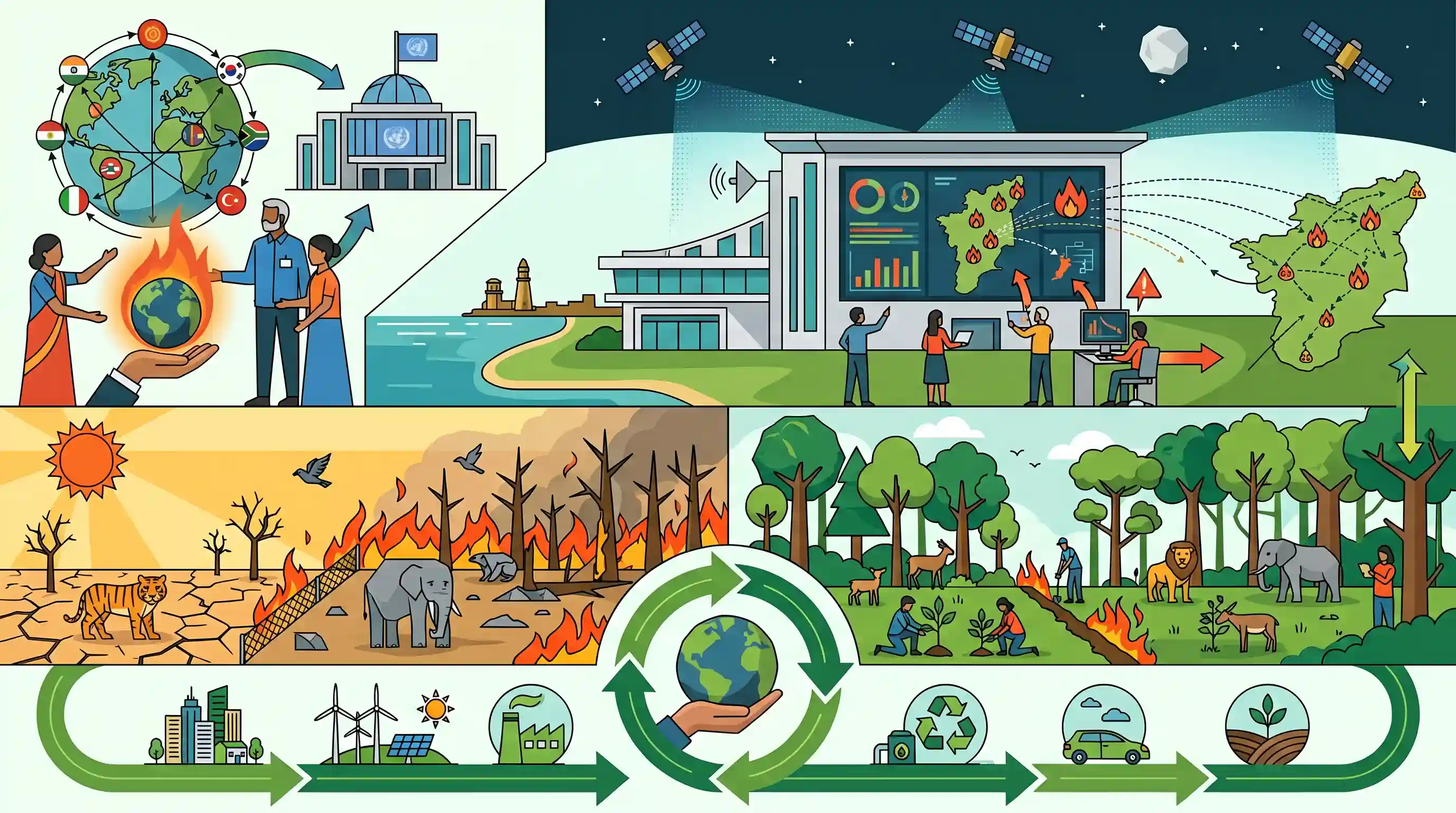
The Tamil Nadu Climate Summit 4.0 emphasized the urgent need for robust forest-fire preparedness and climate-resilient ecosystems. Participants discussed India's role at UNEA-7 in fostering global collaboration on wildfires. Tamil Nadu's model of anticipatory governance was presented as a blueprint, featuring a centralized Command and Control Centre in Chennai that works with district-level units using real-time satellite data for early detection. The summit also addressed the interconnected challenges of biodiversity loss, habitat fragmentation, and the importance of transitioning to a circular green economy.
Key Points
- Tamil Nadu Climate Summit 4.0 concluded with a strong focus on strengthening climate-resilient ecosystems and improving forest-fire preparedness in a warming world.
- The summit highlighted India's leadership at the 7th United Nations Environment Assembly (UNEA-7), where it successfully secured a resolution for international collaboration on wildfires.
- Tamil Nadu showcased its anticipatory governance model, which includes a State-Level Command and Control Centre in Chennai linked with district-level control rooms.
- The state uses a decentralized yet integrated architecture relying on real-time data streams, satellite inputs, and rapid-response mechanisms for early detection of forest fires.
- Discussions also covered pressing environmental issues such as biodiversity loss due to habitat fragmentation, urbanization, pollution, and the transition toward a circular green economy.
Important Terms
United Nations Environment Assembly (UNEA-7)

The seventh session of the UN's highest environmental body (2025), where India successfully led a global resolution to strengthen international cooperation and management of wildfires.
UPSC context
GS Paper II (International Institutions) & GS III (Environment); tests India’s leadership in global environmental governance.
Anticipatory Governance
A proactive administrative model that utilizes real-time data, technology, and foresight to identify, monitor, and mitigate future risks like forest fires before they escalate.
UPSC context
GS Paper II (Governance) & GS III (Disaster Management); explores innovative state-level strategies for climate-risk mitigation.
Tamil Nadu Green Climate Company (TNGCC)
India’s first state-backed, non-profit climate governance entity (Special Purpose Vehicle) established by Tamil Nadu to coordinate climate missions, mobilize green finance, and ensure cross-sectoral implementation.
UPSC context
GS Paper III (Environment/Economy); significant for sub-national climate action models and innovative financing for net-zero targets.
Integrated Fire Management (IFM)
A holistic, science-based approach to wildfire management that integrates risk assessment, prevention, preparedness, response, and post-fire recovery, often involving local communities and satellite monitoring.
UPSC context
GS Paper III (Disaster Management/Environment); key strategy for managing climate-induced forest fires and ecological resilience.
Habitat Fragmentation
The breaking up of large, continuous natural habitats into smaller, isolated fragments due to human activities, leading to biodiversity loss and disrupted ecosystem services.
UPSC context
GS Paper III (Environment & Biodiversity); central to discussions on wildlife conservation and ecological impacts of urbanization.
Circular Green Economy
An economic model designed to minimize waste and maximize resource efficiency through recycling, reuse, and repair, decoupling economic growth from environmental degradation.
UPSC context
GS Paper III (Environment/Economy); fundamental for sustainable development and resource-efficient climate action strategies.
Prelims Trap
"The UNEA-7 resolution on the Global Management of Wildfires was spearheaded by wildfire-prone nations like Australia or the USA."
India successfully secured the adoption of this resolution at UNEA-7, highlighting its emerging leadership in global proactive wildfire prevention.
Static Concepts Connected
What makes Indian forests vulnerable to fires, and what are the predominant types?
- Predominant fire type: Surface fires burning ground litter are most common in India, unlike the devastating crown fires typical of temperate/boreal forests.
- Most vulnerable biome: Dry deciduous forests face the highest risk due to prolonged pre-monsoon dry spells and abundant dry leaf litter acting as fuel.
- Primary causes: Over 95% of forest fires in India are anthropogenic, driven by non-timber forest product (NTFP) collection, shifting cultivation, and accidental ignitions.
What is the mandate and structure of the UN Environment Assembly (UNEA)?
- Global authority: Created in 2012 at the Rio+20 conference, UNEA is the world's highest-level decision-making body on environmental matters.
- Universal membership: Unlike the UNEP Governing Council it replaced, UNEA enjoys universal membership of all 193 UN Member States.
- Meeting frequency: It meets biennially in Nairobi, Kenya, to set priorities, adopt resolutions, and draft global environmental policies.
Cross-Topic Patterns
Space tech for disaster governance
TN's use of satellite inputs for early fire detection mirrors the national integration of ISRO's Bhuvan and FSI's FAST system, shifting disaster management from reactive relief to anticipatory preparedness.
Circular economy as a biodiversity shield
The summit connects circular green economy goals with biodiversity, demonstrating how minimizing virgin resource extraction directly reduces habitat fragmentation, land-use change, and ecological degradation.

Expect a Prelims question on UNEA-7 pairing India’s wildfire resolution with Forest Survey of India data on vulnerable deciduous zones.
Linked PYQs · 5
Linked PYQs · 5
- 2019MainsGS3
Disaster preparedness is the first step in any disaster management process. Explain how hazard zonation mapping will help disaster mitigation in the case of landslides.
- 2013MainsGS3
How important are vulnerability and risk assessment for pre-disaster management ? As an administrator, what are key areas that you would focus on in a Disaster Management System.
- 2024MainsGS3
What is disaster resilience? How is it determined? Describe various elements of a resilience framework. Also mention the global targets of Sendai Framework for Disaster Risk Reduction (2015–2030).
- 2021PrelimsGS1
With reference to the 'New York Declaration on Forests', which of the following statements are correct? 1. It was first endorsed at the United Nations Climate Summit in 2014. 2. It endorses a global timeline to end the loss of forests. 3. It is a legally binding international declaration. 4. It is endorsed by governments, big companies and indigenous communities. 5. India was one of the signatories at its inception. Select the correct answer using the code given below.
- 2019MainsGS3
Define the concept of carrying capacity of an ecosystem as relevant to an environment. Explain how understanding this concept is vital while planning for sustainable development of a region.
