Trinamool Congress faces internal crisis as MPs plan breakaway bloc
Source:Indian Express ↗
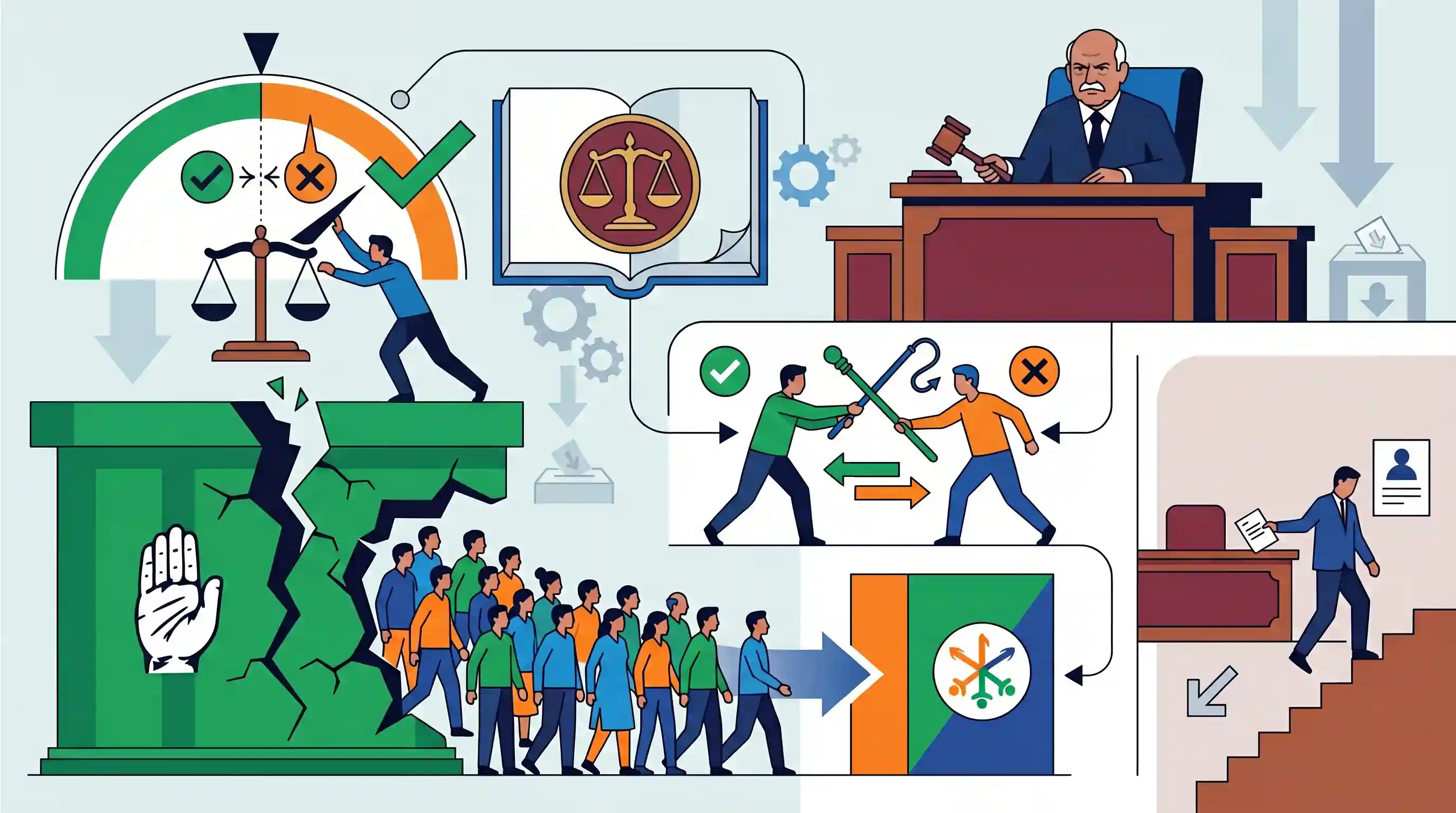
Why It Matters
Provides a practical illustration of the Tenth Schedule's exemption clause, which requires a two-thirds majority of a legislative party to merge or split without facing disqualification. It also highlights internal party dynamics, the crucial role of the Chief Whip in parliamentary functioning, and how presiding officers manage member resignations.
Summary
The Trinamool Congress (TMC) is grappling with a severe internal revolt, as approximately 20 of its 28 Lok Sabha MPs prepare to form a separate breakaway bloc to support the NDA. This crisis, following electoral setbacks in West Bengal, tests the provisions of the Tenth Schedule (Anti-Defection Law). To evade disqualification, the rebel MPs must secure a two-thirds majority, or 19 MPs, to constitute a valid split or merger. The situation is further complicated by disputes over the position of the party's Chief Whip in the Lok Sabha and the resignation of senior Rajya Sabha MP Sukhendu Sekhar Ray. The unfolding events underscore the complexities of parliamentary procedures, party discipline, and the practical application of anti-defection statutes.
Key Points
- Around 20 out of 28 TMC Lok Sabha MPs are reportedly planning to form a separate bloc to support the NDA, signaling a massive internal revolt.
- To bypass disqualification under the Tenth Schedule (Anti-Defection Law), the rebel faction requires a two-thirds majority, meaning at least 19 MPs must break away together.
- The parliamentary crisis is deepened by confusion over internal party appointments, such as conflicting claims for the Chief Whip position in the Lok Sabha.
- The turmoil follows the TMC's electoral setbacks in West Bengal and involves notable departures, including Rajya Sabha MP Sukhendu Sekhar Ray vacating his seat and leaving the party.
Important Terms
Anti-Defection Law (Tenth Schedule)

Provisions in the Constitution's Tenth Schedule (52nd Amendment, 1985) for disqualifying legislators who voluntarily quit their party or defy party leadership on floor votes.
UPSC context
GS Paper II: Parliament functioning and disqualification issues. Tests understanding of floor-crossing and executive-legislative balance.
Chief Whip
A political party official tasked with maintaining internal discipline and ensuring members attend and vote according to party instructions in the legislature.
UPSC context
GS Paper II: Parliamentary procedure. Tests role of party discipline versus individual legislator's freedom.
Lok Sabha
The Lower House of the Indian Parliament, composed of representatives directly elected by the people through universal adult suffrage for a five-year term.
UPSC context
GS Paper II: Federal legislature structure. Tests knowledge of house powers and accountability mechanisms.
Rajya Sabha
The permanent Upper House of Parliament representing States and Union Territories, where members serve six-year terms with one-third retiring every two years.
UPSC context
GS Paper II: Bicameralism. Tests role of the federal chamber in legislative checks.
National Democratic Alliance (NDA)
A center-right political alliance in India led by the Bharatiya Janata Party (BJP), founded in 1998 to contest general elections.
UPSC context
GS Paper II: Coalition politics. Tests understanding of electoral alliances and governance patterns.
Trinamool Congress (TMC)
A regional political party primarily based in West Bengal, currently recognized as a State Party by the Election Commission of India.
UPSC context
GS Paper II: Political parties. Tests criteria for National vs. State party status recognition.
Prelims Trap
"The office of the Chief Whip is defined and established under the Tenth Schedule."
The office of the Whip is based purely on conventions of parliamentary government. It is not mentioned in the Constitution, Tenth Schedule, or Rules of the House.
Static Concepts Connected
What are the current exemptions to disqualification under the Tenth Schedule?
- Merger clause: Members are protected if their original political party merges with another party, provided at least two-thirds of the legislative party's members agree to it.
- Split deleted: The 91st Constitutional Amendment Act (2003) deleted the earlier provision that protected a 'split' involving one-third of the legislative party's members.
- Presiding Officer: Members elected as Presiding Officers (Speaker/Chairman) are exempt if they voluntarily give up their party membership upon election.
What is the legal and parliamentary status of a party Whip?
- Conventional origin: It is based strictly on conventions of parliamentary government; it finds no mention in the Constitution or the Rules of the House.
- Legal backing: The Tenth Schedule gives the Whip legal teeth; a member faces disqualification if they defy the party's voting direction without permission or condonation within 15 days.
Cross-Topic Patterns
Speaker as Tribunal & Judicial Review
The Kihoto Hollohan case (1992) established that Presiding Officers act as tribunals under the Tenth Schedule, making their final disqualification decisions explicitly subject to judicial review.
Anti-Defection and Governor's Floor Test
Party revolts intimately link the Tenth Schedule to the Governor's discretionary power to order a trust vote (Bommai case guidelines), as tested in recent state crises.

The technical distinction between a legislative 'split' and a legal 'merger' under the 91st Amendment is highly probable for 2026.
Linked PYQs · 5
Linked PYQs · 5
- 2014PrelimsGS1
Which one of the following Schedules of the Constitution of India contains provisions regarding anti-defection?
- 2025PrelimsGS1
Consider the following statements : I. If any question arises as to whether a Member of the House of the People has become subject to disqualification under the 10th Schedule, the President's decision in accordance with the opinion of the Council of Union Ministers shall be final. II. There is no mention of the word 'political party' in the Constitution of India. Which of the statements given above is/are correct?
- 2020MainsGS2
Once a Speaker, Always a Speaker' ! Do you think this practice should be adopted to impart objectivity to the office of the Speaker of Lok Sabha ? What could be its implications for the robust functioning of parliamentary business in India?
- 2019MainsGS2
Individual Parliamentarian's role as the national law maker is on a decline, which in turn, has adversely impacted the quality of debates and their outcome. Discuss.
- 2025PrelimsGS1
Consider the following statements : I. On the dissolution of the House of the People, the Speaker shall not vacate his/her office until immediately before the first meeting of the House of the People after the dissolution. II. According to the provisions of the Constitution of India, a Member of the House of the People on being elected as Speaker shall resign from his/her political party immediately. III. The Speaker of the House of the People may be removed from his/her office by a resolution of the House of the People passed by a majority of all the then Members of the House, provided that no resolution shall be moved unless at least fourteen days' notice has been given of the intention to move the resolution. Which of the statements given above are correct?
